
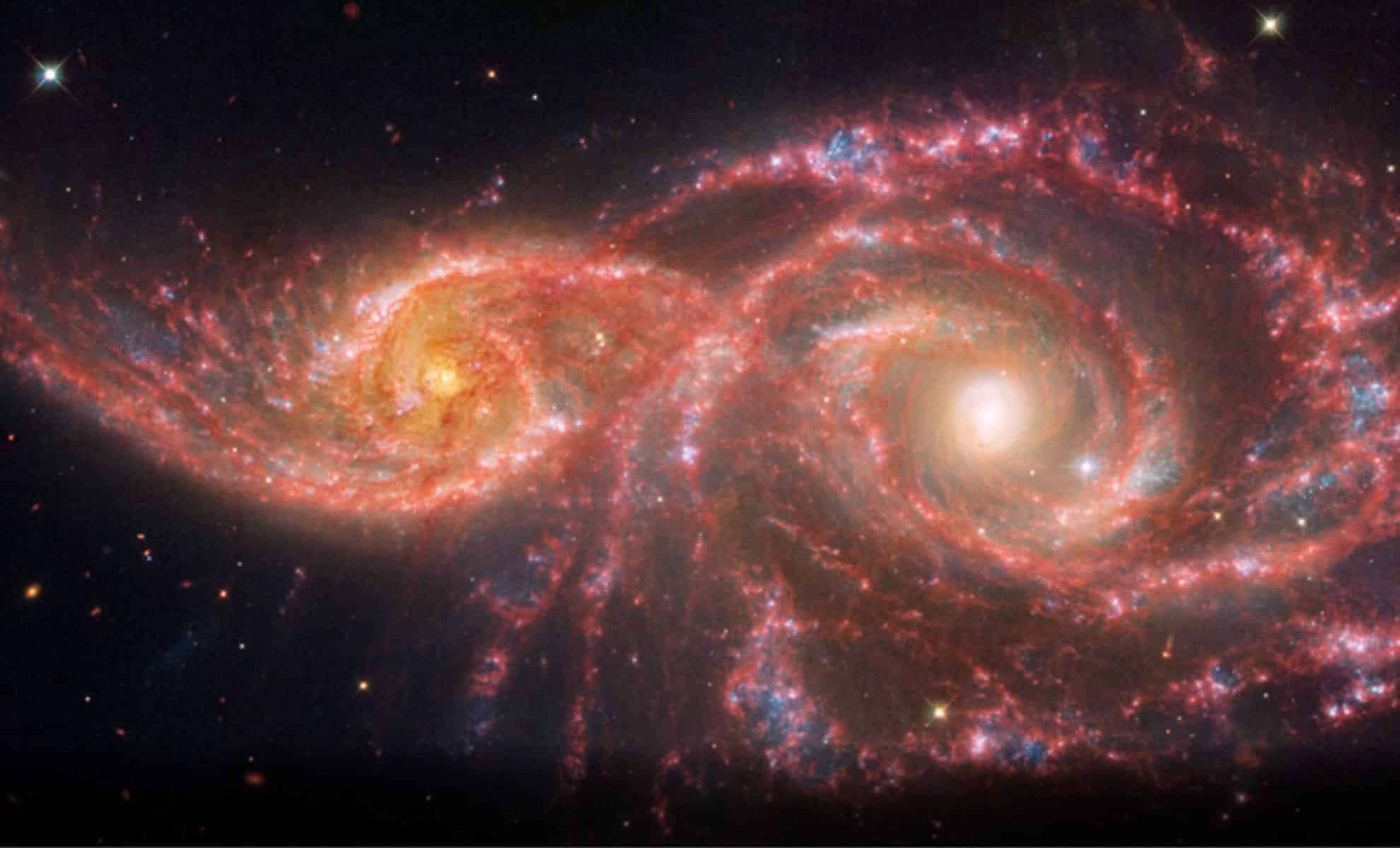
NASA's James Webb Space Telescope and Hubble Space Telescope have teamed up to deliver an extraordinary glimpse of two interacting spiral galaxies, IC 2163 and NGC 2207, situated approximately 114 million light-years away in the constellation Canis Major.
Known as the “Blood-Soaked Eyes,” this galactic duo presents a dramatic, almost eerie appearance with their intense, eye-like centers peering out from a tangle of ethereal arms. This mesmerizing image blends mid-infrared data from Webb with ultraviolet and visible light from Hubble, resulting in a haunting visual that evokes the spooky ambiance of Halloween.
An Enigmatic Cosmic Encounter
The smaller galaxy, IC 2163, is slowly moving behind its larger companion, NGC 2207, in a close encounter that started millions of years ago. This interaction has generated shock waves and stretched tidal features, appearing as bright, vein-like patterns of red and blue. The James Webb team described their appearance: “They resemble blood coursing through the top of a fleshless visage. The piercing gaze of their blazing eye-like nuclei stares into the vast cosmic void.” These evocative words capture the eerie essence of the imagery, making these colliding galaxies seem like a scene from a cosmic thriller.

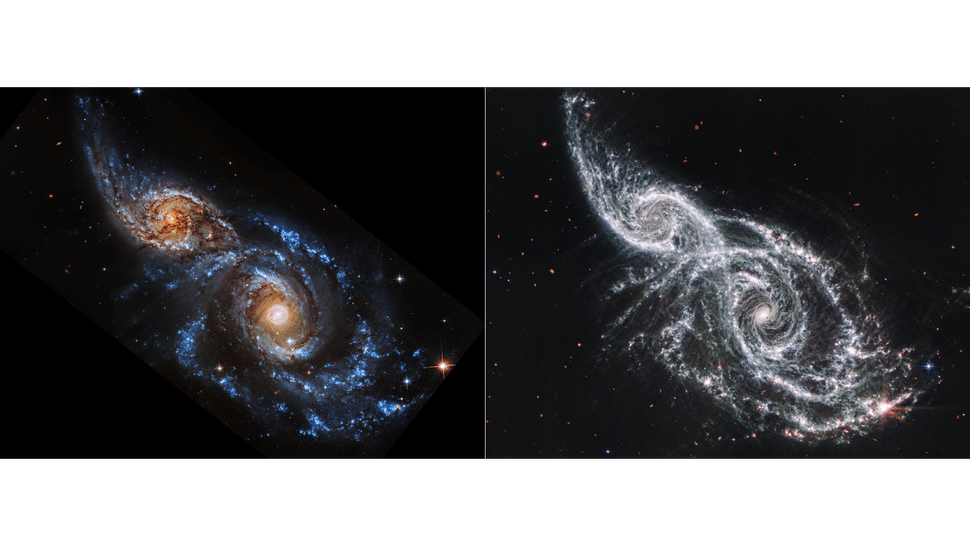
Hubble’s ultraviolet and visible-light views highlight the star-studded arms in vivid blue, while their cores blaze with bright orange hues. Webb’s mid-infrared observations expose the cold dust within both galaxies, casting their arms in ghostly whites and spotlighting regions dense with interstellar matter. The synergy between Hubble’s vibrant ultraviolet colors and Webb’s chilling mid-infrared glow reveals the intricate elegance of this galactic encounter like never before.
Accelerated Star Birth and Explosive Events
This cosmic interaction has significantly boosted star formation in both IC 2163 and NGC 2207. Gravitational forces have stirred gas clouds, igniting a stellar baby boom that generates roughly two dozen new Sun-like stars yearly, vastly outpacing the Milky Way’s quieter pace of two or three such stars each year. These star-forming hotspots are visible as radiantly blue zones in Hubble’s imagery and as pink and white patches in Webb’s data. A scientist likened these areas to dazzling fireworks, illuminating the galaxies' spiral arms.
Additionally, the pair has experienced seven documented supernova explosions over recent decades—a strikingly high number compared to the Milky Way’s typical one every fifty years. These powerful blasts likely cleared away surrounding gas and dust, paving the way for fresh star birth. This turbulent environment exemplifies how destruction and creation co-exist in the cosmic landscape.
The Gradual Galactic Merger
While IC 2163 and NGC 2207 have not yet merged, their slow cosmic dance will continue over hundreds of millions of years, eventually reshaping both galaxies. Gravity will twist their spiral arms into new shapes, and their cores may unite into a single, massive core. As gas and dust reserves diminish, star formation will decline, and the merged galaxy will enter a more peaceful stage. In the meantime, we can witness this fascinating interaction unfold, marveling at how gravity sculpts galaxies into forms both stunning and surreal.
The combined observations from Webb and Hubble provide vital insights into the physics of galactic interactions, a critical element for comprehending galaxy evolution across the cosmos. Webb’s Mid-Infrared Instrument (MIRI), partly created by NASA’s Jet Propulsion Laboratory, was essential for capturing these eerily beautiful mid-infrared views. “The James Webb Space Telescope extends the horizons of our cosmic observations,” an astronomer noted, emphasizing Webb's crucial role in space research.
This chilling yet captivating cosmic portrait reveals a slow-motion collision between two majestic spiral galaxies, an ongoing spectacle destined to transform them profoundly. As we explore the universe with increasingly powerful tools like Webb and Hubble, we're reminded that even the universe’s spookiest sights offer invaluable cosmic insights.
- Categories:
- Astronomy ,
- News ,
- Nasa








0 comments
Sign in to Comment