
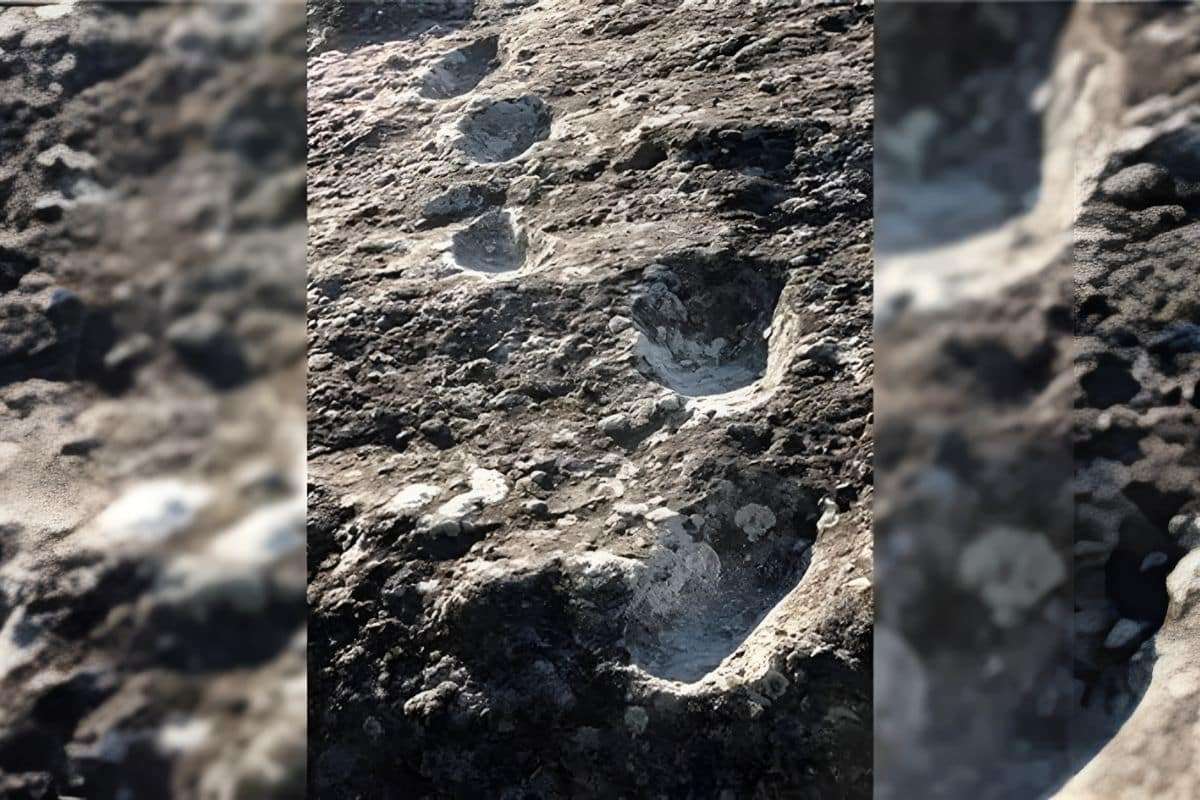
About 350,000 years ago, near an extinct volcano in southern Italy, ancient humans embarked on a remarkable journey across newly solidified volcanic terrain. These footprints, fossilized on the slopes of the Roccamonfina volcano, have fascinated scientists ever since their discovery.
Dubbed the “Devil’s Trails,” these marks illuminate a distant era when humans traversed landscapes shaped by volcanic upheaval. Recent research has explored the identity of these travelers, their survival strategies in a harsh environment, and the reasons behind their risky passage over unstable volcanic ground.
Exploring the Devil’s Trails
The Roccamonfina volcano erupted forcefully approximately 350,000 years ago, releasing immense volumes of ash and molten rock. This pyroclastic flow filled nearby valleys with scorching debris and ash, creating a daunting and perilous setting. Once the volcanic material began to solidify, it briefly formed a soft, moldable surface. During this short interval, when it was safe enough to walk on but still impressionable, a group of ancient humans left their footprints behind.

The Devil’s Trails, preserved on a steep incline of the volcanic deposit, have captivated both scientists and visitors. These footprints belong to at least four individuals of varying sizes who bravely traversed terrain that was likely still warm and slippery. Impressioned in the hardened ignimbrite (solidified pyroclastic flow), these prints tell a powerful story of endurance and adaptability.
Who Left the Tracks?
One of the main puzzles has been identifying the human species behind the footprints. Using sophisticated techniques, researchers estimated the body size and weight of the trackmakers by analyzing their footprint dimensions. The challenge was compounded by the uneven, steep volcanic slope, which complicated the use of footprint interpretation formulas normally developed for flat ground.
Despite these hurdles, the findings suggest the individuals weighed between 55.5 and 64.6 kilograms (122.4 to 142.4 pounds) and ranged from 152.9 to 176.7 centimeters (5 feet to 5 feet 9 inches) in stature. The average height calculated was around 166 centimeters (5 feet 5 inches), with an average weight near 60 kilograms (132 pounds).
These traits are consistent with Homo heidelbergensis, an extinct human ancestor that inhabited Europe during that era. This species is thought to be a common forebear of both Neanderthals and modern humans. Fossil records from Europe show some Homo heidelbergensis individuals reached heights up to 181.6 centimeters (5 feet 11 inches).
What the Footprints Reveal About Ancient Life
The track impressions provide insights into the social composition of these early humans. Based on size and depth variations in the prints, scientists propose the group likely consisted of an adult male and two smaller individuals, perhaps women or children. Though the exact group structure is uncertain, the careful yet deliberate way they moved suggests they took great care navigating the unstable volcanic surface.
The surrounding terrain was highly challenging: steep, uneven, and likely damp, making footing treacherous. To maintain balance, these humans adjusted their walking patterns, as indicated by the footprints. This adaptability highlights their ingenuity and survival capabilities.
The Purpose Behind the Volcanic Crossing
The reasons behind their journey over the volcanic debris remain open to interpretation. Some experts theorize curiosity drove them to explore the fresh volcanic terrain, while others believe practical motives—like hunting, foraging, or scouting shelters—may have been the cause. It's equally plausible these individuals were merely traveling within their range, unaware that their footprints would be preserved over hundreds of millennia.
No matter the motive, these tracks offer a rare glimpse into how early humans coped with extreme environmental challenges and provide evidence of their courage and adaptability.
Deciphering the Past
While studies of the Devil’s Trails have uncovered fascinating details, numerous questions persist. The difficult topography where the footprints were formed complicates precise identification and behavioral interpretation.
Researchers recognize the limits of current analytical methods but are hopeful that ongoing research will deepen understanding of this extraordinary find. What remains unequivocal is that the Devil’s Trails present a distinctive and invaluable chapter in human evolutionary history.
- Categories:
- Science











0 comments
Sign in to Comment