

New research reveals the outer Solar System hosts far more small icy bodies than earlier estimates suggested.
Using observations from the Subaru Telescope in Hawaii alongside data from NASA’s New Horizons mission, astronomers have identified a plentiful group of distant, frozen objects known as Kuiper Belt Objects (KBOs), located well beyond the traditional edges of the Kuiper Belt.
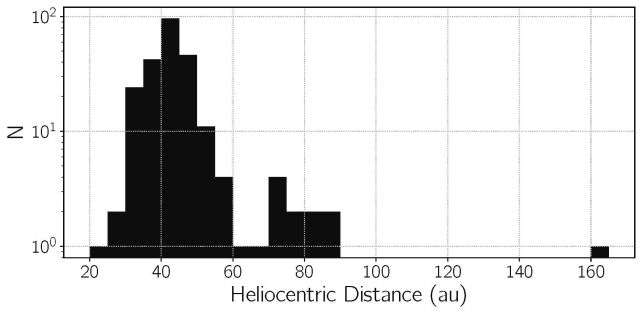
An international research team discovered 263 previously unknown KBOs, including 11 situated between 70 and 90 astronomical units (AU) from the Sun—far beyond the usual 30-55 AU range where most KBOs have been observed. This unexpected find challenges prior assumptions about the Solar System’s outer limits and the mechanisms behind its evolution.

Subaru Telescope Reveals Surprising Distant Objects
The partnership between the Subaru Telescope and NASA's New Horizons spacecraft has generated some of the clearest views ever obtained of the Solar System’s outermost regions. Subaru’s advanced Hyper Suprime-Cam (HSC), with its expansive field of view, enabled astronomers to survey remote zones beyond the reach of many traditional telescopes. Over several years, this instrument uncovered a dense cluster of small bodies particularly concentrated between 70 and 90 AU, well past Neptune’s orbit and the known Kuiper Belt's periphery.
The detection of 11 KBOs in this distant belt prompts questions about their origins and the extent of the early Solar System. Dr. Fumi Yoshida from Japan's University of Occupational and Environmental Health Sciences noted, “Confirming these objects suggests the primordial solar nebula spanned a much wider area, impacting our models of planet formation within our Solar System.” These findings hint that the Solar System’s formative disk was larger than previously thought, which may reshape theories on how planetary systems develop.
Revealing a More Intricate Outer Solar System Structure
The newfound KBOs and the identification of a notable void between 55 and 70 AU point to a more complex architecture in the outer Solar System. Such gaps among small bodies have also been observed in young planetary systems around other stars, often indicating the past presence of planets or massive objects that cleared out debris, marking boundaries between different populations of minor bodies.
Dr. Wesley Fraser from the National Research Council of Canada emphasized that previous observations may have underestimated the Kuiper Belt's complexity due to observational limits. “Our Solar System's Kuiper Belt appeared small compared to extrasolar disks, but this may reflect a detection bias,” he explained. The discovery of this distant group changes the narrative, suggesting our Kuiper Belt is more substantial and diverse than once believed.
These insights propose that the early Solar System resembled dust and debris disks seen around emerging stars today, featuring multiple belts and clearings. This greater complexity aligns our system more closely with extrasolar planetary systems, facilitating new comparisons in planetary formation models across the cosmos.
Consequences for Theories on Planet Formation and Solar Evolution
Identifying these remote KBOs has profound implications for understanding planetary origins both locally and beyond. The possibility of a second Kuiper Belt at greater distances raises questions about how such bodies formed and survived virtually unaltered for billions of years. These ancient remnants provide a window into the primordial solar nebula – the vast cloud of gas and dust from which the Sun and planets emerged.
In Dr. Yoshida’s words, “Studying these far-flung objects and their orbits marks a key step toward unraveling the Solar System’s formation history, placing it in context with the development of exoplanetary systems, and advancing universal theories of planet formation.” Because these KBOs experience minimal solar radiation, they remain pristine examples of the material from the Solar System’s birth.
Moreover, this expanded picture of the Kuiper Belt helps astronomers to better compare our system’s structure with those around other stars. The presence of both gaps and multiple belts seems to be a common theme in planetary systems, hinting at important processes shaping planet formation. These revelations may transform strategies for detecting and studying planetary formation in distant star systems.
The Future of Exploring the Outer Solar System
The discovery of this distant population marks just the beginning. NASA's New Horizons spacecraft, currently beyond 60 AU, continues to send valuable information about these distant realms. Having previously explored Pluto and the KBO Arrokoth, New Horizons is now positioned to observe these newly uncovered objects directly. Alongside ongoing Subaru Telescope surveys, scientists aim to refine orbital details and physical properties for this remote cohort.
Alan Stern, lead scientist for the New Horizons mission, expressed enthusiasm: “This breakthrough reveals uncharted and exciting features in the outer Solar System, made possible by the exceptional capabilities of the Subaru Telescope.” The partnership between Subaru and New Horizons is expected to persist, enabling detailed tracking and characterization of this newfound population.
In the years ahead, these findings promise to deepen our understanding of Solar System formation and evolution. What was once presumed to be a sparse, quiet region beyond Neptune is now revealed as an intricate and active zone, rich with clues to our cosmic origins.








0 comments
Sign in to Comment