

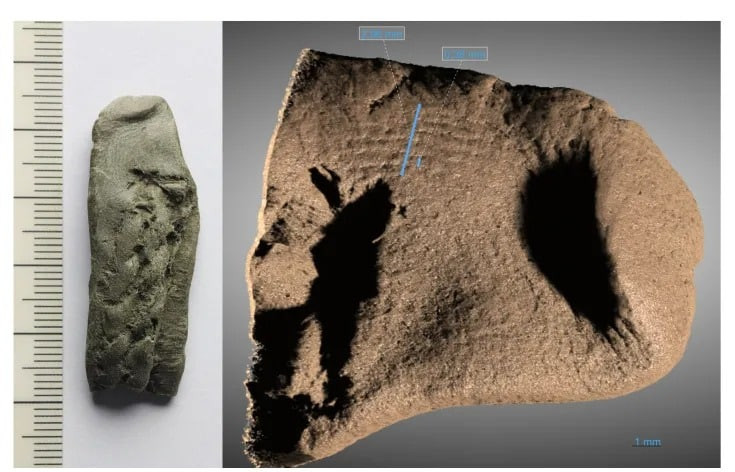
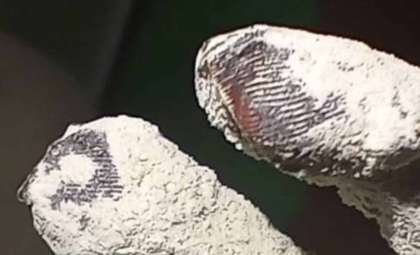
A delicate fingerprint embedded in hardened black tar over two thousand years ago could unlock long-standing secrets for archaeologists exploring Northern Europe’s earliest maritime history. This print was discovered on the Hjortspring boat, a prehistoric craft connected to a fierce attack on the Danish island of Als in the 4th century B.C.E.
Experts suggest this subtle fingerprint belonged to an individual who played a role in crafting or readying the vessel prior to its historic sinking. This nearly indiscernible mark is now inspiring fresh inquiries into the raiders’ identity, origins, and the true events of the ancient conflict that left the ship buried in a bog for more than two millennia.
Immortalized Fingerprint Discovered in Ancient Boat Sealant
The imprint was discovered in dried pine tar, traditionally applied to waterproof the vessel. Specialists think the mark was unintentionally made by a builder or maintainer of the boat before it embarked on its fateful journey. Unearthed initially from a Danish bog in the 1880s and excavated in the 1920s, the Hjortspring boat is believed to have been part of an offensive fleet assaulting Als.


It appears the island’s defenders repulsed the incursion, and the captured vessel may have been deposited in the bog as a victory ritual offering. This vessel stands out as the sole prehistoric plank-built ship yet found in Scandinavia.
“Where these sea raiders might have come from, and why they attacked the island of Als has long been a mystery,” said Mikael Fauvelle in a statement published by Lund University.
New Clues Change the Baltic Sea Raider Narrative
Historically, researchers hypothesized the raiders originated near today’s Hamburg in Germany. However, recent findings published in PLOS One suggest a more easterly provenance. The team identified the boat’s sealant as pine pitch rather than the expected birch tar, hinting the ship’s construction was linked to areas rich in pine forests along the Baltic coast.
“The boat was waterproofed with pine pitch, which was surprising,” Fauvelle explained. “This suggests the boat was built somewhere with abundant pine forests.”

Current evidence points to regions east of Rügen and Scania. If proven accurate, this suggests the raiders traversed several hundred kilometers of open water before arriving at Als.
Cutting-Edge Technology Illuminates Ancient Vessel
The team revisited preserved remnants of the boat housed at the National Museum of Denmark. Certain artifacts evaded earlier chemical treatments, providing a valuable chance to analyze the original materials with advanced instruments.
Utilizing X-ray tomography, researchers produced high-resolution scans of the fingerprint, forming a 3D digital replica. They complemented this with mass spectrometry and chromatography to determine the precise makeup of the tar.
Carbon dating of rope samples confirmed the vessel’s origin in the pre-Roman Iron Age. Additionally, the study highlighted sophisticated rope-making and sewing methods evident in the surviving cordage.
Unraveling an Ancient Enigma with Modern Tools
Scientists now hope that the tar may also protect ancient human DNA traces. As Fauvelle remarked in the same report:
“We are also hoping to be able to extract ancient DNA from the caulking tar on the boat, which could give us more detailed information on the ancient people who used this boat.”
Should genetic material be retrieved, researchers could gain extraordinary insights into the identities of the vessel’s builders and sailors. Along with the fingerprint, this data could represent one of the most direct connections to prehistoric Nordic mariners discovered to date.
- Categories:
- News












0 comments
Sign in to Comment