
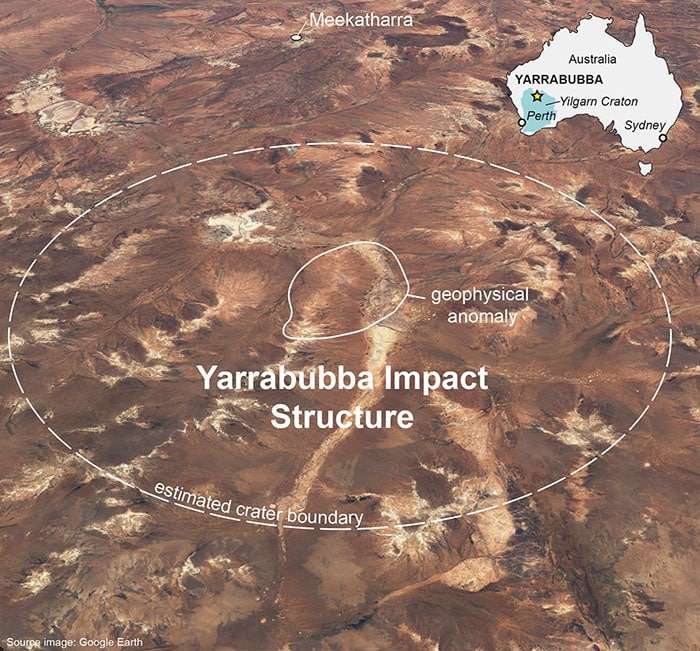
Buried beneath eroded layers in Western Australia’s Midwest region, researchers have confirmed the Yarrabubba crater as the earliest recognized asteroid impact mark on Earth’s surface.
Dating back approximately 2.229 billion years, this crater surpasses all previously documented impact sites in age. Unlike younger impact formations preserved with clearer features, Yarrabubba has been heavily weathered, making its identification an important development in the study of planetary history.
An Impact Site Predating Vredefort
Previously, the Vredefort crater in South Africa, believed to be around 2.023 billion years old, was regarded as Earth's oldest. Recent findings now place Yarrabubba roughly 200 million years earlier, establishing it as the most ancient impact structure discovered so far.

Situated close to Meekatharra, roughly 600 kilometers northeast of Perth, the crater stretches approximately 70 kilometers across. However, natural erosion and tectonic shifts have all but removed any visible surface traces.
Though identified in the early 2000s, the crater’s exact timing remained uncertain until a collaborative team from Curtin University and Imperial College London examined zircon and monazite minerals containing uranium. By tracking uranium's radioactive decay into lead, their uranium-lead dating technique pinpointed the impact to 2.229 billion years ago. This discovery was detailed in a Nature Communications article.
Lead researcher Chris Kirkland emphasized the broader implications: “It not only confirms the oldest known impact but also invites us to explore how such cosmic events influenced Earth's ancient climate systems.”
Did the Impact Influence Ancient Climate?
A striking aspect of the Yarrabubba discovery is its temporal overlap with the conclusion of the Huronian glaciation, a period when global ice sheets enveloped Earth. Some experts propose this correlation may be more than coincidence.
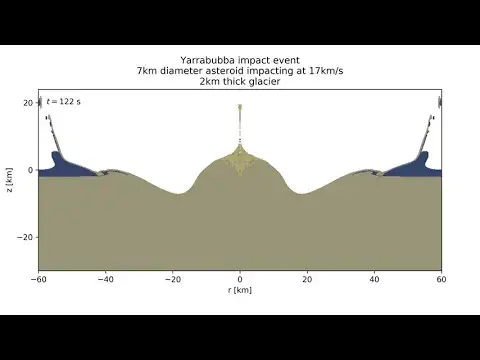
Thomas Davison and his team at Imperial College London modeled an asteroid approximately 7 kilometers wide striking an ice-covered planet at a velocity around 17 km/s.
The simulations suggested the impact could have vaporized enormous ice volumes, releasing upwards of 200 billion tons of water vapor into the atmosphere.
Since water vapor is a potent greenhouse gas, this sudden injection could have induced a warming effect, possibly contributing to the thawing of Earth’s extensive ice cover.
“There’s a remarkable alignment between Yarrabubba’s age and the end of a global glaciation,” noted Nicholas Timms from Curtin University. “The impact might have released sufficient water vapor to tip the climate balance toward warming.”
Challenges in Detecting Yarrabubba
Unlike the Chicxulub crater in Mexico, with distinct geological evidence from an asteroid strike 66 million years ago, Yarrabubba has been deeply eroded. Millennia of wind, water, and tectonic forces have stripped away its surface signatures, making it virtually undetectable without specialized technology.
Researchers made progress through identifying magnetic anomalies below ground, revealing curved magnetic formations typical of impact sites. Additionally, rock samples from within the structure exhibited shock metamorphism, confirming the extraterrestrial origin.
Implications for Earth and Planetary Science
The uncovering of Yarrabubba reshapes perspectives on Earth’s formative years and highlights asteroid impacts’ roles in shaping planetary geology and atmospheric dynamics. It also sheds light on how ancient impacts might have driven climatic shifts, which are pivotal in understanding life’s evolution.
This discovery prompts new research on how asteroid impacts might influence long-duration climate cycles. If such events contributed to ending historic ice ages, it raises the possibility that future collisions could impact climate profoundly.
“This discovery reminds us that asteroid impacts are not just catastrophic events,” said Chris Kirkland. “They are also powerful forces of planetary change.”
Though the Yarrabubba crater itself is no longer visible, its status as the Earth’s earliest known impact location will continue influencing scientific debates about our planet’s distant past and forthcoming future.






0 comments
Sign in to Comment