
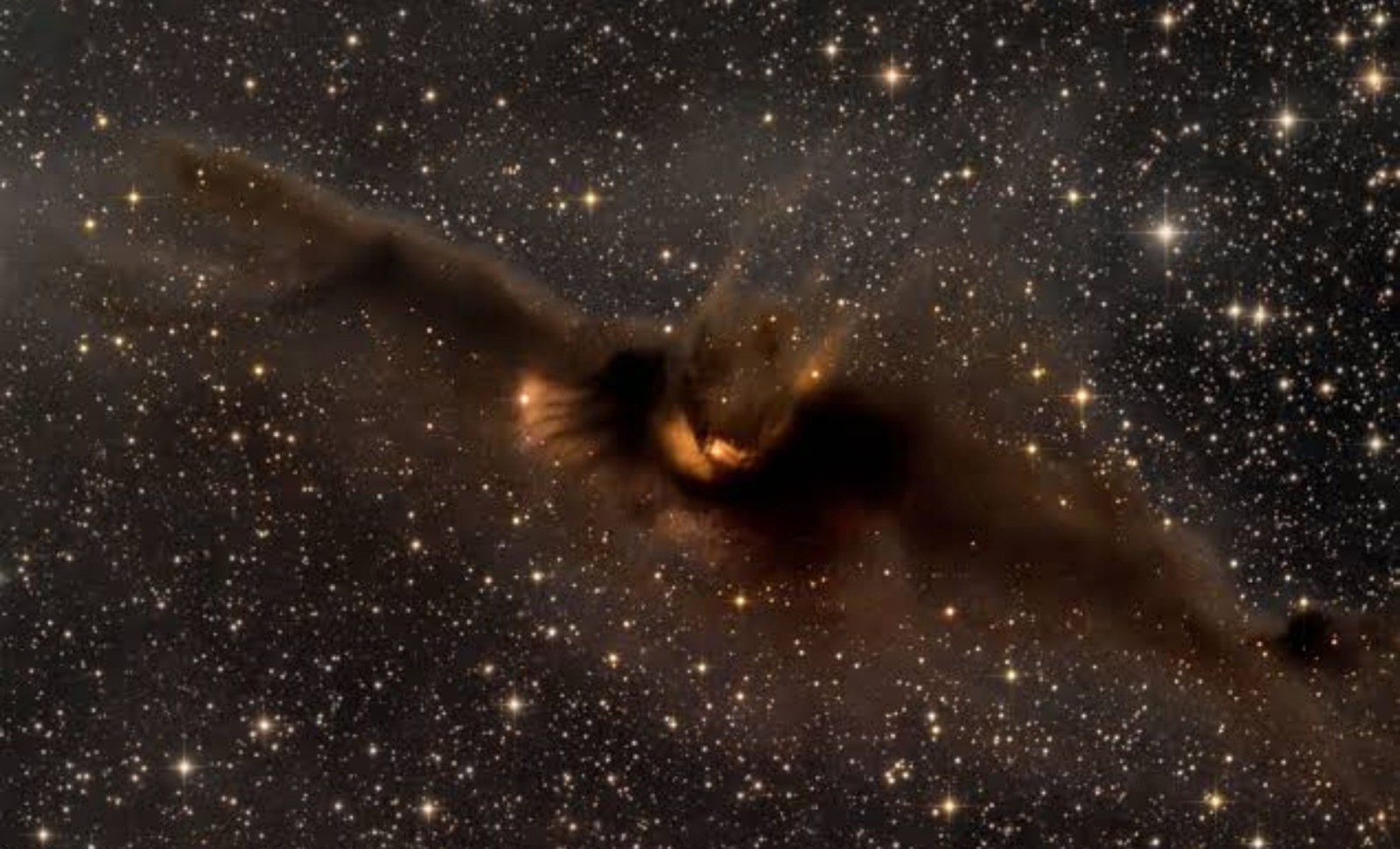
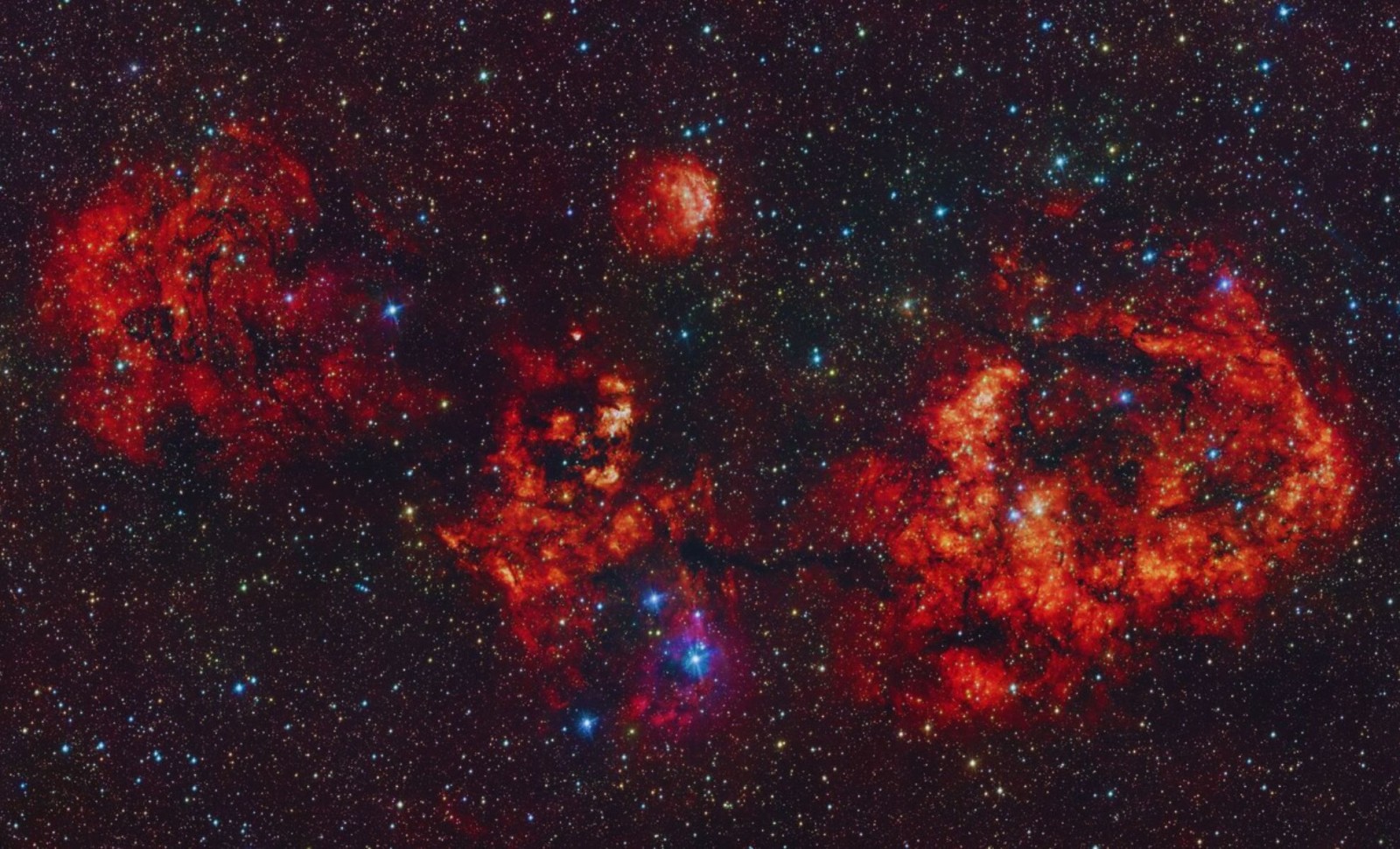
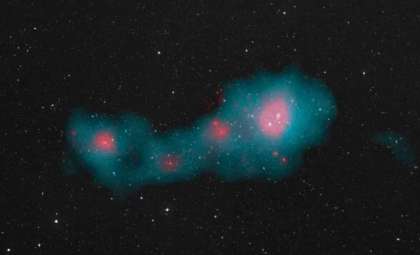
A massive, bat-like formation made of gas and dust has been imaged in the southern skies by Chile’s Very Large Telescope Survey Telescope (VST). This haunting celestial figure, glowing with a deep red tint, stretches across an area four times the diameter of the full Moon, according to the European Southern Observatory (ESO), perfectly timing the observation with the Halloween season.
Situated roughly 10,000 light-years from Earth, nestled between the Circinus and Norma constellations, this striking nebula is part of an active stellar nursery. Its vivid crimson illumination owes to ionized hydrogen gas energized by the intense radiation from newly formed stars within the cloud.
Managed by the Italian National Institute for Astrophysics (INAF) and positioned at ESO’s Paranal Observatory in the arid Atacama Desert, the VST boasts the cutting-edge OmegaCAM, a 268-megapixel camera with a wide field of view enabling it to capture such expansive cosmic structures. This vast cloud remains unnamed but is unmistakably reminiscent of a bat soaring through space.

A Stellar Nursery Illuminated by Intense Red Glow and Dust Lanes
Far from just a fascinating shape in the heavens, this formation is a nursery nurturing star birth in real time. Powerful newborn stars energize the surrounding hydrogen gas, creating the rich red glow visible in the image.
Dark, dense dust filaments weave through the nebula, obscuring the light from more distant stars and outlining what looks like the framework of a bat. According to ESO, these cold, dense filaments serve as ideal environments for star formation inside the cloud.
RCW 94 and RCW 95 Provide the Nebula’s Distinct Features
The nebula is anchored by two prominent star-forming regions cataloged in the RCW Catalog. RCW 94 corresponds to the bat’s right wing, while RCW 95 marks its body. The remaining shapes that outline the bat's silhouette lack formal names but enhance the striking resemblance to the creature in flight.
These designated regions assist astronomers in pinpointing and examining specific parts of the giant molecular cloud. The photograph was created by stacking images taken across multiple filters that isolate distinct wavelengths.
Open-Access Data Reveal Star-Birth Processes in the Nebula
This stunning image was generated using data from two extensive sky surveys: VPHAS+, which maps visible light across the southern Milky Way, and VVV, which employs infrared technology to penetrate dense cosmic dust clouds. Both surveys are openly accessible, welcoming researchers and the public to explore the data and discover mesmerizing cosmic phenomena.
The advanced instruments behind these surveys, OmegaCAM and VISTA, provide more than just captivating images; their data significantly contribute to understanding star formation and the structure of our galaxy.
- Categories:
- Space



0 comments
Sign in to Comment