
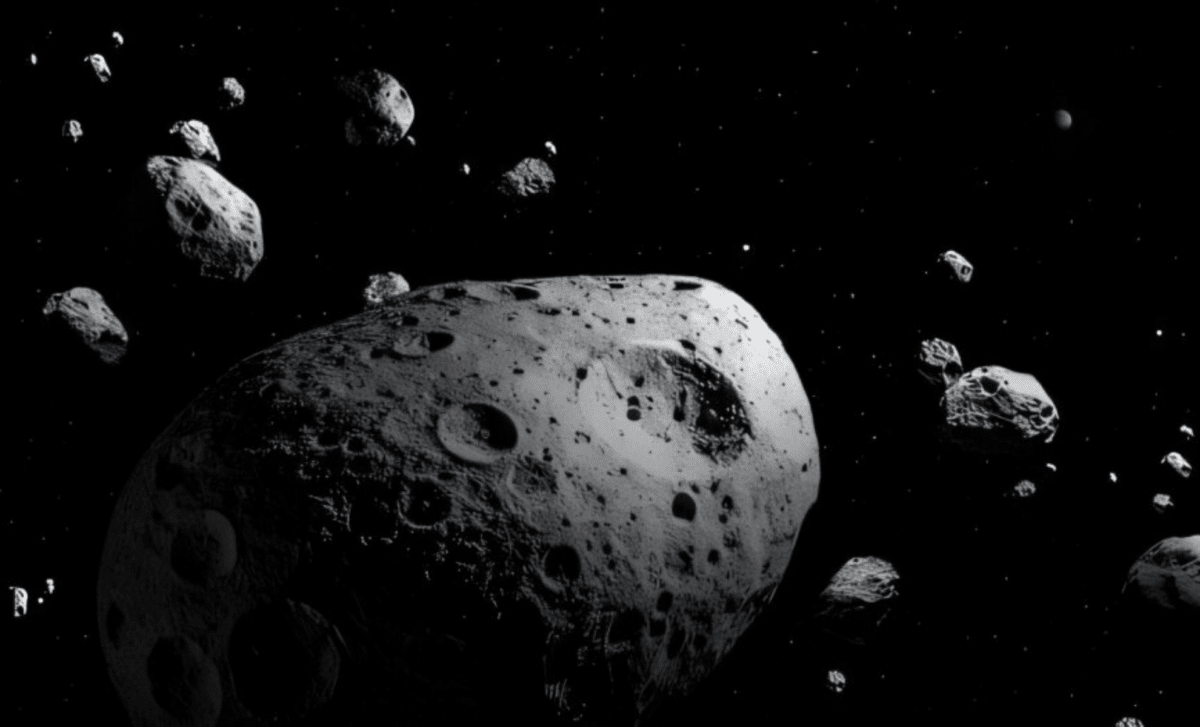
Researchers at the Vera C. Rubin Observatory have uncovered the fastest-spinning asteroid measured to date exceeding 500 meters in diameter. Leveraging the observatory’s cutting-edge instruments and innovative survey methods, their findings were published in The Astrophysical Journal Letters. These results were also shared during the 247th American Astronomical Society (AAS) meeting held in Phoenix, Arizona. The asteroid, designated 2025 MN45, completes a full rotation every 1.88 minutes, an unprecedented speed for its size.
Rubin Observatory’s Unique Capabilities Accelerate Discovery
The identification of 2025 MN45 showcases the remarkable technological advances at the Vera C. Rubin Observatory. Central to this success is the Legacy Survey of Space and Time (LSST) and its powerful LSST Camera, capable of capturing detailed images every 40 seconds. This rapid imaging allows astronomers to survey the sky with unmatched accuracy, revealing previously undiscovered objects. As Luca Rizzi, NSF program director for research infrastructure, explains, “NSF–DOE Rubin Observatory will find things that no one even knew to look for.” This encapsulates the observatory’s potential to transform our understanding of the cosmos over the next decade with its extensive continuous survey.
The Rubin Observatory’s rapid imaging speed is poised to revolutionize astronomical research, not only through discovering objects such as 2025 MN45 but also by generating a rich, dynamic time-lapse of the sky. This comprehensive data set will deepen insight into phenomena ranging from nearby asteroids to distant galaxies, opening new frontiers in understanding cosmic evolution.

Examining Strength in Rapidly Spinning Asteroids
The extraordinary spin rate of 2025 MN45 prompts fresh inquiries into the asteroid’s makeup and durability. To maintain such a swift rotation without disintegrating, the body must possess exceptional structural strength. This challenges the typical view of asteroids as loosely aggregated rubble piles held together mainly by gravity. Sarah Greenstreet, who led the study published in The Astrophysical Journal Letters, states, “Clearly, this asteroid must be made of material that has very high strength in order to keep it in one piece as it spins so rapidly.” The asteroid’s resilience resembles that of solid rock rather than a fragile cluster of debris.
This remarkable finding offers novel clues to the inner structure and formation history of such bodies, suggesting that 2025 MN45 is more cohesive than many similarly sized counterparts. Understanding this robustness sheds light on processes that shaped the early solar system and provides crucial information for assessing potential asteroid threats to Earth by evaluating their mechanical stability.
Insights into Solar System Formation from Fast Rotators
The existence of asteroids like 2025 MN45 emphasizes the intricate and evolving nature of objects populating our solar system. These rapidly rotating bodies serve as natural laboratories for studying the materials that contributed to planet and moon formation. Spin rates can reveal the effects of past collisions and the dynamic conditions under which these space rocks evolved. High-speed rotation often signifies a violent history involving fragmentation or acceleration.
Greenstreet elaborates, “We calculate that it would need a cohesive strength similar to that of solid rock,” indicating that significant collisional events may have reshaped such asteroids’ spin and structure over time.
The Future Role of Rubin Observatory’s Legacy Survey
The initial discovery of 2025 MN45 heralds a new era for solar system studies. The Legacy Survey of Space and Time (LSST) at Rubin Observatory will produce an unprecedented volume of data, scanning the skies nightly to track asteroids, stars, and galaxies. Aaron Roodman, Deputy Head of LSST, remarks, “We have known for years that Rubin would act as a discovery machine for the universe,” with the finding of 2025 MN45 providing early validation of this promise.
Rubin’s LSST is expected to identify thousands more asteroids, detailing their spins, compositions, and interactions. This trove of information will advance the study of asteroids and enhance efforts to monitor objects that could potentially threaten Earth. The observatory’s capacity to capture images at 40-second intervals revolutionizes time-domain astronomy, enabling close real-time examination of fast-spinning asteroids like never before.
Expanding Horizons: Discovering Distant Asteroids in the Main Belt
Most known fast-rotating asteroids, including 2025 MN45, reside within the main asteroid belt, orbiting between Mars and Jupiter. These locations are distant from Earth, making detection challenging due to their faintness. Thanks to Rubin’s exceptional light-gathering ability and precision, astronomers can study these dim, distant objects in unprecedented detail.
As Rubin’s survey continues, more rapid rotators will likely be discovered in the far reaches of the asteroid belt, holding critical clues about the solar system’s formation and the evolution of smaller planetary fragments. The early results from Rubin’s commissioning phase already demonstrate its transformative impact on asteroid research and distant object discovery.
- Categories:
- News






0 comments
Sign in to Comment