
Scientists have identified an unexpected origin of ultra-high-energy gamma radiation much closer to Earth than once thought.
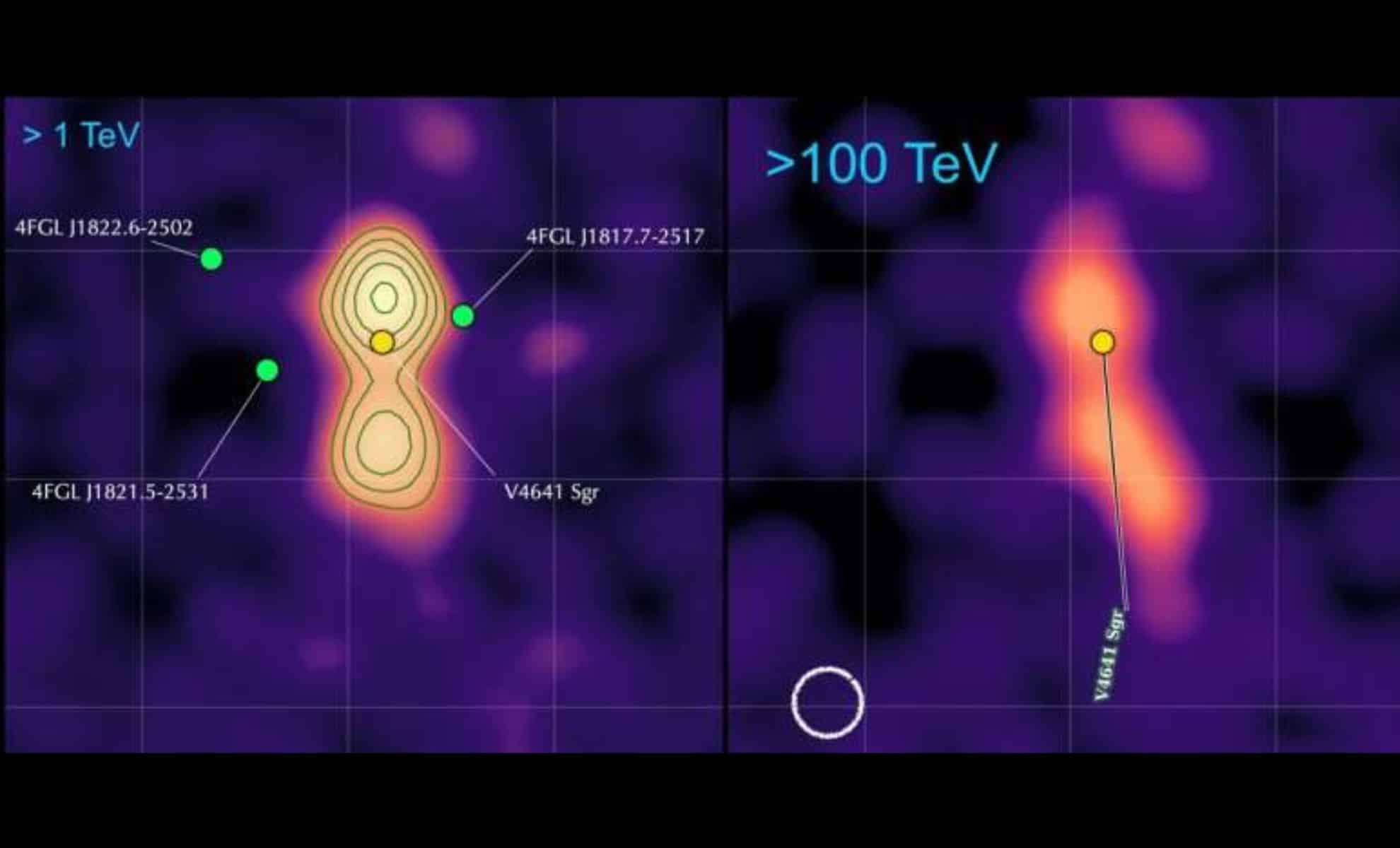
The microquasar known as V4641 Sagittarii (V4641 Sgr), situated within our Milky Way galaxy, emits gamma-ray photons with energies reaching up to 200 teraelectronvolts (TeV), a discovery that challenges existing theories about cosmic ray sources.
Using data collected by the High-Altitude Water Cherenkov (HAWC) Observatory, researchers are rethinking the prevailing ideas about where the universe’s most energetic particles originate, shifting attention from far-flung galaxies to closer stellar objects.

Microquasars as Powerful Cosmic Accelerators
For many years, it was widely believed that the most intense cosmic rays originated from exploding stars or the colossal jets powered by quasars at the centers of remote galaxies. These quasars, anchored by supermassive black holes surrounded by swirling disks of gas, eject streams of matter moving near the speed of light, producing significant gamma-ray radiation. They were seen as the main drivers behind the highest energy particles detected.
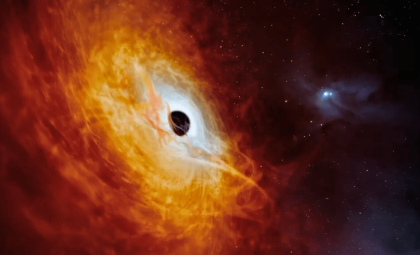
Recent observations, however, spotlight the role of microquasars, particularly V4641 Sagittarii, as potent sources of gamma photons. Unlike quasars, microquasars are more compact binary systems consisting of a heavy star orbiting a stellar-mass black hole. As material from the star is drawn into the black hole, it generates jets traveling at enormous speeds. According to findings from HAWC, these jets can blast out radiation at energy levels much greater than previously anticipated. Dr. Sabrina Casanova, from the Institute of Nuclear Physics of the Polish Academy of Sciences and a lead investigator on the project, explained: “Gamma photons typically detected from microquasars have much lower energy than those from quasars. But the HAWC data reveals something extraordinary—photons from a microquasar in our own galaxy with energies tens of thousands of times greater than what we usually see!”
The HAWC Observatory, perched atop Mexico’s Sierra Negra volcano, employs 300 water tanks to observe Cherenkov radiation—the brief flashes of light produced when particles exceed the speed of light in water. This technology enables detection of gamma rays spanning from hundreds of gigaelectronvolts to the teraelectronvolt range, offering unmatched detail into microquasar phenomena such as those from V4641 Sgr.
The Remarkable Jets of V4641 Sagittarii
V4641 Sagittarii lies in the constellation Sagittarius, roughly 20,000 light-years from Earth. Its binary system comprises a black hole about six times the Sun’s mass alongside a companion star three times as massive. Their swift mutual orbit, completing every three days, powers the intense jets observed emanating from the system. Uniquely, these jets are oriented nearly directly towards Earth, creating relativistic effects that lead to an optical illusion—jets appear to travel nine times faster than light due to their speed and viewing angle.
The detection of such extraordinarily energetic gamma rays from V4641 Sgr is groundbreaking. Prior to this, gamma emissions from microquasars had been observed, but never at these extreme energy levels. “Our findings suggest microquasars could be major contributors to the galaxy’s highest-energy cosmic ray flux,” Dr. Casanova remarked, underlining the profound impact this result has on cosmic ray source theories.
These exceptionally powerful gamma rays challenge the long-standing conviction that the most energetic cosmic rays originate solely from distant quasars or supernova remnants. Instead, this reveals a surprisingly close-to-Earth source of ultra-high-energy particles, enabling direct study of these extraordinary processes.
Revolutionizing Cosmic Ray Studies
The revelations from HAWC have significant consequences for cosmic ray research. Similar detections by the Large High Altitude Air Shower Observatory (LHAASO) in China, which has observed elevated-energy radiation from other microquasars, reinforce the notion that these compact systems play an essential role in cosmic ray generation. This could prompt scientists to substantially revise their understanding and investigation of the mechanisms behind the universe’s most energetic particles.
One key advantage offered by microquasars over distant quasars is their relative closeness, permitting much clearer observation. Radiation from quasars must cross millions of light-years and can be absorbed or dispersed along the journey, whereas gamma rays produced by microquasars within our galaxy encounter fewer obstructions. This proximity allows detailed examination of ultra-high-energy particle acceleration and the underlying physics governing jets, black holes, and cosmic ray production.
Additionally, microquasars evolve on shorter timescales compared to quasars. While quasars change over millions of years, microquasar jets can be monitored over days, providing exceptional opportunities to observe high-energy astrophysical phenomena in real time.
The study led by Dr. Casanova and her team, published in Nature, marks a major advance in the field of high-energy astrophysics. Ongoing observations from facilities like HAWC and LHAASO are expected to shed further light on the contribution of microquasars to cosmic rays and rewrite our comprehension of the energetic cosmos.
- Categories:
- Astronomy ,
- News ,
- Science









0 comments
Sign in to Comment