
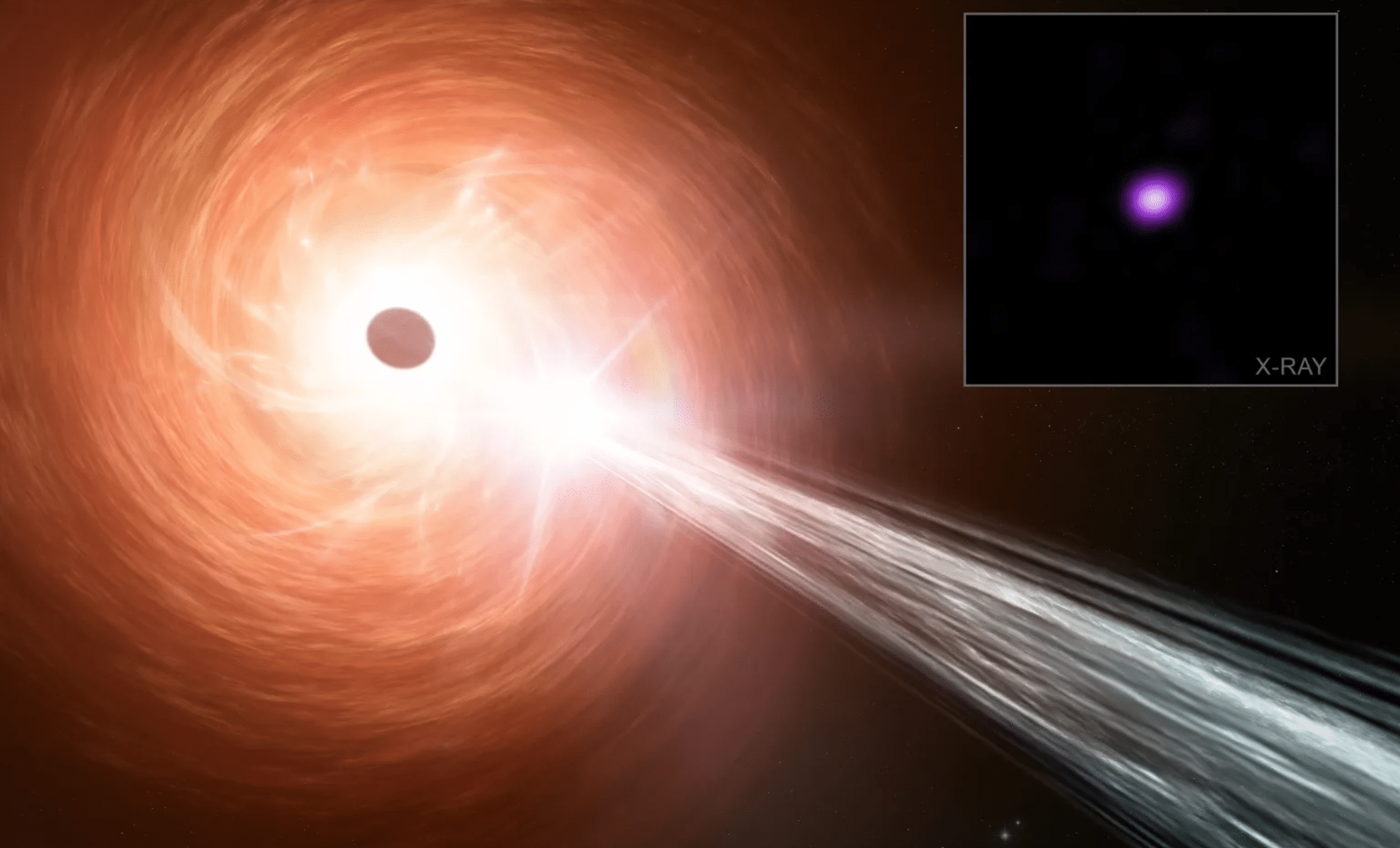
In an extraordinary revelation, NASA’s Chandra X-ray Observatory has identified a black hole growing at an unprecedented speed, providing fresh insights into black hole development during the universe’s infancy. This discovery, published in The Astrophysical Journal, challenges existing black hole growth theories and offers a new perspective on how these cosmic behemoths emerged in primeval times.
Unveiling a Rapidly Accreting Giant
This remarkable black hole, situated 12.8 billion light-years away, possesses a mass roughly a billion times that of the Sun, ranking it among the most massive known black holes from the early cosmos. Its existence during the universe’s first billion years provides a rare window into a poorly understood epoch. What stands out is the extraordinary growth speed of this black hole, with an accretion rate estimated at 2.4 times the Eddington limit, surpassing the theoretical boundary where radiation pressure should halt further material accumulation.
“Witnessing such a black hole expanding at this remarkable pace was truly unexpected,” explained Luca Ighina, lead author from the Center for Astrophysics | Harvard & Smithsonian. This finding is prompting scientists to revisit current models and develop new explanations for how colossal black holes can form so quickly in the young universe.

Quasar RACS J0320-35: A Luminous Early Cosmos Lighthouse
The black hole powers the quasar known as RACS J0320-35, emitting more X-rays than any comparable source observed within the universe’s first billion years. These X-rays originate from highly energized matter spiraling into the black hole, which heats up and radiates across a broad range of wavelengths.
Quasars like RACS J0320-35 are invaluable for exploring early cosmic conditions. By analyzing their radiation, astronomers can infer the environment where black holes initially formed and track their extraordinary growth rates, such as those demonstrated by this quasar.
Exploring Black Hole Origins: Theories on Initial Formation
Decoding the origins of the universe’s earliest black holes remains a major scientific puzzle. The research suggests that some massive black holes may have emerged from the collapse of vast, metal-poor gas clouds prevalent in the ancient universe.
“Determining both the current mass and growth rate of the black hole allows us to estimate its initial size at birth,” noted co-author Alberto Moretti from INAF-Osservatorio Astronomico di Brera. This approach enables testing hypotheses about black hole genesis, challenging the notion that such giants require rare and extreme birth scenarios.
Moreover, these observations imply that instead of forming with enormous mass initially, some black holes might begin smaller and grow extraordinarily fast, signaling a need to update black hole growth models.
Particle Jets and Their Significance in Black Hole Growth
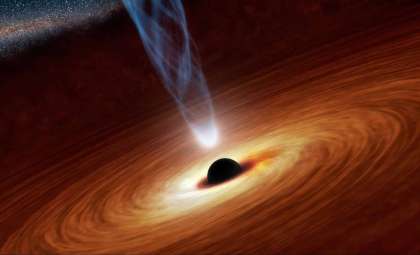
A striking feature of RACS J0320-35 is the powerful particle jets streaming away from the black hole near light speed. Jets of this nature are uncommon in quasars and may relate directly to the excessive growth rate, generated by intense radiation from the rapidly infalling matter.
“How the universe gave rise to the very first black holes remains a profound question,” remarked co-author Thomas of Connor from the Center for Astrophysics. These energetic jets add complexity to the story of black hole evolution, hinting that their accelerated expansion could influence jet formation.
This discovery provides crucial information on black hole behavior and their interactions with their environment, offering a foundation for future investigations into black holes and quasars from the universe’s earliest epochs.
- Categories:
- News


0 comments
Sign in to Comment