

Scientists have uncovered a remarkable cosmic phenomenon: a blazar—an intensely bright and active galactic core powered by a supermassive black hole—existing just one billion years post-Big Bang. This discovery challenges established theories about black hole development and hints at a crowded early cosmos with similar energetic sources.
A Luminous Beacon from the Dawning Universe
Detailed in a recent Nature Astronomy publication led by Eduardo Bañados from the Max Planck Institute for Astronomy, the team analyzed distant cosmic data to identify a blazar whose light has journeyed 12.9 billion years. This offers an extraordinary window into the universe’s formative epochs.
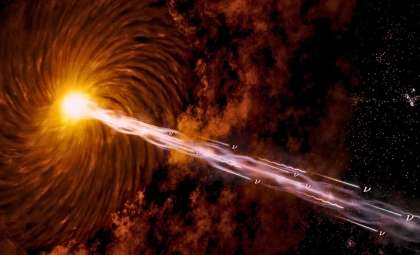
Blazars are a unique type of active galactic nuclei (AGN), featuring supermassive black holes ravenously accreting matter. What sets blazars apart is their orientation: one of their twin jets aimed precisely at Earth. This alignment magnifies their luminosity, transforming them into cosmic lighthouses visible across billions of light-years.

The blazar in question, J0410–0139, was spotted at an incredible redshift of 6.9964, ranking it among the most distant known blazars. Its detection implies the early universe might have been considerably more energetic and bustling than previously assumed, with numerous AGN rapidly maturing within the first billion years after cosmic inception.
How Did Such a Massive Black Hole Evolve So Quickly?
The rapid emergence of supermassive black holes, millions to billions of times the Sun’s mass, remains an astrophysical conundrum. Conventional black hole growth models predict a much slower accumulation of mass, making J0410–0139’s swift growth a striking anomaly.
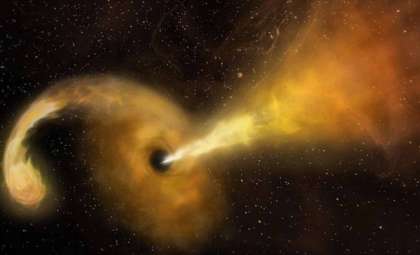
Researchers have speculated that AGN jets may be instrumental in boosting black hole growth rates. These jets’ intense magnetic fields could funnel surrounding gas efficiently into the black hole’s feeding zone, accelerating mass gain far beyond typical rates.
J0410–0139’s discovery lends weight to the idea that jet-driven AGN were pivotal during the early universe’s evolution. This could necessitate revisiting existing black hole formation theories to integrate these highly efficient mechanisms.
Unveiling a Larger Ensemble of Ancient Blazars
This blazar was detected through integrated radio, infrared, and X-ray data collected by the Very Large Telescope (VLT), ALMA radio observatory, and NASA’s Chandra X-ray Observatory. These instruments identified signature blazar features such as intense high-energy radiation, quick variability, and energetic particle jets.

The detection also implies a larger hidden population of blazars in the early cosmos.
Because blazars are only visible when their jets are aimed toward us, J0410–0139’s presence indicates many jet-powered AGN remain undiscovered. Confirming this would reveal rapid supermassive black hole development was common within the universe’s first billion years.
- Categories:
- News







0 comments
Sign in to Comment