
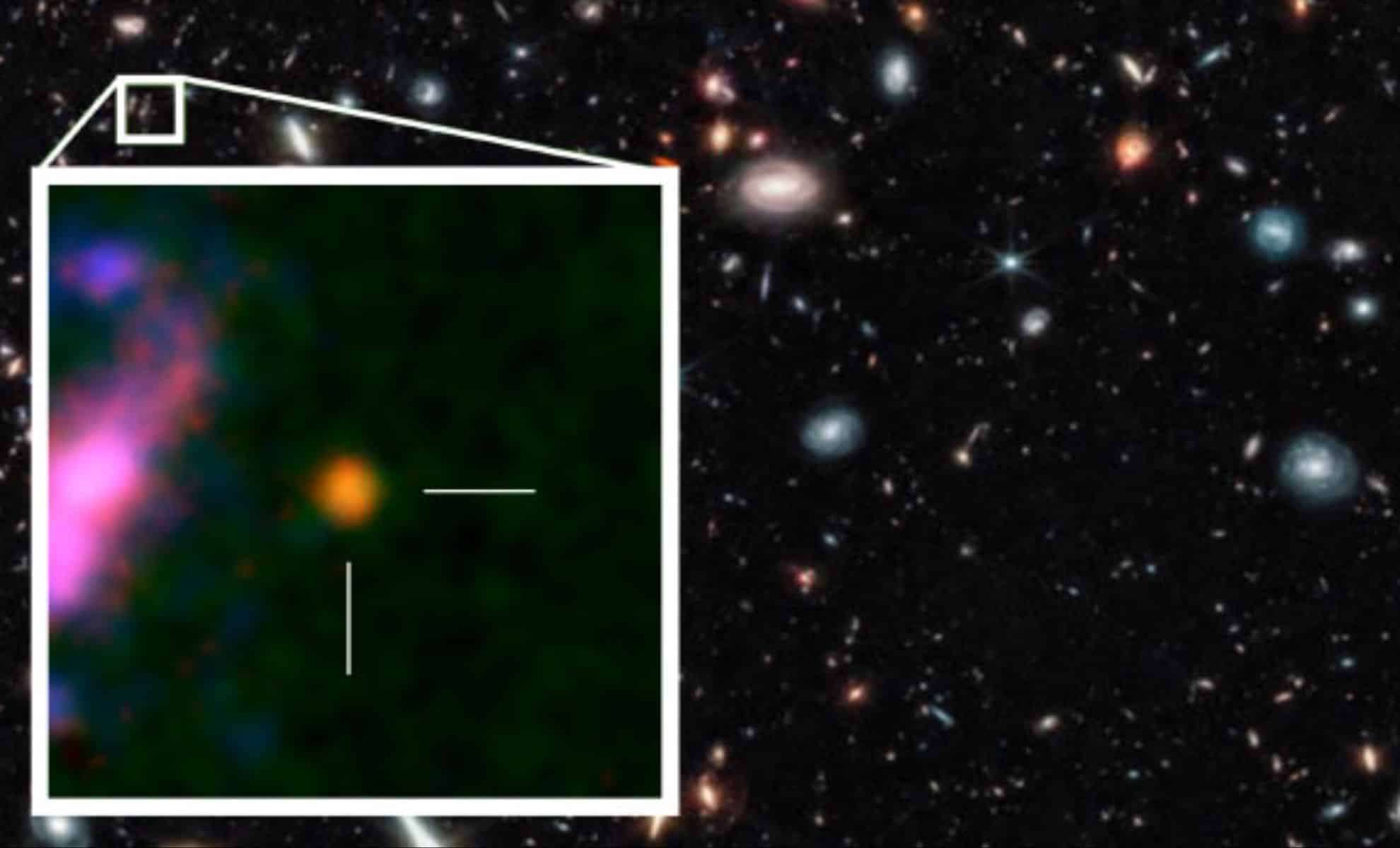
Researchers have uncovered oxygen in a galaxy so far away its light has been journeying across space for 13.4 billion years, providing unprecedented insight into the cosmos’s earliest era. This remarkable finding, documented in a recent Nature Astronomy publication, marks the most distant detection of atomic oxygen recorded, offering a rare window into the universe just a few hundred million years post-Big Bang.
Combining ALMA and JWST to Discover an Ancient Celestial Gem
The oxygen presence in galaxy GHZ2 was revealed through the joint efforts of two state-of-the-art observatories: the Atacama Large Millimeter/submillimeter Array (ALMA) and the James Webb Space Telescope (JWST). Jorge Zavala, one of the astronomers on the team, described the challenging observation process: “We aimed the over forty 12-meter antennas of ALMA alongside the 6.5-meter JWST at a seemingly empty patch of sky for multiple hours.” Utilizing these instruments together enabled the detection of faint emissions from energized atoms such as oxygen and hydrogen, unveiling the galaxy’s elemental composition and star-forming activity. This detection exemplifies the crucial role of multi-wavelength observatories in probing the distant universe.
A Compact, Metal-Poor Galaxy Exhibiting Vigorous Star Formation
GHZ2 is a diminutive galaxy, its mass equating to several hundred million suns confined within a few hundred light-years, mirroring the density of contemporary star clusters. This extreme concentration raises intriguing questions about the processes that formed such dense environments shortly after the Big Bang. The galaxy’s metallicity—the level of elements heavier than hydrogen and helium—is approximately ten percent that of the Sun’s vicinity, indicative of a chemically young system. These heavy elements, including oxygen, arise from hot, short-lived stars whose radiation energizes the surrounding gas. GHZ2’s rapid star formation cycles contrast with the more gradual pace observed in older galaxies, potentially explaining the swift buildup of massive galaxies in the early epochs.

Clues to Globular Cluster Formation and Early Galactic Development
The characteristics of GHZ2 might shed light on how globular clusters—ancient, densely star-packed systems within galaxies like the Milky Way—originated. Scientists have observed similarities in elemental distributions and stellar densities between GHZ2 and these enduring clusters. Determining whether galaxies like GHZ2 acted as progenitors to globular clusters could solve an enduring astrophysical puzzle. Tom Bakx from Chalmers University remarked on the significance of the findings: “This work crowns years of effort to decode galaxies from the universe’s dawn.” He noted that “further telescope observations will be vital to explore the evolution of metals, star formation, and black holes in the early cosmos.” Upcoming studies aim to examine GHZ2’s internal structure and chemical makeup in greater detail, enriching our understanding of formative cosmic processes.
- Categories:
- News





0 comments
Sign in to Comment