
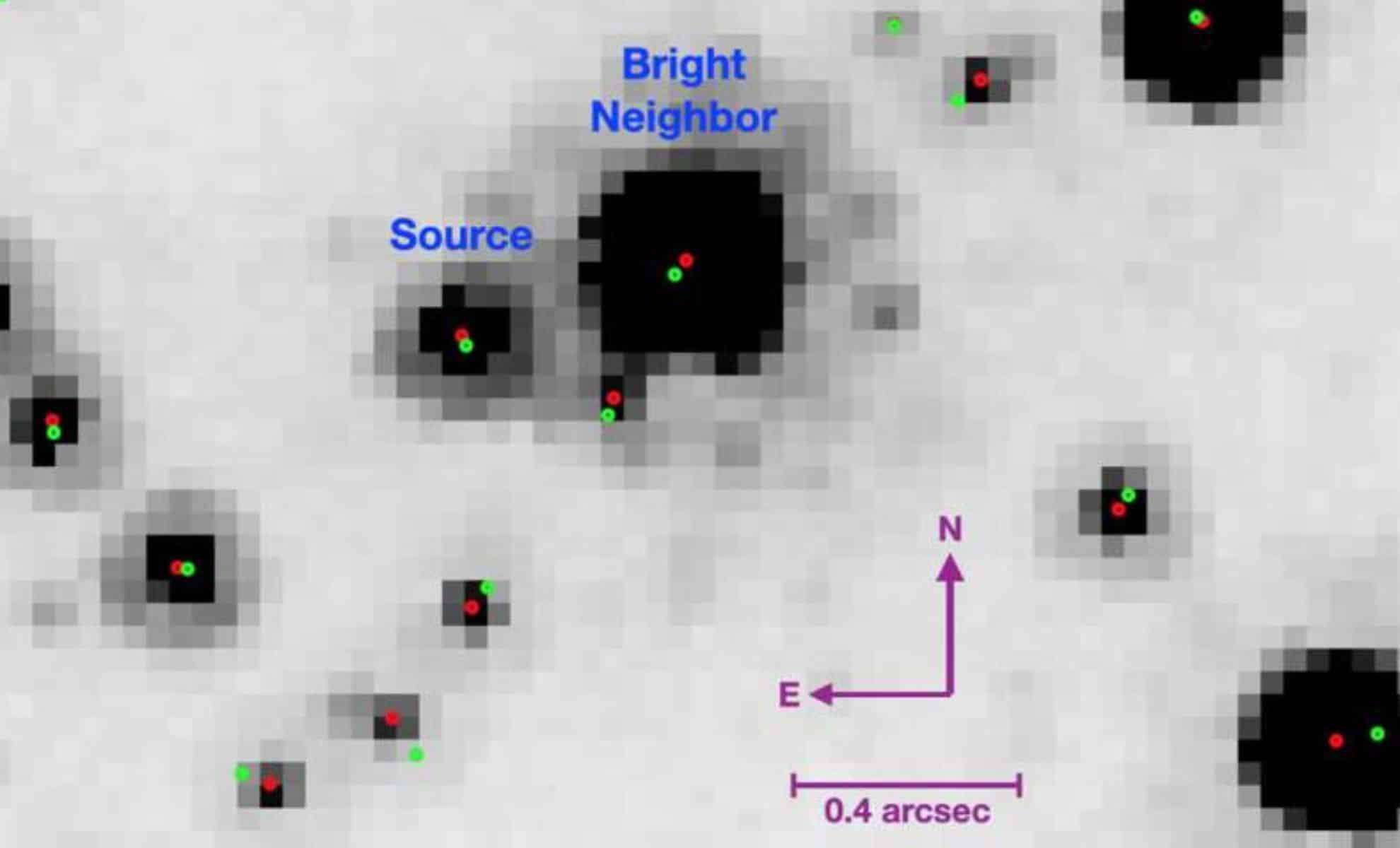
A groundbreaking finding reveals the first confirmed solitary stellar-mass black hole drifting through the Milky Way without a companion star. Positioned towards the Sagittarius constellation, this black hole is estimated to have a mass roughly seven times that of our Sun, marking an unprecedented observation of a free-floating black hole.
The research, featured in The Astrophysical Journal, was led by Kailash C. Sahu and his team at the Space Telescope Science Institute. Drawing from more than ten years of precise measurements collected by the Hubble Space Telescope along with data from the Gaia observatory, this object was initially detected in 2011, but its true classification remained uncertain until now.
An Invisible Titan Revealed Through Warped Starlight
The black hole’s unique detection method distinguishes it from typical discoveries. Usually, stellar-mass black holes are found due to their interaction with companion stars—accreting material or emitting high-energy radiation. This object, however, is unique due to its lack of any stellar partner, rendering it virtually undetectable through conventional means.

Astronomers instead identified it using the phenomenon of gravitational microlensing, which happens when a massive unseen object passes between Earth and a distant star, bending and amplifying the star’s light. This fleeting event, consistent with Einstein’s general relativity, enabled researchers to calculate the black hole’s mass by observing the distortion in the background star’s position.
The microlensing occurrence, known as OGLE-2011-BLG-0462, persisted for over 270 days, allowing for unusually detailed observations. Precise astrometric tracking of the star’s deflection confirmed that the lensing body is both dark and extraordinarily dense, excluding objects less compact than a black hole.
Ending Years of Uncertainty in Black Hole Identification
Following the initial find, another scientific group suggested the lensing source might be a neutron star, a dense remnant with potential to create similar gravitational effects. This sparked a scientific dispute until newer data from Hubble and Gaia collected between 2021 and 2022 provided compelling astrometric measurements supporting the black hole explanation.
The leading team estimated the mass at approximately 7.1 solar masses, whereas the alternative group proposed a slightly lower value near 5.8 solar masses with a wider error range. Both estimates, however, exceed the accepted upper mass limit of a neutron star—approximately 2.1 to 2.5 solar masses. This consensus now confirms the object as a solitary stellar-mass black hole.
This discovery marks a historic achievement: the first unambiguous observation of a black hole existing in total isolation without gravitational or radiative influence from a nearby star.
Peering Into the Dark: The Future of Rogue Black Hole Research
The identification of this lone black hole paves the way for deeper exploration of the Milky Way’s population of “wandering” black holes, which could number in the hundreds of millions. Such objects are thought to form from the collapse of massive stars in isolation or from black holes expelled from binary systems due to supernova explosions or gravitational encounters.
Detecting these invisible objects is challenging without microlensing events, but the upcoming Nancy Grace Roman Space Telescope, launching in 2027, promises to revolutionize this search. With its expansive field of view and sensitive photometric capabilities, Roman will be a premier instrument for discovering many more isolated black holes.
By confirming the existence of this stealthy black hole—hidden for over a decade—astronomers now embark on a new era that will uncover the darkest cosmic bodies via their subtle gravitational signatures.
- Categories:
- News





0 comments
Sign in to Comment