
Astronomers have identified what could be the first known source linked to a fast radio burst (FRB) in a galaxy far from our own. Employing precise radio data alongside infrared imaging from the James Webb Space Telescope (JWST), the team traced a powerful radio signal back to a faint object that may shed light on the FRB’s origins.
This breakthrough tackles a major mystery in astrophysics: what triggers fast radio bursts? These fleeting bursts of radio waves last mere milliseconds but can be detected across vast distances in the universe. Since their discovery in 2007, hundreds of FRBs have been recorded, yet pinpointing an exact source has proven elusive.
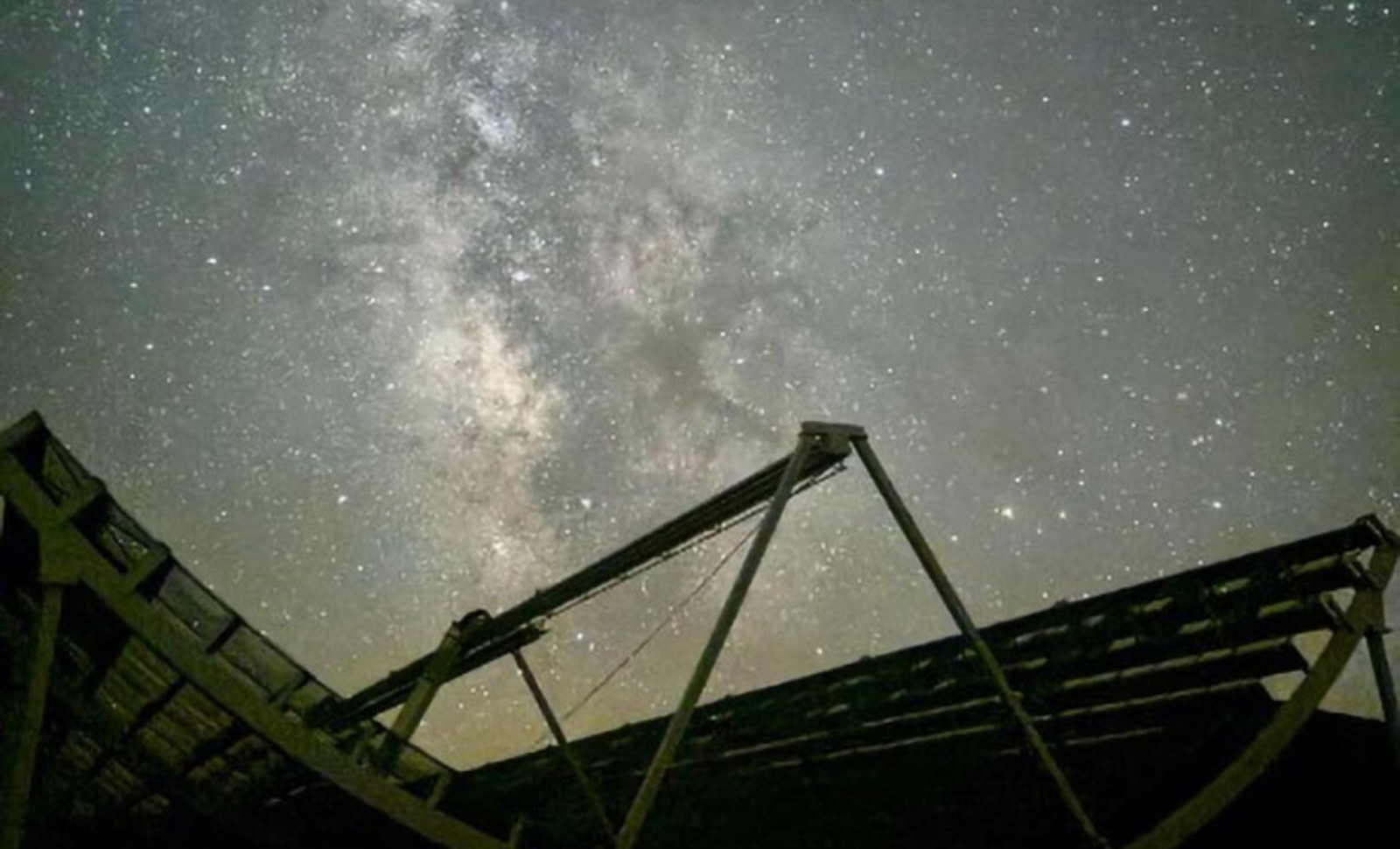
Leading the investigation was Peter Blanchard, a research associate at Harvard College Observatory, part of the Center for Astrophysics | Harvard & Smithsonian (CfA). By combining enhanced radio data from the upgraded CHIME Outriggers array with JWST’s infrared observations, the scientists conducted the most detailed search to date for an FRB’s source.

The focus was on FRB 20250316A, detected on March 16, 2025, in galaxy NGC 4141, about 130 million light-years away. Its relatively close proximity and ultra-precise position made it an excellent target for follow-up study.
Unprecedented Accuracy Brings New Insights
Fast radio bursts remain one of astronomy’s most puzzling events, characterized by their sudden appearance, massive energy release, and disappearance within milliseconds. While it is known that FRBs originate beyond the Milky Way, discovering their exact astrophysical sources has been a significant challenge.
The turning point came with observations from the upgraded CHIME Outriggers in Canada, which allowed astronomers to locate FRB 20250316A with exceptional precision and target JWST’s instruments at the exact site of the burst.
The Center for Astrophysics | Harvard & Smithsonian reports that JWST’s infrared sensors identified a faint luminous object near the radio burst’s origin.
“This was a unique opportunity to quickly turn JWST’s powerful infrared eye on the location of an FRB for the first time,” Blanchard said. “And we were rewarded with an exciting result – we see a faint source of infrared light very close to where the radio burst occurred.”
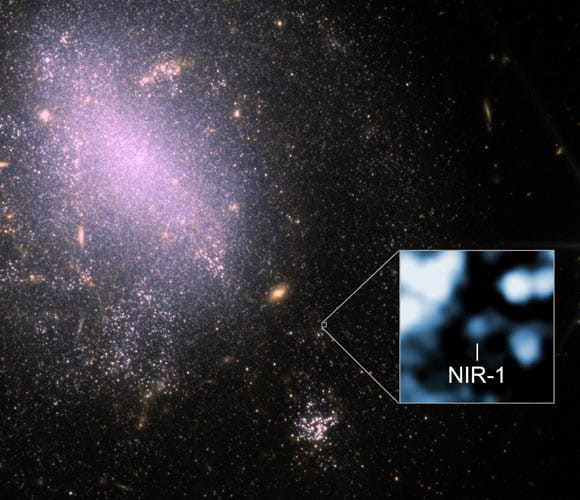
The infrared source identified, named NIR-1, became the main subject for further scrutiny.
Clues from a Dim Stellar Body
Infrared data suggests that NIR-1 is either a red giant star approaching the later stages of its lifecycle or a massive star of moderate age. While red giants resemble our Sun nearing their end, the alternative points to a star considerably bigger than the Sun.
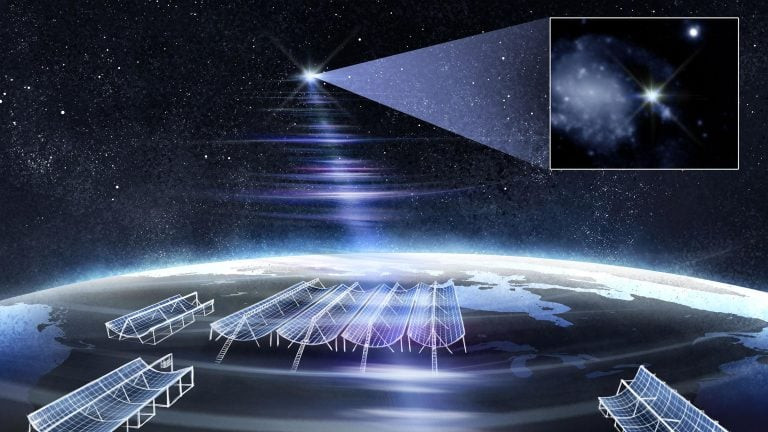
Neither star type typically produces FRBs on their own, so the scientists propose that NIR-1 could be part of a binary system with an unseen neutron star. If matter from NIR-1 transfers to its dense companion, that process might produce the intense radio burst.
The granularity of these observations is rare in FRB studies. Edo Berger, a CfA researcher and co-author, remarked that observational gaps have long hindered verification of theories about FRB origins.
“Being able to isolate individual stars around an FRB is a huge gain over previous searches, and it begins to tell us what sort of stellar systems could produce these powerful bursts,” Berger said.
New Clues Connect FRB to Magnetar Possibility
The team explored the surrounding area of the burst site to check if NIR-1’s presence was genuinely linked to the FRB. They found a compact cluster of young, massive stars nearby.
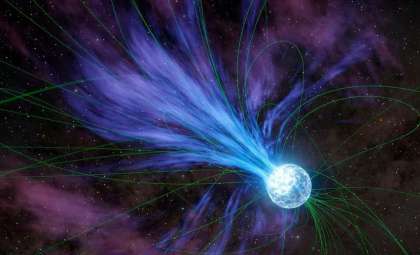
This finding brought attention to the hypothesis involving a magnetar, an extraordinarily magnetic neutron star formed after a massive star collapses. One star from this cluster may have already become a magnetar and could have generated the radio burst. Given its distance, such an object would be too dim for JWST to detect directly.
Moreover, the study considered other possible origins like a dense cluster of older stars or a giant massive star. However, these were discounted because they would generate brighter infrared emissions than what was observed.
“Whether or not the association with the star is real, we’ve learned a lot about the burst’s origin,” Blanchard said. “If a double star system isn’t the answer, our work hints that an isolated magnetar caused the FRB.”
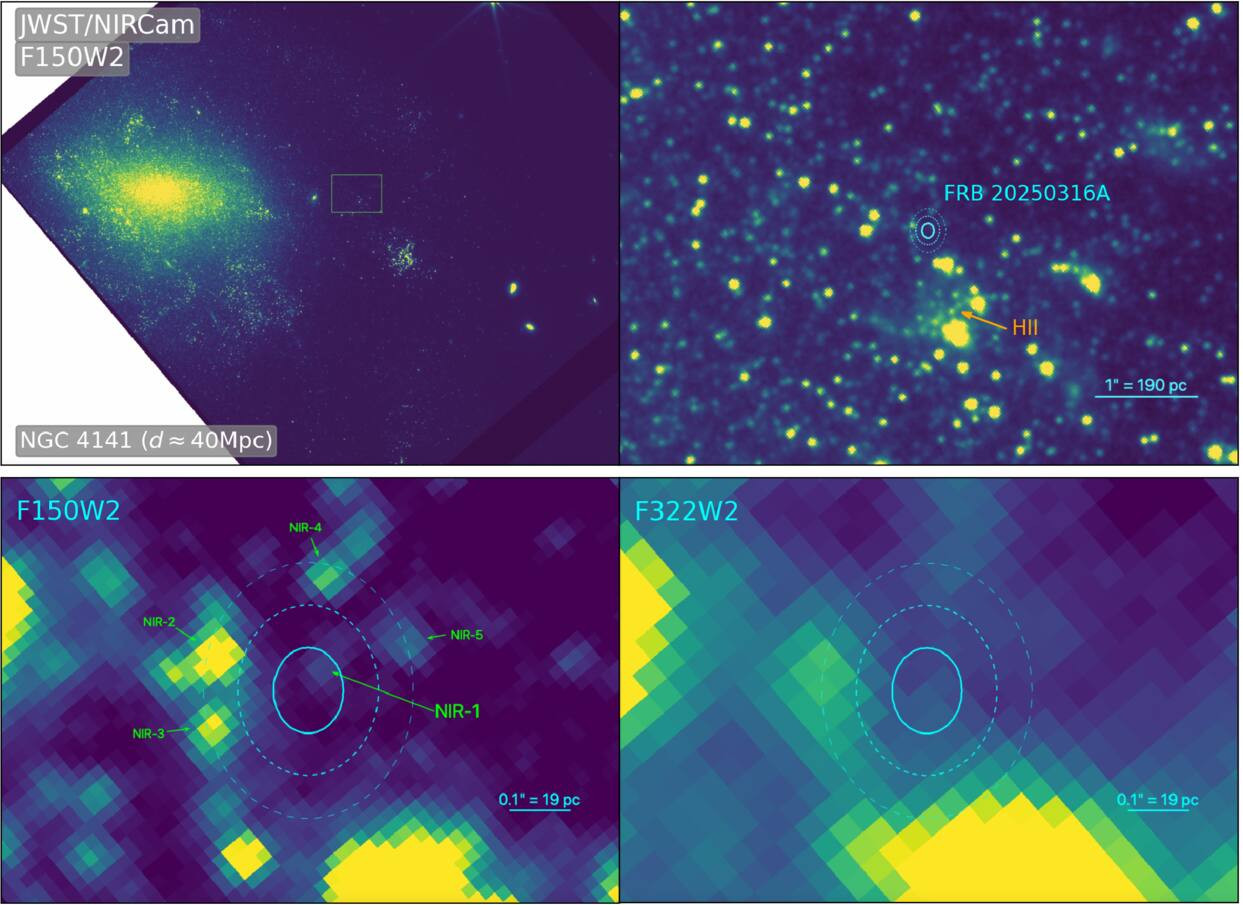
Additionally, the faint infrared light detected could be a reflection from a flare generated by the burst’s source. Upcoming JWST observations will monitor if this light diminishes over time.
- Categories:
- Science








0 comments
Sign in to Comment