

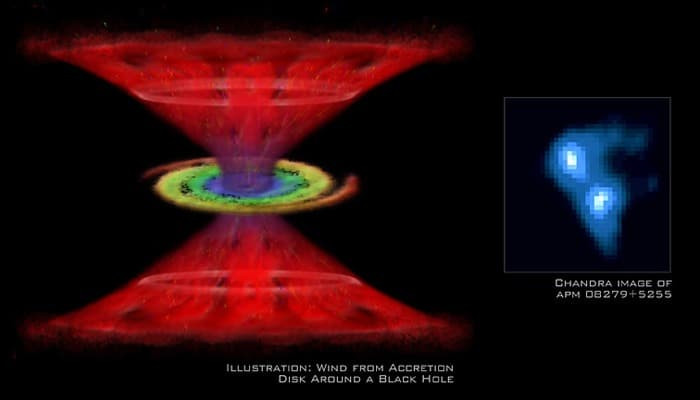
Researchers have uncovered an enormous concentration of water vapor enveloping the quasar APM 08279+5255, situated over 12 billion light-years away from our planet. The volume of water found is estimated to be about 140 trillion times greater than all Earth's oceans combined, representing the most extensive water reservoir known in the cosmos.
This quasar is fueled by a supermassive black hole with a mass roughly 20 billion times that of the Sun. It emits energy on a scale likened to a thousand trillion Suns, creating an extreme environment where gas and dust are intensely heated and altered. Such circumstances enable scientists to study matter near one of the universe’s most powerful phenomena.
Since this object is observed at such an extraordinary distance, the light we receive started its journey when the universe was still in its infancy. This makes the quasar a crucial landmark for exploring the processes behind galaxy formation and evolution across billions of years.

The Influence of a Massive Black Hole
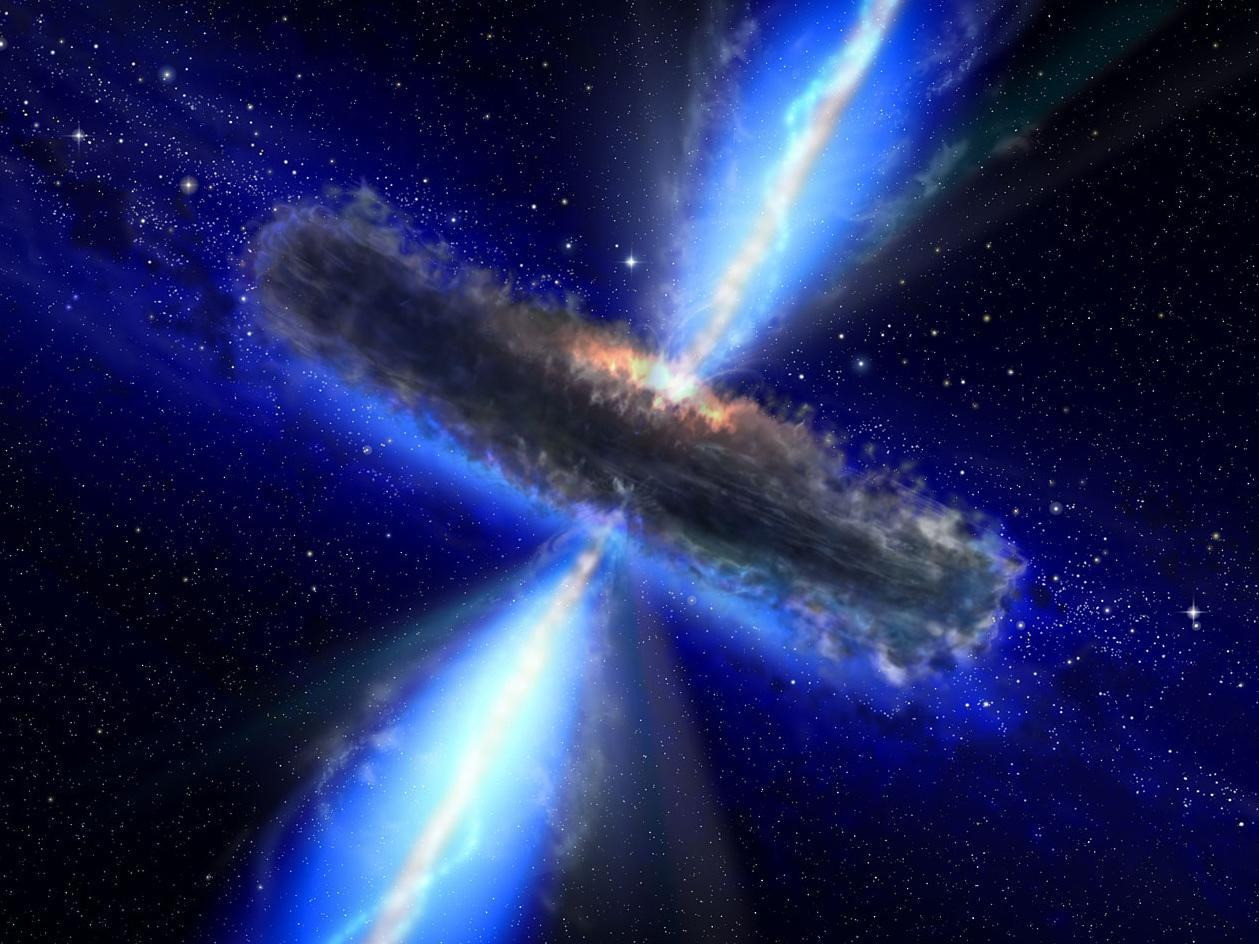
At the core of APM 08279+5255 lies a black hole drawing in nearby matter. As the material spirals inward, it heats up and generates intense radiation over a broad spectrum, making this quasar one of the brightest cosmic sources known.
As reported in the Astrophysical Journal Letters, these energetic processes produce a singular environment where molecules can form and persist despite severe radiation exposure. The emitted energy extends far beyond the black hole’s vicinity, influencing surrounding gas and altering the structure of the region around it.
Quasars like this have intrigued astronomers due to their luminosity outshining entire galaxies. Their brilliance allows researchers to explore distant areas of space that would otherwise remain unresolved, providing valuable data on the cosmic matter distribution on a grand scale.
An Unprecedented Quantity of Water Vapor
The detected water vapor spreads across hundreds of light-years. Although the gas density is much lower than Earth's atmosphere, it remains significantly warmer and denser than typical interstellar environments. According to Matt Bradford, who led one of the study groups:
“The environment around this quasar is very unique in that it’s producing this huge mass of water,” he said. “It’s another demonstration that water is pervasive throughout the universe, even at the very earliest times.”
The temperature of this gas is about -63°F, relatively warm for such a remote cosmic locale, and its concentration is markedly higher compared to similar settings.
Scientists also detected molecules such as carbon monoxide, indicating a chemically rich zone with abundant material. This gas might continue to feed the black hole, enabling further growth, or possibly enable the birth of new stars within the region.
The Early Universe’s Dynamic Landscape
This breakthrough was made possible by combining several cutting-edge instruments. Initial detection came from Z-Spec at the Caltech Submillimeter Observatory in Hawaii, which first identified water vapor signals.
The findings were subsequently verified by the Combined Array for Research in Millimeter-Wave Astronomy (CARMA) in California, with follow-up observations by the Plateau de Bure Interferometer in France refining the measurements further.
While earlier research had hinted at the water’s presence through a single spectral signal, newer measurements confirmed multiple lines, establishing not only its existence but also revealing just how vast this reservoir is. Utilizing multiple observation platforms clarified that this is the largest and most remote water deposit ever recorded.
- Categories:
- Science









0 comments
Sign in to Comment