
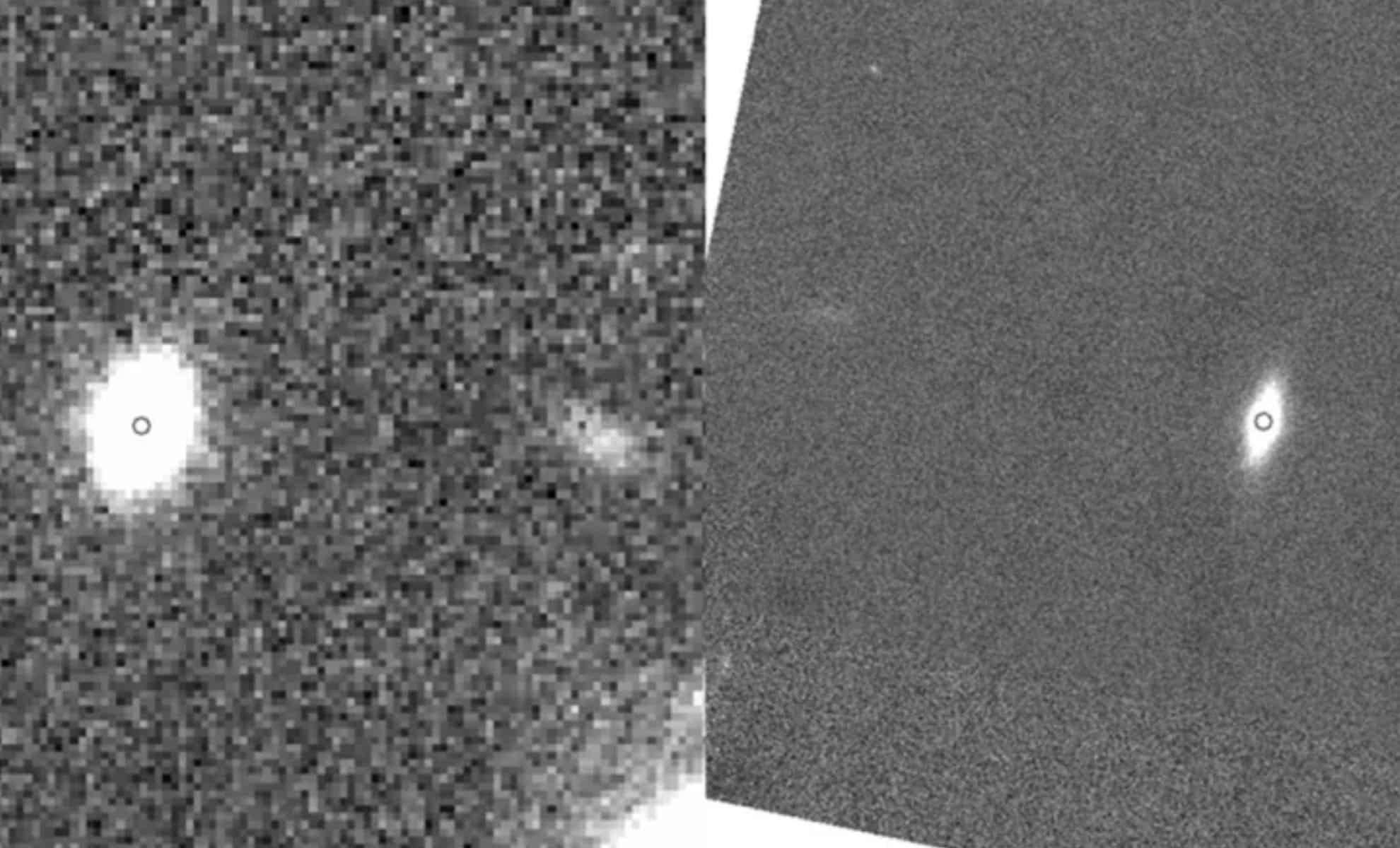
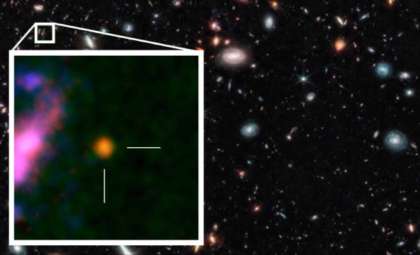
A groundbreaking research article in the Monthly Notices of the Royal Astronomical Society announces the identification of the farthest and most pristine fossil galaxy yet known, named KiDS J0842+0059, situated approximately 3 billion light-years away from our planet. This extraordinary galaxy has remained nearly unchanged over 7 billion years, offering scientists a rare glimpse into the formative epochs of the universe and the genesis of massive galactic structures.
The discovery was spearheaded by a team from the Italian National Institute for Astrophysics (INAF), employing advanced observational technology including the powerful Large Binocular Telescope located in Arizona. KiDS J0842+0059 is not just the most distant fossil galaxy found so far but also the first to be observed well beyond the local cosmic neighborhood, previously limited to about 1 billion light-years away, thereby broadening our understanding of early cosmic environments.
Understanding Fossil Galaxies and Their Significance
Fossil galaxies are extraordinary celestial objects that offer a snapshot of an ancient universe. These galaxies differ from typical ones by avoiding common evolutionary developments such as mergers and ongoing starbirth. After a swift initial star formation spurt, fossil galaxies effectively ceased developing and have remained largely undisturbed for billions of years.

“By pure chance, these relic galaxies escaped merging events, thereby preserving their original structure over cosmic time,” said Crescenzo Tortora, an INAF researcher and study lead. “Their rarity stems from the increasing likelihood of galaxies merging as the universe evolves.”
Fossil galaxies stand out as cosmic time capsules, conserving conditions from the universe’s youth. Examining them grants astronomers insights into the first phases of galaxy formation and star production. Unlike most galaxies that undergo extensive merging and growth, these fossilized systems retained their primordial makeup, helping decode the original cosmic environment.
How Fossil Galaxies Formed in the Universe’s Early Days
The birth of fossil galaxies occurs over two distinct stages. Initially, a brief but intense phase of star formation leads to a compact, dense galaxy that serves as the prototypical fossil. This violent stellar production is rapid and shapes the galaxy’s core properties.
“It begins with an early, vigorous period of star creation that results in a small, dense progenitor,” noted Chiara Spiniello, co-author and University of Oxford researcher. “This initial phase lays down the foundation for what becomes the fossil galaxy.”
The following stage, common to other galaxies, involves growth through interactions, mergers, and morphological transformations. Fossil galaxies, however, skip this evolutionary step, their masses and forms nearly fixed from the initial starburst, creating a unique structure unlike ordinary galaxies.
What Causes Fossil Galaxies to Be So Compact and Dormant?
A defining trait of fossil galaxies is their extraordinary star density combined with an absence of new star formation. In contrast to our actively evolving Milky Way, these galaxies no longer generate stars, consisting instead of billions of sun-sized stars in a static state.
“These ancient galaxies harbor billions of stars but have ceased forming new ones,” said Spiniello. “They originated when the cosmos was very young and somehow avoided interactions or mergers, remaining unchanged over billions of years.”
This quiescent nature makes fossil galaxies invaluable for research, as they preserve original conditions free from the disturbances common in most large galaxies, thus serving as a direct connection to the universe’s distant past.
Supermassive Black Hole Influence on Star Formation Shutdown
One unresolved aspect is why these galaxies abruptly stopped forming stars. Professor Michele Cappellari from the University of Oxford suggests the energy output from supermassive black holes at their centers may have halted star formation. These black holes can produce intense winds that either expel gas or heat it sufficiently to prevent new stars from emerging.
“As cosmic relics, these galaxies avoided typical growth through mergers, allowing us to trace early star formation activity,” Cappellari explained. “Current data from nearby and distant galaxies indicates feedback from supermassive black holes likely suppressed further star birth, although this process is still being actively investigated.”
What Distinguishes KiDS J0842+0059 from Other Fossil Galaxies?
KiDS J0842+0059 earns the label of an “extreme relic” because nearly all its stars, about 99.5%, were created during a single, early starburst event with no significant activity afterward. This dormancy positions it as a textbook example of a fossil galaxy.
“This extreme relic status highlights how almost the entire stellar population was formed in the universe’s infancy with no subsequent star formation,” remarked Spiniello.
Understanding this galaxy’s properties deepens knowledge about why certain galaxies evolve dramatically whereas others remain static, shedding light on early galactic development.
Looking Ahead: Future Fossil Galaxy Investigations
The identification of KiDS J0842+0059 as a distant fossil galaxy marks a significant advance in exploring cosmic history. With upcoming astronomical instruments like James Webb and Euclid telescopes designed for deep-space observations, scientists anticipate uncovering more such relics, enhancing our grasp of the early universe.
“There may be factors preventing these galaxies from merging, but without clarity, it’s hard to predict their long-term evolution,” said Spiniello, underscoring that while fossil galaxies have stayed undisturbed for eons, their futures remain uncertain.
The Scarcity and Scientific Value of Fossil Galaxies
Fossil galaxies are extremely rare, making their detection and study crucial yet challenging. Sébastien Comerón, an astronomer at Universidad de La Laguna, highlights the enigmatic nature of these galaxies.
“Relic galaxies remain a puzzle,” Comerón said. “The existence of untouched galaxies from the earliest large structures in the universe demands explanation.”
Finding KiDS J0842+0059 encourages optimism that more fossil galaxies can be discovered, providing unique perspectives on galaxy birth, star formation, and cosmic evolution.
- Categories:
- News




0 comments
Sign in to Comment