

Recent findings indicate that Venus, long viewed as Earth’s inhospitable counterpart, may share a comparable geological past with our planet.
Researchers have discovered that Venus’ distinctive elevated regions, called tesserae, could have originated via mechanisms similar to those that formed Earth’s primordial continents billions of years ago.
This innovative research offers fresh perspectives on how planets develop and suggests that tectonic-like processes might have taken place on other worlds.

Unveiling Venus’ Geological Origins
Under the guidance of Associate Professor Fabio Capitanio at the Monash University School of Earth, Atmosphere and Environment, an international team partnered with NASA to explore Venusian geology, with findings published in Nature Geoscience.
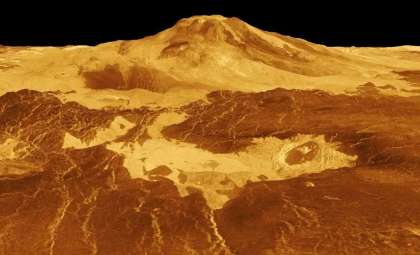
The team employed advanced computer simulations alongside data from NASA’s Magellan spacecraft to investigate the formation of Ishtar Terra, the largest plateau on Venus. Ishtar Terra’s massive plateaus and towering peaks make it an exceptional site for studying Venus’ geological framework.

The simulations indicated that Ishtar Terra and its tesserae might have formed similarly to Earth’s cratons, which are ancient continental cores shaped billions of years ago through tectonic activity, including the thinning and melting of Earth’s crust that allowed molten magma to ascend and create elevated landforms.
Likewise, Venus’ crust could have experienced thinning and partial melting driven by its unique geological environment, triggering molten rock to rise and form extensive uplands. With time, mantle resistance would facilitate cooling, resulting in plateau-like highlands bordered by folded mountain ranges.
“Given Venus’ scorching surface temperature near 460°C and absence of current plate tectonics, we hadn’t anticipated such intricate geological structures,” noted Associate Professor Capitanio. This revelation challenges prior assumptions about planetary development and implies Venus may have undergone tectonic-like processes akin to those on early Earth.
The Importance of Ishtar Terra
Ishtar Terra, a vast elevated region on Venus, features mountain belts with heights comparable to Earth's Himalayas. The crust here is substantially thick, resembling terrestrial cratons. On Earth, these formations arise from tectonic plate collisions that elevate mountains and shape landscapes. That Ishtar Terra may have originated through similar dynamics raises the possibility of past tectonic activity on Venus.
Simulation results revealed that Venus’ surface could become thin and partially molten due to low crustal strength, enabling magma to surface and elevate terrain. Over time, increasing mantle resistance would cool and harden this material, forming high plains surrounded by folded mountain belts, in a process paralleling the creation of Earth’s early continental cores. These cratons provide valuable clues about the dawn of planetary topography, atmospheres, and potentially life.
“This discovery opens an exciting window into Venus’ geological past and its connections to Earth’s early development,” Capitanio emphasized. Understanding how these “continental” features formed on Venus may illuminate the broader evolution of rocky planets, including our own.
Broader Implications for Planetary Development
Insights into how Venus’ distinctive geological features emerged can deepen our knowledge of rocky planet formation. Earth’s cratons hold vital evidence of how planetary surfaces, atmospheres, and conditions conducive to life were established. By investigating analogous structures on Venus, scientists aim to unlock mysteries related to Earth’s primordial history. This comparative approach enriches our grasp of planetary evolution and tectonic phenomena.
The findings extend beyond Venus, offering novel viewpoints on the geological narratives of other rocky bodies within our solar system and beyond. They suggest that planets currently lacking active plate tectonics—such as Venus—might have experienced significant tectonic processes in their past. This perspective has implications for assessing planetary habitability, since tectonics are often linked to environmental conditions favorable for life.
“Our study lays groundwork for upcoming Venus missions including DAVINCI, VERITAS, and EnVision,” Capitanio added.
These explorations aim to uncover further details about Venus’ geological evolution and its relationship with Earth, potentially providing insights into the forces that shaped our planet. The research reinforces the value of sustained Venus exploration, as it holds key information about early solar system history.
- Categories:
- Astronomy ,
- News ,
- Space ,
- Nasa











0 comments
Sign in to Comment