
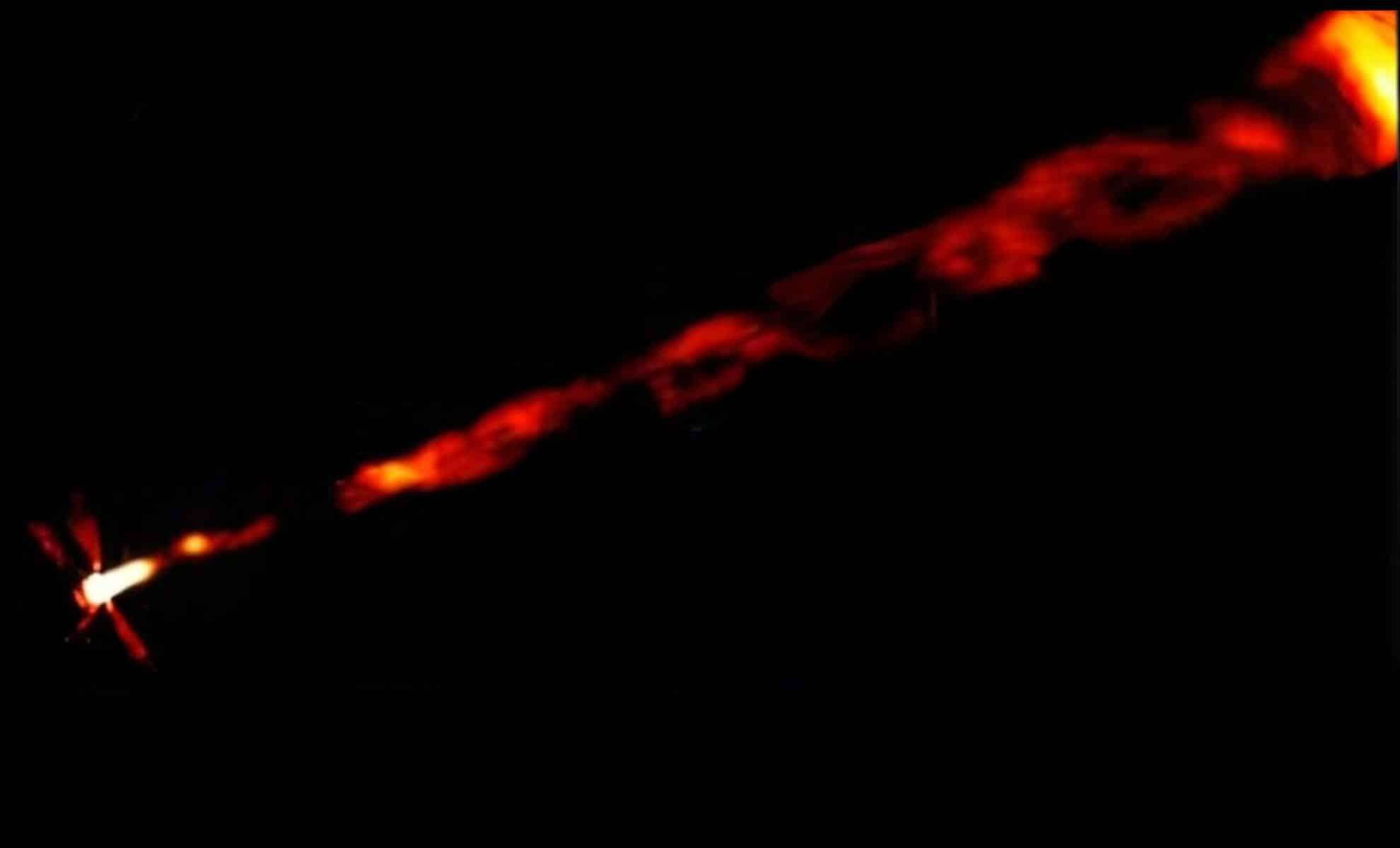
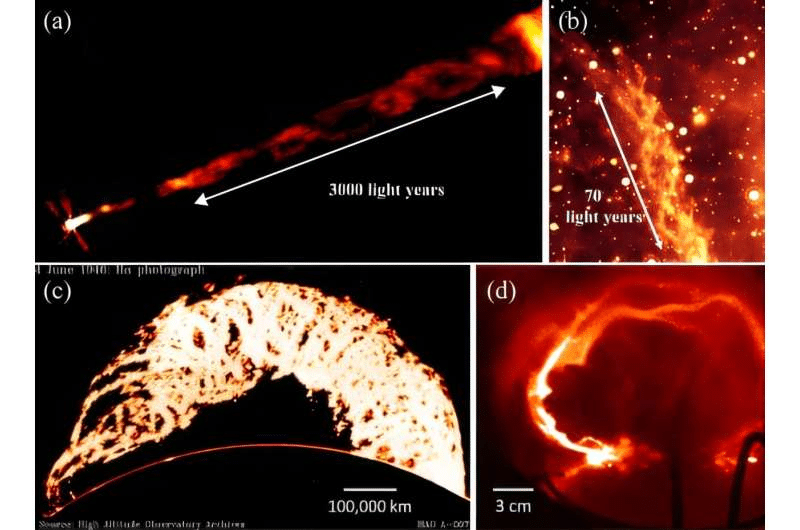
Scientists at the California Institute of Technology (Caltech) have made a pivotal breakthrough in understanding braided magnetic flux ropes — twisted plasma structures threaded with magnetic fields. These formations appear not only in laboratory settings but also in massive cosmic entities like the Double Helix Nebula. Their study, featured in Physical Review Letters, reveals striking similarities in the behavior of these flux ropes across vastly different scales.
Exploring the Nature of Magnetic Flux Ropes: Solar Flares to Controlled Experiments
Magnetic flux ropes—spiraled strands composed of plasma and magnetic fields—are essential to the dynamics seen in the Sun’s outer atmosphere. These structures are central to processes such as solar flares, transient bursts of energy caused by magnetic field activity. By better comprehending how these ropes form and behave, scientists can deepen their insight into solar events and their impact on space weather.
Researchers Paul Bellan and Yang Zhang at Caltech have advanced this understanding by successfully recreating magnetic flux ropes under laboratory conditions. Their method involves ionizing gas between two electrodes inside a vacuum chamber with an applied magnetic field generated by coils. As a result, they produce braided ropes that closely resemble those found in astronomical observations. Yang describes the setup: “Two electrodes are set within a vacuum chamber, surrounded by coils generating a magnetic field. High voltage ionizes the gas, creating plasma that forms the braided structures.”

The Mechanics of Braided Magnetic Structures
The distinctive feature of Bellan and Zhang’s flux ropes is the intricate braiding of multiple strands. Although single flux ropes have been extensively studied, the dynamics of braided ropes—particularly those with parallel current flows along each strand—remained elusive. “We’ve uncovered the underlying physics responsible for these braided formations,” Bellan states.
The key lies in the interplay of magnetic forces within the ropes. Each helical strand carries an electric current, producing both attractive and repulsive magnetic interactions. Bellan explains, “Two currents flowing parallel along intertwined helices experience attraction, while currents wrapped in opposite directions generate repulsion.”
These competing forces balance at a precise helical angle, known as the critical angle. If the ropes twist too tightly, magnetic repulsion dominates, whereas looser twists enhance attraction. At this equilibrium, the braided structure attains its minimum energy configuration, maintaining stability.
Applying Laboratory Discoveries to the Universe at Large
A fascinating outcome of this work is the demonstration of magnetohydrodynamics equations’ scalability. Although Bellan’s experiments occur on a small scale, the principles translate to immense cosmic settings like the Double Helix Nebula thousands of light years away. Bellan emphasizes, “Magnetized plasma physics is incredibly scalable; the same laws govern what we see in labs and across the universe.”
This universality unites plasma behavior in controlled experiments and in highly energetic celestial environments such as solar flares and interstellar magnetic structures.
Magnetic Flux Ropes’ Significance for Space Weather Prediction
Beyond fundamental physics, magnetic flux ropes critically influence space weather, which affects satellite communications, GPS operations, and power grids on Earth. Improving comprehension of their dynamics helps scientists anticipate disruptive solar phenomena. Robust models describing flux rope behavior enhance forecasting capabilities for solar and geomagnetic disturbances.
The ability to generate solar-like braided flux ropes in the lab provides a valuable platform for experimental studies on space weather. Bellan explains, “Balancing attractive and repulsive forces produces a critical helical angle that stabilizes these ropes. Our findings enhance understanding of solar magnetic dynamics and can advance prediction models for space weather impacts.”
- Categories:
- News









0 comments
Sign in to Comment