
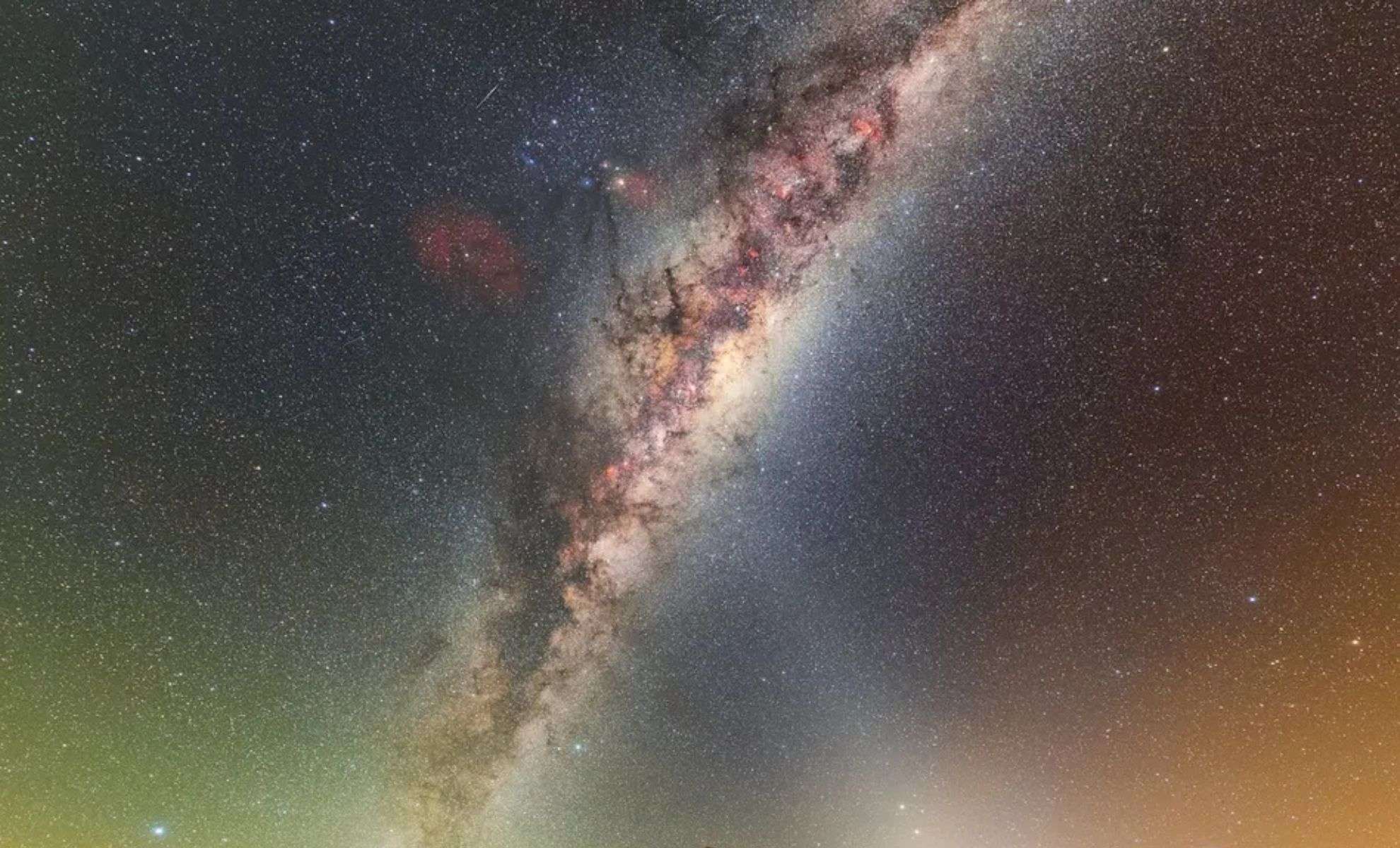
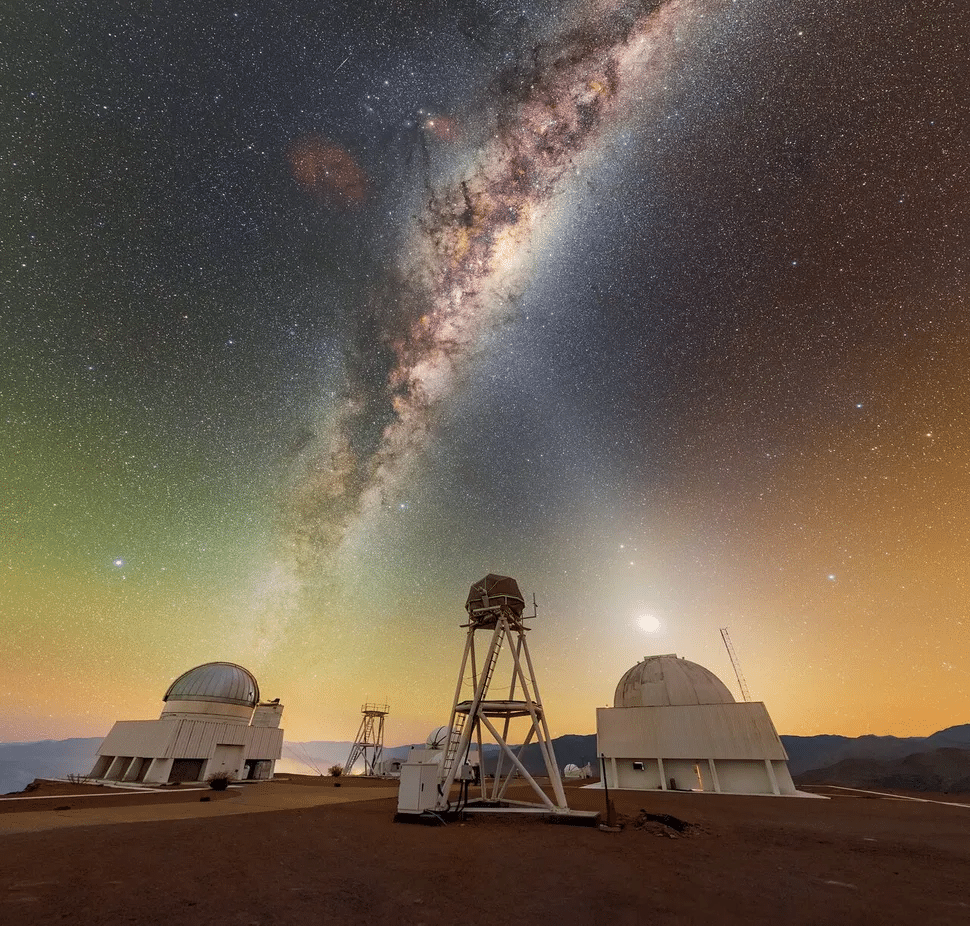
Astrophotographer Petr Horálek has unveiled a spectacular celestial scene over Chile, showcasing an extraordinary conjunction of two cosmic marvels. His 2022 photograph, taken at the Cerro Tololo Inter-American Observatory (CTIO), reveals not only the luminous core of our Milky Way galaxy but also the elusive zodiacal light—an ethereal glow rarely seen by casual skywatchers. Perched high in the Andes, the observatory offers an unparalleled vantage point to capture these two phenomena side by side, emphasizing the intricate beauty of our cosmic neighborhood.
The Radiant Center of the Milky Way: An Astronomical Treasure
The Milky Way, our galactic home that harbors our solar system, has long fascinated astronomers, especially those in the Southern Hemisphere. The dense, star-packed nucleus of the galaxy passes through constellations such as Scorpius, Sagittarius, and Ophiuchus—constellations that are prominent in southern skies. Observatories like CTIO, situated at 7,200 feet (2,200 meters) elevation, benefit from exceptionally clear and dark conditions, unveiling a spectacular cascade of stars, nebulae, and other celestial wonders. This pristine environment allows astrophotographers like Horálek to capture dazzling images of the Milky Way’s core that are difficult to obtain elsewhere on Earth.
This photograph not only illuminates the brilliance of the galaxy’s center but also underscores the richness of the celestial tapestry visible from southern latitudes. High-altitude observatories provide astronomers with minimal atmospheric interference, creating ideal conditions to explore the grandeur of our galaxy. The presence of the Milky Way overhead serves as a powerful reminder of the universe’s vast scale and our place within it, inspiring curiosity and wonder about what lies beyond.

Unveiling Zodiacal Light: A Subtle Solar System Glow
Alongside the Milky Way, Horálek’s image captures the faint yet captivating zodiacal light. This subtle glow arises from sunlight scattering off fine cosmic dust distributed throughout our solar system, originating from sources such as asteroids, comets, and possibly leftover remnants from planet formation. Despite its gentle luminance, zodiacal light is notoriously hard to spot—especially in urban areas with light pollution or under brighter night skies—making sightings in remote locations like the Andes particularly special.
Zodiacal light best reveals itself during twilight hours, forming a triangular beam stretching along the ecliptic—the Sun’s apparent path across the sky. This phenomenon is most prominent around the equinoxes and is sometimes dubbed “false dawn” or “false dusk,” depending on whether it appears in the early morning or evening. It takes its name from the zodiac constellations through which this glow passes, allowing us a rare glimpse of interplanetary dust within our own solar neighborhood.
A Rare Convergence of Celestial Phenomena
The rare encounter of the Milky Way and zodiacal light in a single frame presents a remarkable cosmic portrait. While the Milky Way represents a vast, distant galaxy made up of countless stars and nebulae millions of light-years away, zodiacal light is a more immediate, solar system-related effect caused by sunlight reflecting off tiny particles nearby. Both phenomena, though different in scale and origin, connect us with the wider universe—from star formation to the dusty remnants orbiting our Sun.
Observatories like CTIO, situated above much of Earth’s atmospheric disturbance, provide the crucial clarity required to witness such delicate celestial features. It is this remarkable combination of the bright galactic core and the soft zodiacal glow that Horálek’s photograph so beautifully preserves, inviting viewers to appreciate the profound complexity and allure of the cosmos.
Southern Hemisphere Observatories: Unlocking the Mysteries Beyond
The Southern Hemisphere’s unique vantage offers unparalleled access to the Milky Way and a host of distant astronomical targets, making it vital for cutting-edge research. Facilities like CTIO, operated by the National Optical-Infrared Astronomy Research Laboratory (NOIRLab), are nestled in remote, high-altitude regions to maximize observational clarity without interference from artificial light or atmospheric haze. Scientists working at these observatories have made significant strides in understanding stellar birth, galactic behavior, and the elusive dark matter that dominates much of the universe’s mass, underscoring the global importance of southern sky research.
- Categories:
- News






0 comments
Sign in to Comment