
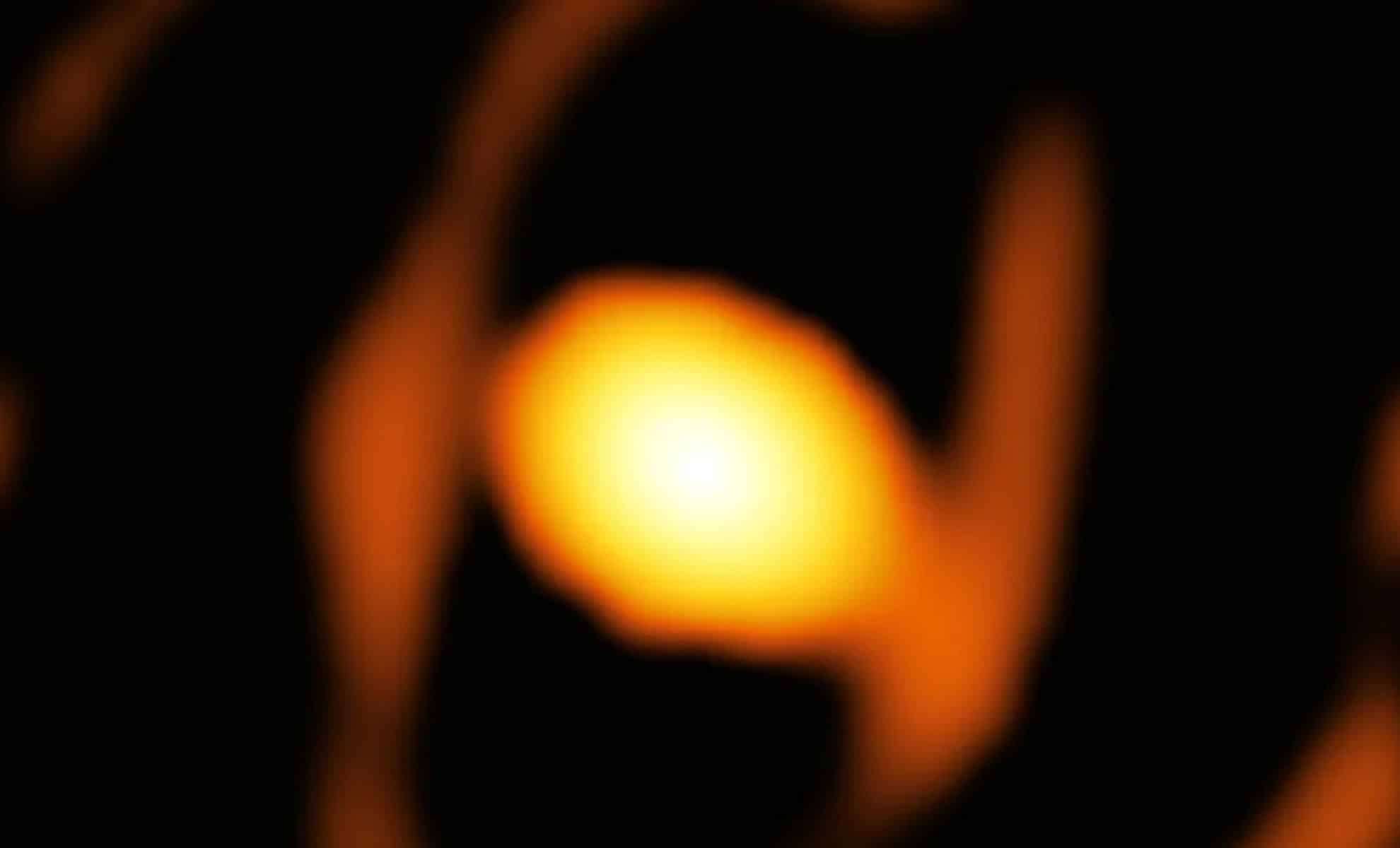
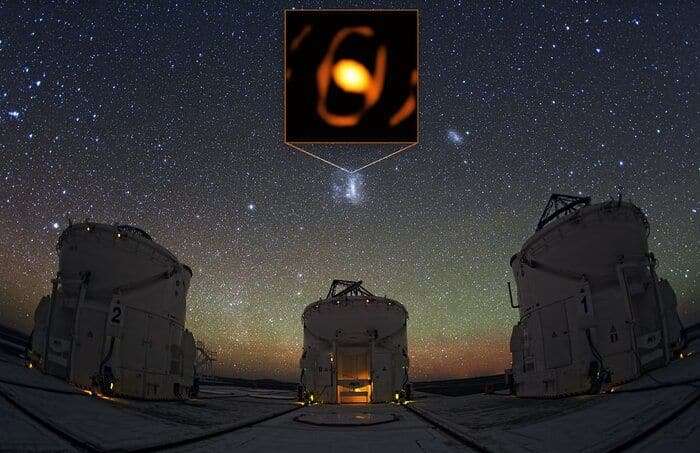
Scientists have obtained the first detailed image of WOH G64, an enormous red supergiant situated 160,000 light-years away in the Large Magellanic Cloud. Utilizing the capabilities of the Very Large Telescope Interferometer (VLTI) in Chile, researchers unveiled the star encased in a dense, oval-shaped envelope of gas and dust. This groundbreaking observation provides a unique glimpse into the late-life stages of a star beyond our galaxy.
Measuring more than 2,000 times the diameter of the Sun, WOH G64 is among the largest stars known. These new observations shed light on the life cycle of massive stars, particularly how they lose their outer layers before culminating in dramatic supernova explosions. This milestone advances our understanding of stellar giants and their final phases.
Mapping the Surrounding Envelope of WOH G64
The VLTI revealed a complex, uneven circumstellar envelope enveloping WOH G64, composed of material expelled as the star undergoes intense mass loss. Unlike the more uniform shells found around some stars, this envelope’s asymmetric shape indicates the presence of dynamic influences such as stellar winds, magnetic activity, or gravitational effects from a companion star.

Keiichi Ohnaka, leading the research at Andrés Bello National University in Chile, remarked, “For the first time, we have succeeded in taking a zoomed-in image of a dying star in a galaxy outside our own Milky Way. We discovered an egg-shaped cocoon closely surrounding the star.”
This discovery highlights how massive stars interact with their surroundings, periodically shedding material that enriches space with elements essential for forming new stars and planets.
Tracking the Star’s Fading Light and Ejected Matter
WOH G64 has exhibited noticeable dimming over the past ten years, attributed to the increasingly dense material surrounding it. As the star ejects gas and dust, these particles absorb and scatter its light, reducing its observed brightness.
This dimming links to intensified phases of mass loss, where turbulence within the star’s outer layers causes localized bursts of ejection. Gerd Weigelt from the Max Planck Institute for Radio Astronomy explained, “We have found that the star has been experiencing a significant change in the last 10 years, providing us with a rare opportunity to witness a star’s life in real-time.”
Studying these brightness fluctuations helps connect observable signals to the underlying processes driving material loss in red supergiants.
High-Definition Imaging Highlights Irregular Structures
The detailed structure of WOH G64’s circumstellar envelope was revealed through observations made with the GRAVITY instrument installed at the VLTI. By coherently combining light from several telescopes, this technology effectively mimics a much larger instrument, allowing astronomers to resolve complex and asymmetric features around the star.
Ohnaka emphasized the importance of this breakthrough, stating, “We are excited because this may be related to the drastic ejection of material from the dying star before a supernova explosion.”
Achieving this level of detail marks a major advancement, enabling scientists to explore how stellar winds, magnetic forces, and gravity interact to sculpt the final environment around massive stars.
Approaching the Supernova Phase of WOH G64
As a red supergiant nearing the end of its life cycle, WOH G64 is experiencing elevated mass loss, signaling its impending core collapse. When the internal pressure can no longer counteract gravity, the star will explode in a supernova, releasing tremendous energy and scattering heavy elements into space.
The exact timing of this explosion is still unknown but could occur in thousands of years. The aftermath will likely result in the formation of either a black hole or a neutron star, dependent on the remaining core mass.
Jacco van Loon, director of Keele Observatory, commented, “This star is one of the most extreme of its kind, and any drastic change may bring it closer to an explosive end.”
Enhancing Our Understanding of Massive Star Life Cycles
The intricate imaging and analysis of WOH G64 mark significant progress in decoding the terminal phases of massive stars. By examining the irregularities and changes in its circumstellar envelope, astronomers can better interpret the physical forces influencing stellar transformation.
As reported by Space.com, this research lays the groundwork for a deeper comprehension of similar stars both within the Milky Way and in other galaxies. The study underscores the value of advanced telescopic instrumentation and international scientific collaboration in uncovering the secrets of the cosmos.
With WOH G64 on the verge of its final act, these observations provide a remarkable glimpse into the powerful cosmic phenomena driving the life and death of stars across the universe.
- Categories:
- News







0 comments
Sign in to Comment