

Imagine if space wasn’t simply an empty void but behaved like a dense, viscous fluid flowing through the cosmos. A groundbreaking new hypothesis suggests just that, potentially addressing inconsistencies between established cosmic theories and the latest observational data.
Physicist Muhammad Ghulam Khuwajah Khan from the Indian Institute of Technology in Jodhpur presents this innovative view, proposing that the fabric of space might stretch and move in a manner comparable to honey, subtly resisting the expansion forces acting on the universe.
Are Current Cosmological Models Losing Ground?
This research arrives amid growing challenges to the widely accepted ΛCDM model (Lambda Cold Dark Matter), which has traditionally served as the backbone for explaining dark matter, dark energy, and universal expansion. Recent astronomical findings diverge from the model’s predictions, opening the door for Khan’s fluid-space concept to offer new insights.

Initially shared as a preprint on arXiv, the study doesn’t discard the ΛCDM framework completely but seeks to harmonize it with the unexpected fluctuations in cosmic expansion rates reported by the Dark Energy Spectroscopic Instrument (DESI) in Arizona and the Dark Energy Survey in Chile. These results hint that dark energy’s influence might not remain constant as once believed.
Rethinking the Cosmological Constant
Central to our current understanding is the cosmological constant, symbolized by the Greek letter Lambda (Λ), which describes the stable energy density of space. This constant energy density is key to explaining why galaxies keep moving apart, driven by the force known as dark energy.
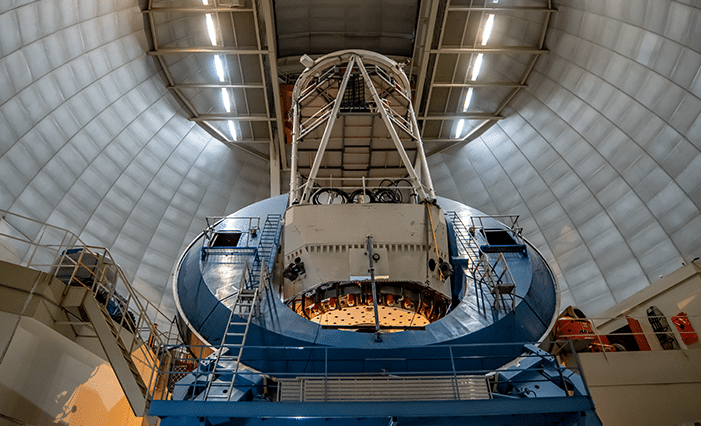
Yet, observations from DESI and the Dark Energy Survey challenge this constancy. According to Futurism, findings indicate the universe’s expansion rate is not uniform, suggesting the effect of dark energy diminishes over time—a phenomenon at odds with a fixed energy density.
Introducing Spatial Phonons and a Flexible Cosmos
Khan’s proposal brings the idea of “spatial phonons,” which he defines as vibrations arising within the structure of space due to atomic-scale activity. These phonons generate waves of tension that gently oppose the accelerating expansion of the universe.
Instead of an absolute void, space may resemble a viscous fluid: capable of deforming and resisting movement, akin to how honey slowly spreads across a surface. This friction-like property, as highlighted in the Futurism article, could explain the observed deviations from expected cosmic behavior.
In this framework, while dark energy continues to drive expansion, spatial phonons act as localized resisting forces, accounting for the uneven expansion rates documented in recent studies.
Though compelling, this theory is currently speculative. It awaits formal peer review and experimental evidence to verify the presence of spatial phonons or confirm that space behaves as a fluid.
- Categories:
- Physics






0 comments
Sign in to Comment