
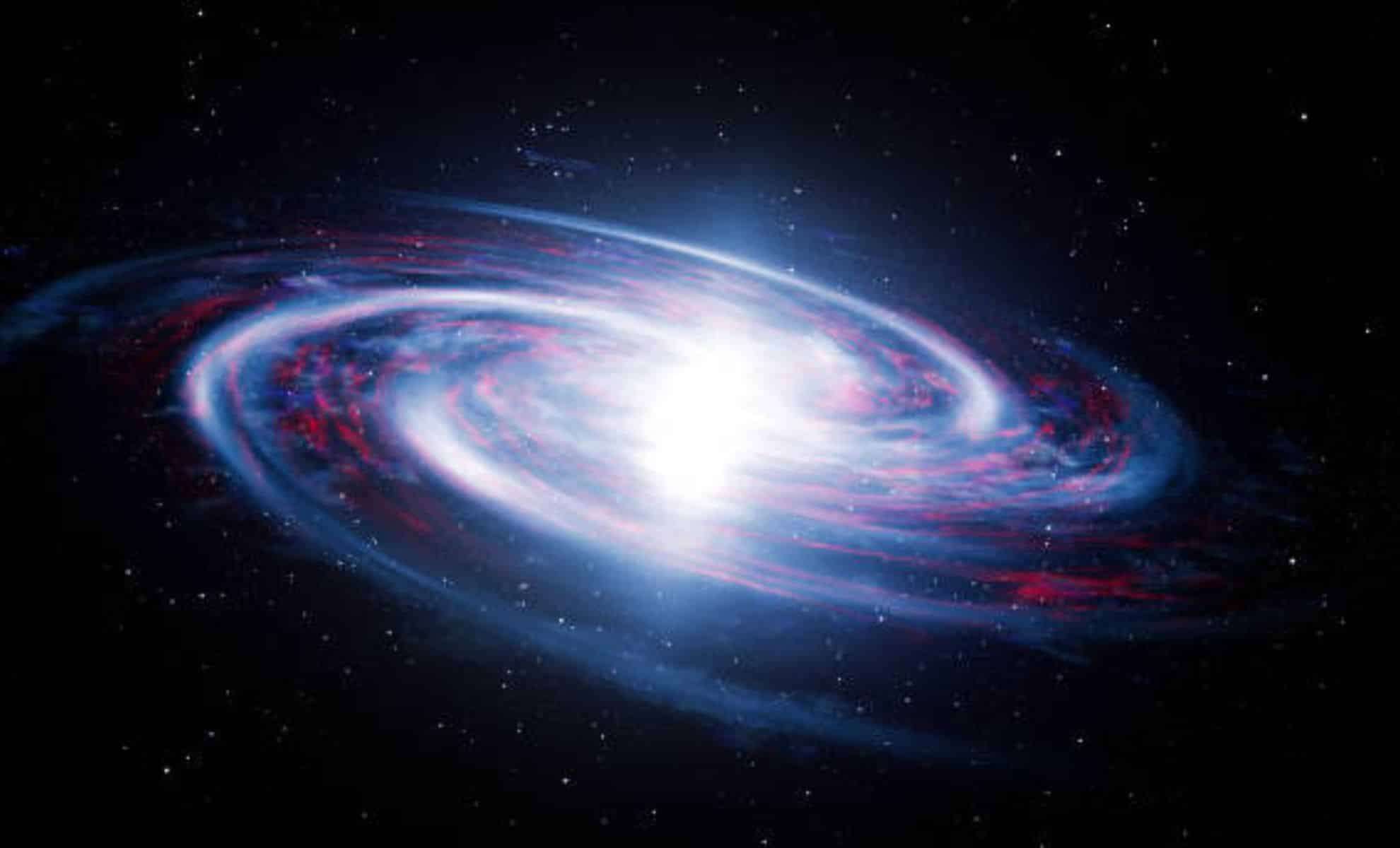
A subtle but profound twist in the cosmos might hold the solution to one of astronomy’s enduring challenges. A recent paper published in the Monthly Notices of the Royal Astronomical Society presents a theory from István Szapudi and colleagues at the University of Hawaiʻi suggesting the universe is slowly rotating, completing a full rotation every 500 billion years.
This gradual cosmic spin could help explain the persistent Hubble tension, a disagreement between current measurements of the universe’s expansion rate and estimates derived from early universe signals. If proven accurate, this idea would refine the standard cosmological framework without conflicting with established physics principles.
How a Slow Cosmic Rotation Could Reconcile Expansion Rate Differences
The Hubble tension describes a notable inconsistency between two methods of gauging the universe’s rate of expansion. Observations of distant supernovae imply a faster expansion than data from the cosmic microwave background (CMB), the relic radiation from the Big Bang, suggests.

To tackle this disparity, Szapudi’s team created a mathematical framework grounded in accepted physics but incorporated a minimal rotational component. Though the spin rate is staggeringly slow—requiring half a trillion years to complete a single turn—it successfully aligns the divergent expansion measurements.
“We were pleasantly surprised to see our rotation-inclusive model resolving the tension without conflicting with current astronomical data,” Szapudi noted. “Even better, it is consistent with other theories that allow rotation.”
Expanding the Universe’s Model Without Breaking Physics
Crucially, this rotational hypothesis respects general relativity and known physical laws. It proposes a subtle complexity: instead of uniform outward expansion in all directions, the cosmos may exhibit a faint spiraling motion.
“To echo Heraclitus, perhaps everything really does turn,” Szapudi remarked, invoking the ancient view that motion is fundamental to existence.
The researchers aim to advance their work by simulating how such an imperceptible cosmic spin could create measurable effects. Potential observations include tiny distortions in the cosmic background, distinctive gravitational wave signals, or subtle patterns in the distribution of galaxies previously unnoticed.
- Categories:
- News








0 comments
Sign in to Comment