
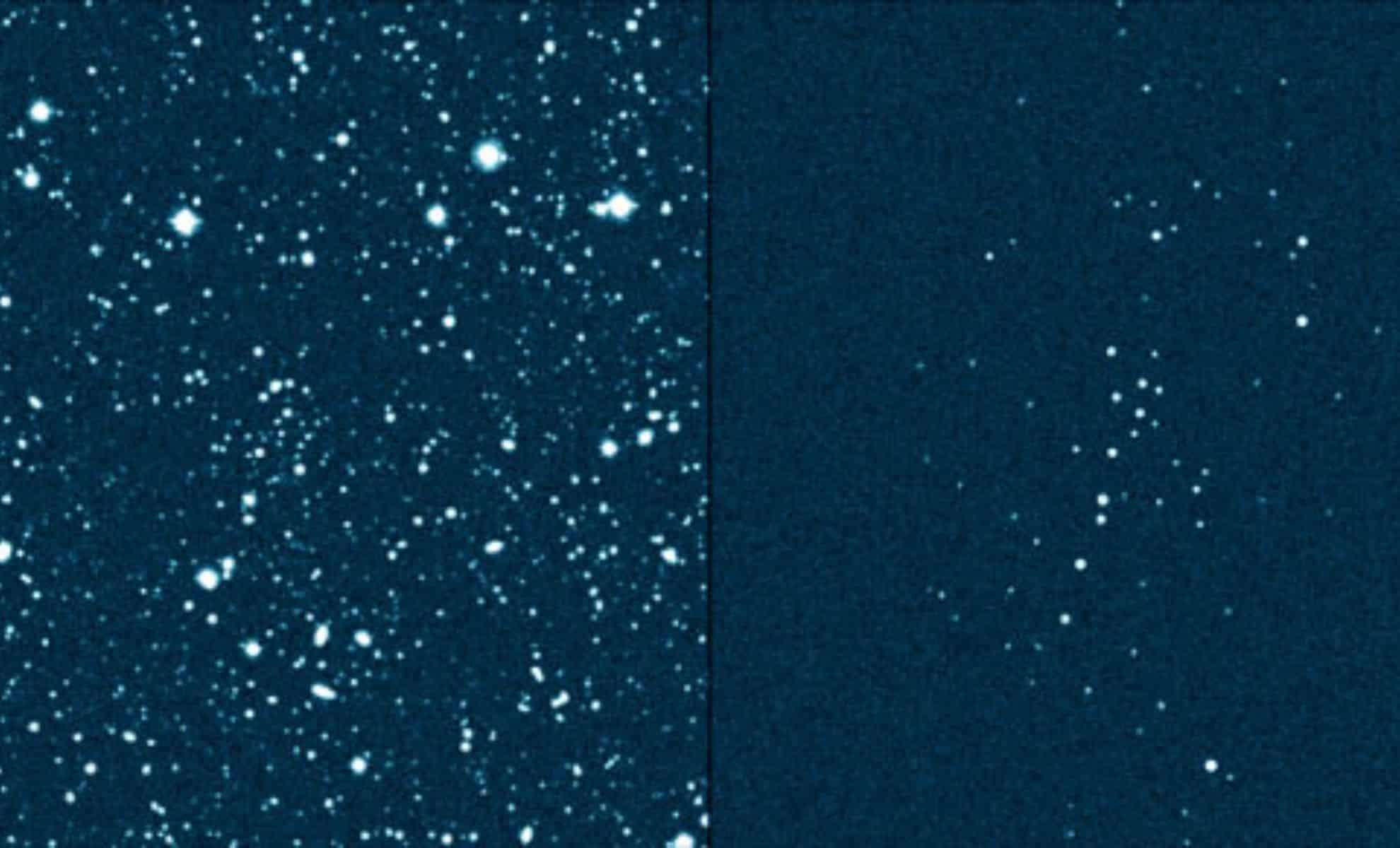
Astronomers have uncovered an extraordinary celestial body within the Ursa Major constellation, which may alter our concepts of what differentiates galaxies from star clusters. Known as UMa3/U1, this intriguing object has sparked debate about whether it represents the tiniest galaxy on record or an ancient star cluster. A recent investigation detailed in the Astrophysical Journal provides compelling evidence suggesting the presence of dark matter within it, a pivotal element in distinguishing galaxies from clusters of stars. This finding ignites new avenues for exploring Ultra-Faint Dwarfs (UFDs) and the influential role of dark matter in galaxy development.
Blurry Boundaries: Star Cluster or Galaxy?
Generally, the difference between galaxies and star clusters is unmistakable for larger bodies. Massive galaxies such as the Milky Way or Andromeda comprise sprawling assemblies of stars, strongly influenced by dark matter's gravitational pull. In contrast, star clusters like the Pleiades are smaller, gravitationally bound groups of stars without dominant dark matter halos. However, when dealing with smaller entities like Ultra-Faint Dwarfs, these distinctions become less clear-cut.
The object called UMa3/U1 spans a mere 20 light-years and contains roughly 60 stars. Despite its compact scale, it displays features hinting at a galactic nature. If confirmed as a galaxy, it would hold the record as the smallest known. Conversely, if it's a star cluster, it would rank among the oldest, aged approximately 11 billion years—noteworthy given the typical lifetimes of star clusters.

This ambiguity arises because UMa3/U1 shows characteristics shared by both galaxies and clusters. This has led researchers to employ multiple investigative approaches, concentrating mostly on deciphering its dark matter content and evaluating its resilience within the gravitational field of the Milky Way.
The Role of Dark Matter
Detecting dark matter is a major factor in classifying UMa3/U1. Dr. Raphaël Errani, an astrophysicist at Carnegie Mellon University, explains, “Accurate, repeated measurements of stellar velocities are critical to estimate the dark matter content in a dwarf galaxy.” As dark matter accounts for about 85% of the Milky Way’s mass, it underpins the gravitational forces that stabilize galaxies.
For UMa3/U1, the likelihood of dark matter is strengthened by its journey through the Milky Way’s interior. Dr. Smith notes, “Dark matter—distinctive of dwarf galaxies over star clusters—is likely present because the satellite’s orbit penetrates the Milky Way’s inner regions, where gravitational tidal forces peak.” Should dark matter dominate, it would provide the gravitational cohesion needed to withstand those tidal forces that typically disrupt star clusters.
Enduring the Milky Way’s Gravitational Strength
The orbit of UMa3/U1 critically influences its potential galaxy classification. The gravitational forces exerted by our galaxy should be capable of dismantling an ordinary star cluster. Dr. Smith adds, “Without sufficient dark matter binding it together, the object would not have persisted on such an orbit; tidal forces would have torn it apart.” This implies that dark matter’s gravitational grip prevents the object’s destruction amid the Milky Way’s intense tidal environment.
If UMa3/U1 is truly dark-matter-dominated, it would rank among the most dark matter-rich galaxies known despite its scale. This is exceptional because galaxies typically have dense star clusters centrally, while star clusters have a more dispersed structure lacking such gravitational dominance. Confirming UMa3/U1 as a galaxy could greatly enhance understanding of galaxy formation and evolution, especially for early universe structures.
A Groundbreaking Achievement
The discovery holds significant weight. Dr. Julio Navarro from the University of Victoria emphasizes, “This milestone aligns perfectly with predictions from the LCDM model.” The Lambda Cold Dark Matter theory proposes dark matter as essential in forming galaxies, particularly faint, dark matter-heavy dwarfs like UMa3/U1. Validating this object would offer direct support for this framework and potentially transform perspectives on galactic origins.
Identifying a dark matter-rich galaxy on such a small scale challenges prevailing ideas about galaxy sizes and makeup. UMa3/U1 could be not only the smallest galaxy identified but also one of the faintest and most dominated by dark matter in the cosmos.
- Categories:
- News










0 comments
Sign in to Comment