
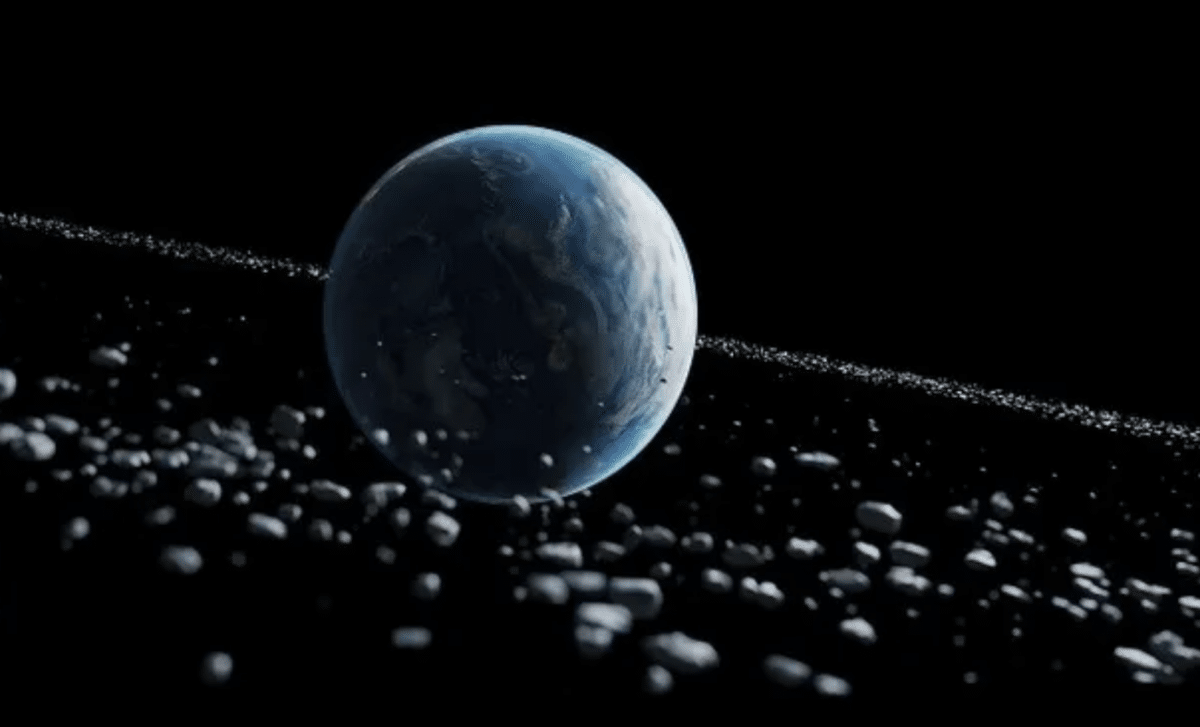
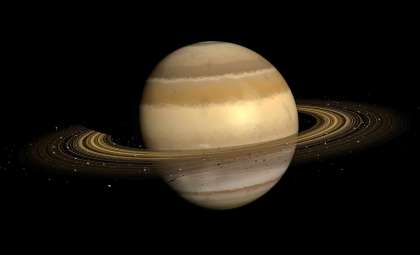
A groundbreaking new study featured in Earth and Planetary Science Letters reveals that Earth may have once been surrounded by a colossal ring system, reminiscent of Saturn’s rings. Composed of countless space debris, this ring could be the reason behind a notable increase in meteorite impacts dating back millions of years. These findings offer fresh insights into Earth's ancient environment and how celestial events could have influenced its geological and climatic history.
An Ancient Asteroid Ring: Earth’s Lost Swirl of Debris
The hypothesis that a vast ring once encircled Earth is supported by compelling scientific data. Published in the journal Earth and Planetary Science Letters, the research is led by Professor Andy Tomkins of Monash University. It focuses on a period around 466 million years ago in the Ordovician era, a time marked by significant geological upheaval. The team analyzed global asteroid impact crater locations from this era and uncovered a remarkable pattern: impacts were predominantly clustered near the equator.
This pattern points to the possibility that a large asteroid or cluster of fragments was torn apart by Earth's tidal forces, giving rise to a ring structure similar to that of Saturn. The Roche limit, which defines the distance within which tidal forces can disintegrate orbiting objects, likely influenced this ring's creation. Over thousands of years, debris from this ring slowly descended onto Earth, triggering an upsurge in meteorite impacts.

“Over millions of years, material from this ring gradually fell to Earth, creating the spike in meteorite impacts observed in the geological record,” said Professor Tomkins.
This remarkable assertion highlights the ring’s role in boosting meteorite bombardment during the Ordovician. Sedimentary rock layers from this era contain unusually high concentrations of meteoritic material, indicating sustained debris influx onto Earth's surface over an extended timeframe.
Climatic Consequences: The Ring’s Role in Ancient Cooling
Beyond its impact-related significance, the hypothesis extends into climatic effects. The Ordovician period experienced one of the most pronounced global temperature drops in Earth's last 500 million years, and the study suggests the ancient ring may have contributed to this cooling episode.
Professor Tomkins emphasized that the ring’s presence could have influenced global temperatures, adding a new dimension to our understanding of how external cosmic phenomena can affect Earth's climate systems.
“The idea that a ring system could have influenced global temperatures adds a new layer of complexity to our understanding of how extra-terrestrial events may have shaped Earth’s climate,” he said.
This implies that meteorite dust and debris might have partially blocked sunlight or altered atmospheric composition, contributing to the cooling trend observed during that era.
By connecting celestial events to climate shifts, the findings open new avenues for interpreting Earth’s paleoclimate and may aid in forecasting future climate variations driven by extraterrestrial influences.
Unusual Crater Concentrations Signal a Past Ring
One of the most compelling aspects of the study is the unusual geographic distribution of impact craters. Researchers mapped 21 ancient Ordovician craters and found they all lie within 30 degrees north or south of the equator—a striking concentration given that less than 30% of Earth’s landmass is within this zone.
The odds of this many impacts randomly occurring so close to the equator are extremely low, comparable to repeatedly rolling a three-sided die and always landing on the same number 21 times in a row. This rare alignment strongly supports the theory that Earth's early ring system was responsible, with gravity guiding ring debris into equatorial impact zones.
This extraordinary crater pattern bolsters the idea that Earth endured a period of intense cosmic bombardment influenced by a temporary but massive asteroid ring encircling the planet.
- Categories:
- Astronomy





0 comments
Sign in to Comment