
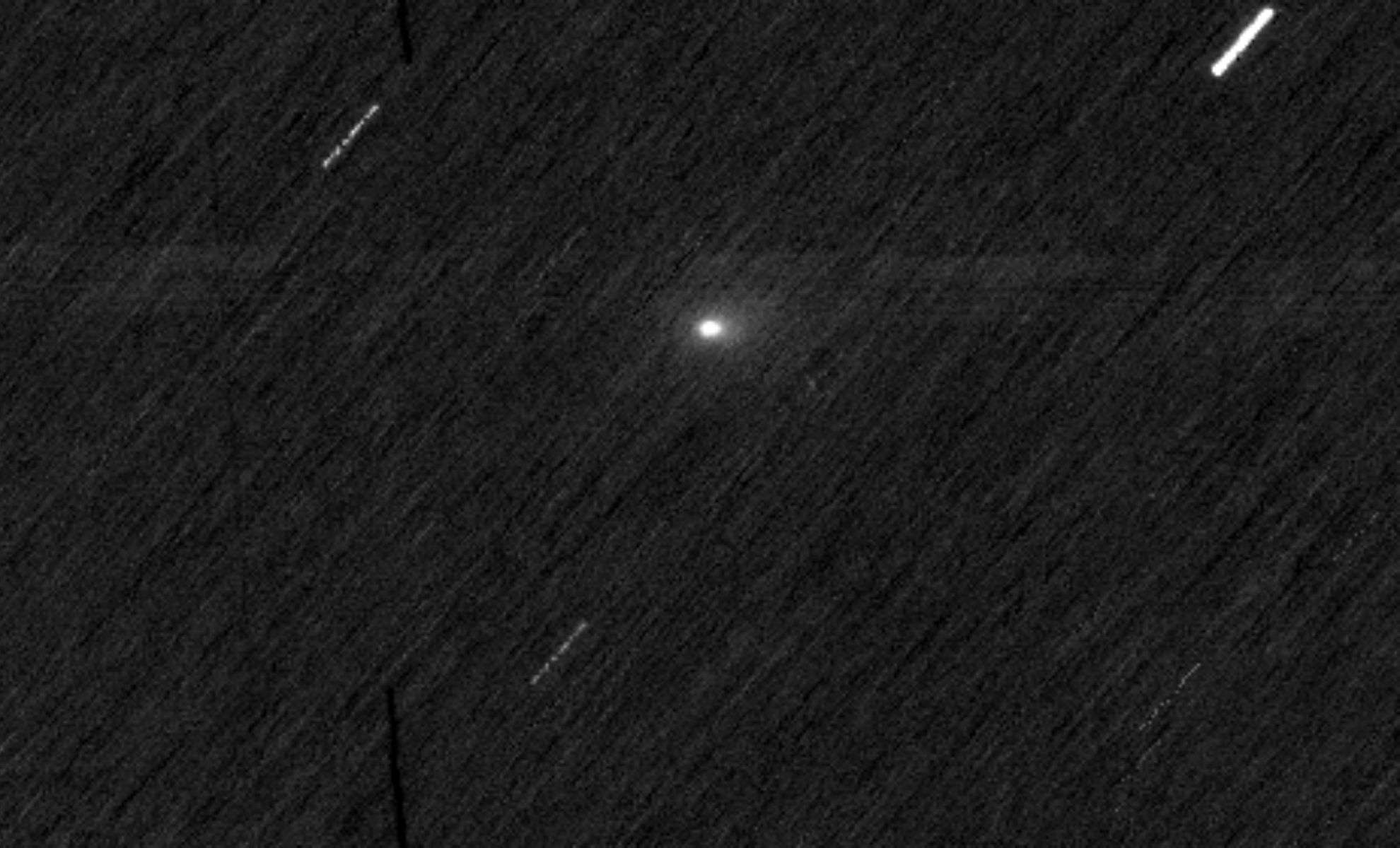
The European Space Agency (ESA) has shared new information regarding the recent flyby of the interstellar comet 3I/ATLAS as it passed close to Mars in early October 2025. Its extraordinary velocity and path have stirred wide interest and speculation, including theories suggesting it might be of alien origin. As tracking efforts continue, researchers are assembling details to unravel its nature.
Initially spotted earlier this year by NASA’s ATLAS telescope in Chile, 3I/ATLAS is just the third confirmed interstellar visitor detected within our solar system. Traveling at an astonishing speed exceeding 41 miles per second, this comet has captivated scientists worldwide. It moves too rapidly to be caught by the Sun’s gravitational pull, assuring its departure back into the depths of space. Despite its peculiar traits and speed, ESA along with other space agencies emphasize it poses no danger.
ESA Contributes to Tracking Comet 3I/ATLAS
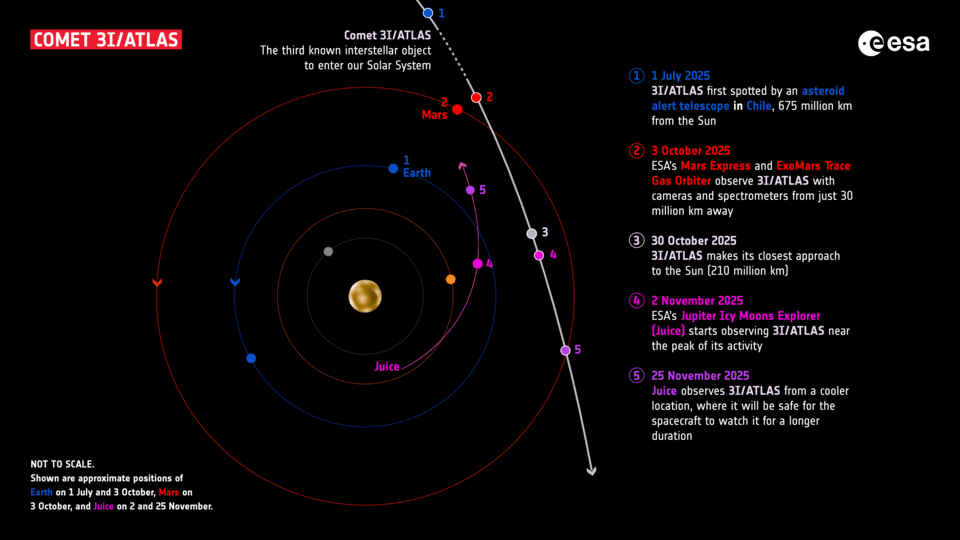
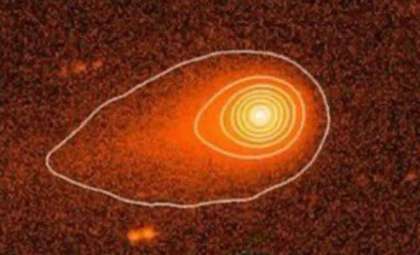
The ESA’s ExoMars Trace Gas Orbiter, primarily dedicated to examining Mars’ atmosphere, redirected its instruments to study 3I/ATLAS between October 1 and 7, 2025. At that time, the comet was roughly 18.6 million miles away from the spacecraft. Observing such a dim target from afar presented challenges, yet ESA researchers succeeded in collecting valuable measurements during this infrequent encounter.

Nick Thomas, lead scientist for ExoMars’ imaging system, highlighted the difficulty in capturing the comet’s images: “The comet appears between 10,000 and 100,000 times fainter compared to our typical targets,” he elaborated. Nonetheless, the information obtained will shed light on the comet’s makeup and its voyage through the solar system.
☄️ #3I/ATLAS comet update!
On 3 October, our ExoMars Trace Gas Orbiter (TGO) turned its eyes towards interstellar comet 3I/ATLAS as it passed close to Mars.
Together with Mars Express, ExoMars TGO had the closest view of the comet of all of our spacecraft. It looked towards the… pic.twitter.com/HJE1CeaEwq— European Space Agency (@esa) October 7, 2025
Is 3I/ATLAS a Sign of Extraterrestrial Technology?
Because of its remarkable speed and distinctive orbit, some have proposed that 3I/ATLAS may not be a typical comet. Harvard astrophysicist Avi Loeb has speculated that the object could be artificial, possibly linked to alien technology. Loeb emphasizes the need for humanity to consider potential encounters with extraterrestrial artifacts.
“We are worried about existential threats from artificial intelligence, from global climate change, from an asteroid impact, but we never discuss alien technology,” Loeb remarked.
Despite the intriguing theories, ESA and NASA experts agree that 3I/ATLAS is almost certainly a natural comet. Observations confirm its typical cometary characteristics, providing little support for the artificial origin ideas. Nonetheless, the mystery fuels ongoing debate about life beyond Earth.
Ensured Safety: No Danger to Our Planet
As 3I/ATLAS continues exiting the solar system, space agencies are certain it does not endanger Earth. The comet is expected to reach its closest point to the Sun near Halloween 2025, after which it will travel back into interstellar space. The European Space Agency confirms it will pass no closer than 170 million miles from Earth, eliminating any risk.
While 3I/ATLAS has generated significant excitement, especially regarding the search for extraterrestrial life, scientists conclude it remains a unique comet passing through our solar neighborhood. Continuous ESA monitoring improves understanding of interstellar visitors and their behavior within our cosmic environment.










0 comments
Sign in to Comment