

Fresh imagery from the European Space Agency’s Mars Express spacecraft showcases an immense geological rupture called Aganippe Fossa on the Martian surface.
This striking feature is a graben—a sunken elongated valley bordered by steep cliffs—spanning approximately 375 miles (600 kilometers), surpassing the length of the Grand Canyon.
The high-resolution photographs deepen our understanding of Mars’ complex geological evolution and offer new clues about the planet’s active geological past.

In-Depth Views from Mars Express
Since its arrival at Mars in 2003, the Mars Express orbiter has been capturing valuable data. On December 13, 2023, it snapped these detailed images showcasing the fine structure of Aganippe Fossa and its adjacent surroundings.

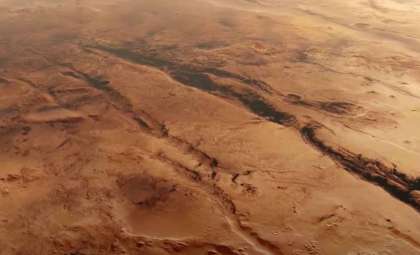
The terrain on the western flank features an array of uneven mounds, ridges, and grooves, whereas the eastern side is smoother and marked by distinctive striped rock formations reminiscent of zebra patterns.
ESA experts suggest that these contrasting surface textures are likely the result of differential wind erosion, noting, “This stark difference was likely caused by historic wind erosion to the right of the graben, which wore down the planet’s surface in that area. However, it is unclear why the rest of the surrounding landscape was unaffected.”
Formation and Geological Importance
Aganippe Fossa is located near Arsia Mons, one of Mars’ largest volcanoes, situated on the expansive Tharsis plateau. This geologically active zone also houses two other prominent volcanoes—Pavonis Mons and Ascraeus Mons—as well as the tallest volcano in the solar system, Olympus Mons.
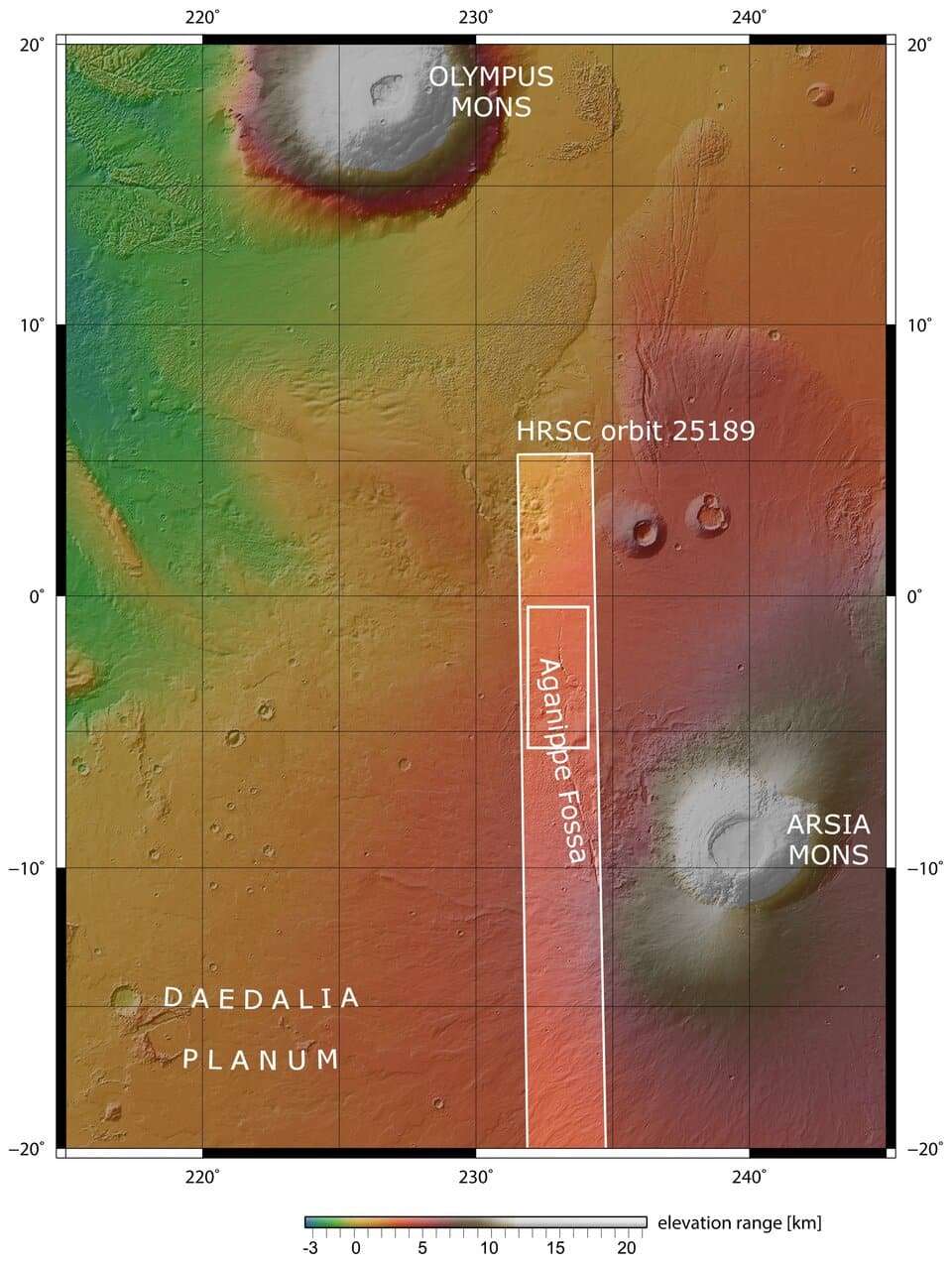
The creation of Aganippe Fossa is thought to have occurred as a result of magma accumulating beneath Arsia Mons, leading to the stretching and fracturing of Mars’ crust. Representatives from ESA commented, “We’re still unsure of how and when Aganippe Fossa came to be, but it seems likely that it was formed as magma rising underneath the colossal mass of the Tharsis volcanoes caused Mars’s crust to stretch and crack.”
This geological development highlights the volcanic and tectonic forces that have shaped the Martian landscape over millions of years.
Martian Landform Comparisons
Although Aganippe Fossa exceeds the Grand Canyon in length, it remains much shorter than the colossal Valles Marineris canyon, which extends over 2,500 miles (4,000 kilometers) across Mars’ equator and holds the title of the solar system’s largest canyon.
Graben formations also appear in Noctis Labyrinthus, a canyon system comparable in size to Italy, positioned between Tharsis and Valles Marineris. These varied topographies underscore Mars’ rich and diverse geological features.
ESA clarified, “Aganippe Fossa is one of many classical albedo features on Mars, which refers to the light and dark features that can be seen on the planet through even an Earth-based telescope.”
Continued Research and Exploration
The discoveries by Mars Express not only highlight Aganippe Fossa’s impressive characteristics but also offer new data that advance our knowledge of Martian geology. The Tharsis region, including Arsia Mons’ volcanic surroundings, remains a key focus for ongoing investigation.
Recent findings include a concealed massive volcano near Noctis Labyrinthus and the detection of over 150,000 tons of ice atop three Tharsis volcano peaks. ESA emphasized, “The mission has been immensely productive over its lifetime, creating a far fuller and more accurate understanding of our planetary neighbor than ever before.”
These latest images of Aganippe Fossa serve as a vivid testament to Mars’ active geological history and the remarkable tools employed in contemporary planetary exploration.
As Mars Express and other probes continue their surveys, they promise to unveil further secrets about Mars’ intricate surface processes and its evolution through time.
- Categories:
- Astronomy ,
- News









0 comments
Sign in to Comment