

New detailed images captured by the European Space Agency’s Mars Express mission showcase the remains of Mars’ once colossal lake.
Called Lake Eridania, this ancient body of water dwarfed all modern Earth lakes, offering critical clues about Mars’ watery history and its capacity to have supported life.
Discovering Mars’ Giant Lake Eridania
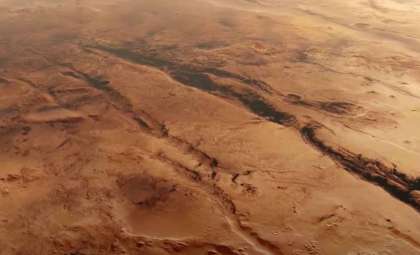
Located within the Caralis Chaos region, Lake Eridania’s basin unveils a complex terrain sculpted by water over eons—featuring ancient lakebeds, impact craters, and striking geological formations. ESA’s latest imagery exposes the remnants of this immense lake.

ESA scientists estimate Lake Eridania once held more water than all known Martian lakes combined, with a volume possibly exceeding three times that of Earth’s Caspian Sea. This starkly highlights the lake’s importance in piecing together Mars’ environmental past.
Mars Express has been orbiting Mars since 2003, focusing on the planet’s geology and surface evolution. The fresh images reveal eroded shorelines and sedimentary deposits from Lake Eridania, dating back approximately 3.7 billion years—an era when a thicker Martian atmosphere likely permitted stable lakes of liquid water.
Geological Structures of the Ancient Martian Lake
The Mars Express images reveal a vast crater partially filled with the lake’s remnants and sedimentary mounds formed by interactions of dust and water. The vivid color-coded topography highlights the varied features, with the former lakebed depicted prominently in blue.
These geological forms yield essential evidence about Mars’ climate evolution and the influence of water on shaping its landscape. ESA remarks on how Martian wind erosion helped shape the raised mounds now observed.

Alongside the large crater, smaller craters featuring gullies and long fault lines resembling fractures are visible. These indicate an active history involving water’s role in their development and later geological changes.
The interplay between water, wind, and the Mars surface has created a diverse geological record that scientists are eager to analyze. Understanding these features is key to reconstructing Mars’ ancient environment.

Water’s Role in Mars’ Potential for Life
Tracing the history of water on Mars is vital for researchers exploring the planet’s habitability. Since water is essential to life as we know it, investigating sites like Lake Eridania sheds light on past conditions favorable for biology.
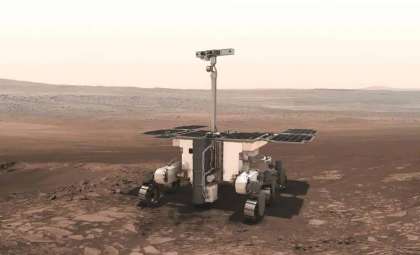
NASA’s Perseverance rover is actively examining Jezero Crater, another ancient lake deposit, for signs of past microbial life. Discoveries of organic compounds and chemical markers support the possibility that Mars may have supported life billions of years ago.
“The rock exhibits chemical signatures and structures that could possibly have been formed by life billions of years ago when the area being explored by the rover contained running water,” NASA stated. These ongoing studies are crucial in answering whether Mars ever hosted life. Ancient lakes like Lake Eridania add compelling targets in this quest.
Exploration Challenges and Future Mars Missions
The rugged remnants of Lake Eridania and other prehistoric lakes remain prime subjects for orbiters and rover investigations. NASA’s Jet Propulsion Laboratory describes the terrain as “rough and dangerous,” presenting difficulties for landing spacecraft. Nonetheless, future robotic or crewed missions may offer deeper insights.
Continuing to analyze Mars Express data alongside other mission findings is enriching our grasp of Mars’ development and its life-hosting potential.
These discoveries not only expand our comprehension of the Red Planet but also fuel enthusiasm for further exploration and the broader pursuit of understanding our solar system. Although Eridania’s harsh landscape poses challenges, its scientific promise makes it a compelling goal for future expeditions.
The images of Lake Eridania provide a powerful window into ancient Mars, showing a period when conditions were far more Earth-like. Each new Mars discovery brings us closer to unraveling the planet’s secrets and exploring the possibilities of extraterrestrial life. Studying Mars’ geological and environmental past is essential to piecing together the history and potential habitability of our cosmic neighborhood.









0 comments
Sign in to Comment