

Scientists have uncovered a new exoplanet circling Barnard’s star, the closest solitary star to our solar neighborhood, merely six light-years distant.
This planet, dubbed Barnard b, is a rocky body boasting at least half the mass of Venus and completes an orbit in just three Earth days. This discovery comes after five years of detailed study using advanced telescopes, offering fresh insights into nearby planetary systems.
Unveiling Barnard b
The detection of Barnard b represents a significant achievement stemming from years of dedicated research and enhanced technology. Utilizing the Very Large Telescope (VLT) at the European Southern Observatory (ESO) in Chile, astronomers observed the planet’s subtle gravitational influence via the radial velocity technique, which tracks the star's slight movements caused by an orbiting planet’s gravity. Critical to this find was the ESPRESSO instrument on the VLT, with confirmation supported by additional data from devices like HARPS at La Silla Observatory and CARMENES in Spain.

The discovery confirms earlier hints from 2018, which had suggested a planet near Barnard’s star but lacked conclusive evidence. Jonay González Hernández, principal researcher from the Instituto de Astrofísica de Canarias, remarked, “Despite taking considerable time, our confidence in detecting a planet never wavered.” After refining their methodology, the team verified Barnard b’s existence, demonstrating that this nearby star hosts planets.

Barnard’s star is located within the Ophiuchus constellation and serves as a critical target for exoplanet researchers. As the second-nearest star system after the Alpha Centauri group, it offers a prime environment to study planet formation around red dwarf stars—smaller, cooler stars than our Sun. Red dwarfs typically host smaller rocky planets, making Barnard b an excellent example of a low-mass exoplanet.
Properties of Barnard b
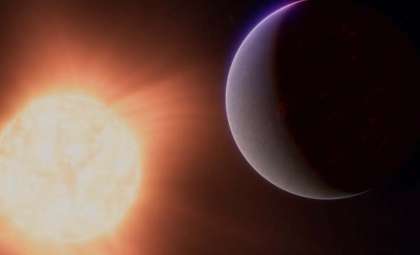
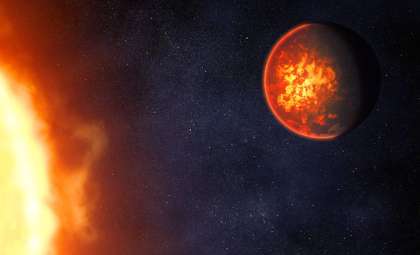
Barnard b’s characteristics are noteworthy due to its small size and the fact that it orbits extraordinarily close to its star—about 20 times nearer than Mercury’s distance from the Sun—completing an orbit in roughly 3.15 Earth days. Even though its star is cooler than the Sun, Barnard b has an estimated surface temperature near 125°C (257°F), too hot for liquid water to exist. As González Hernández noted, “Though the star is much cooler than the Sun, the conditions close-in still preclude liquid water.” This finding indicates the planet is uninhabitable but provides valuable data regarding planetary diversity close to home.
Among the smallest exoplanets found so far, Barnard b possesses a mass below Earth’s, being at least half as massive as Venus. Such discoveries add to the growing catalog of rockier, low-mass planets orbiting red dwarfs. These planets help astronomers better understand planetary formation around stars unlike our own. Since red dwarfs are more common than stars like the Sun, studying systems such as Barnard’s offers important clues about the universe’s planetary makeup.
Although Barnard's star produces far less heat and light than our Sun, Barnard b’s extremely close orbit keeps it hot. This underscores the difficulty of finding habitable planets around cooler stars. While Barnard b lies outside the star’s habitable zone, where life-sustaining liquid water could appear, it encourages the search for potential planets with more favorable conditions in the same system.
Future Prospects for Discovery
Besides Barnard b, researchers have spotted three other possible exoplanets orbiting Barnard’s star. These candidates await confirmation, as preliminary data suggests a multi-planet system. Observations continue using the ESPRESSO instrument, which offers the precision needed to detect and verify smaller worlds in this nearby star system. Study co-author Alejandro Suárez Mascareño stated, “Further observations are necessary to solidify other promising signals.”
The potential of multiple planets here supports the idea that multi-planet systems may be common even around nearby stars. Barnard b now joins a list of low-mass planets like Proxima b and Proxima d orbiting Proxima Centauri, our closest stellar neighbor. These findings suggest a wide diversity of planetary systems encircling stars near our own, each with unique features.
This breakthrough also highlights the power of precision instruments such as ESPRESSO and HARPS. Thanks to their sensitivity, astronomers are unveiling smaller and more distant exoplanets than ever before, enriching our understanding of planetary populations across the Milky Way.
- Categories:
- Astronomy ,
- News ,
- Science ,
- Space







0 comments
Sign in to Comment