

During a leisurely stroll on the shores of South Wales, 10-year-old Tegan made an astonishing find: enormous dinosaur footprints estimated to be over 200 million years old.
Unearthed in a region famed for its prehistoric significance, these footprints have thrilled paleontologists and reinforced Wales’ status as an emerging hotspot for dinosaur remains.
This incredible discovery enriches the area’s fossil archive and has renewed scientific curiosity about the ancient creatures that once inhabited this land.

Unveiling a Remarkable Discovery Along the Welsh Coastline
Tegan and her mother were enjoying time at the beach when they encountered five giant footprints pressed into the sand. The marks, spaced roughly 75 cm (30 inches) apart, towered far beyond human scale, instantly captivating the pair. Understanding the importance of their find, they promptly shared photos with specialists at the National Museum Wales.
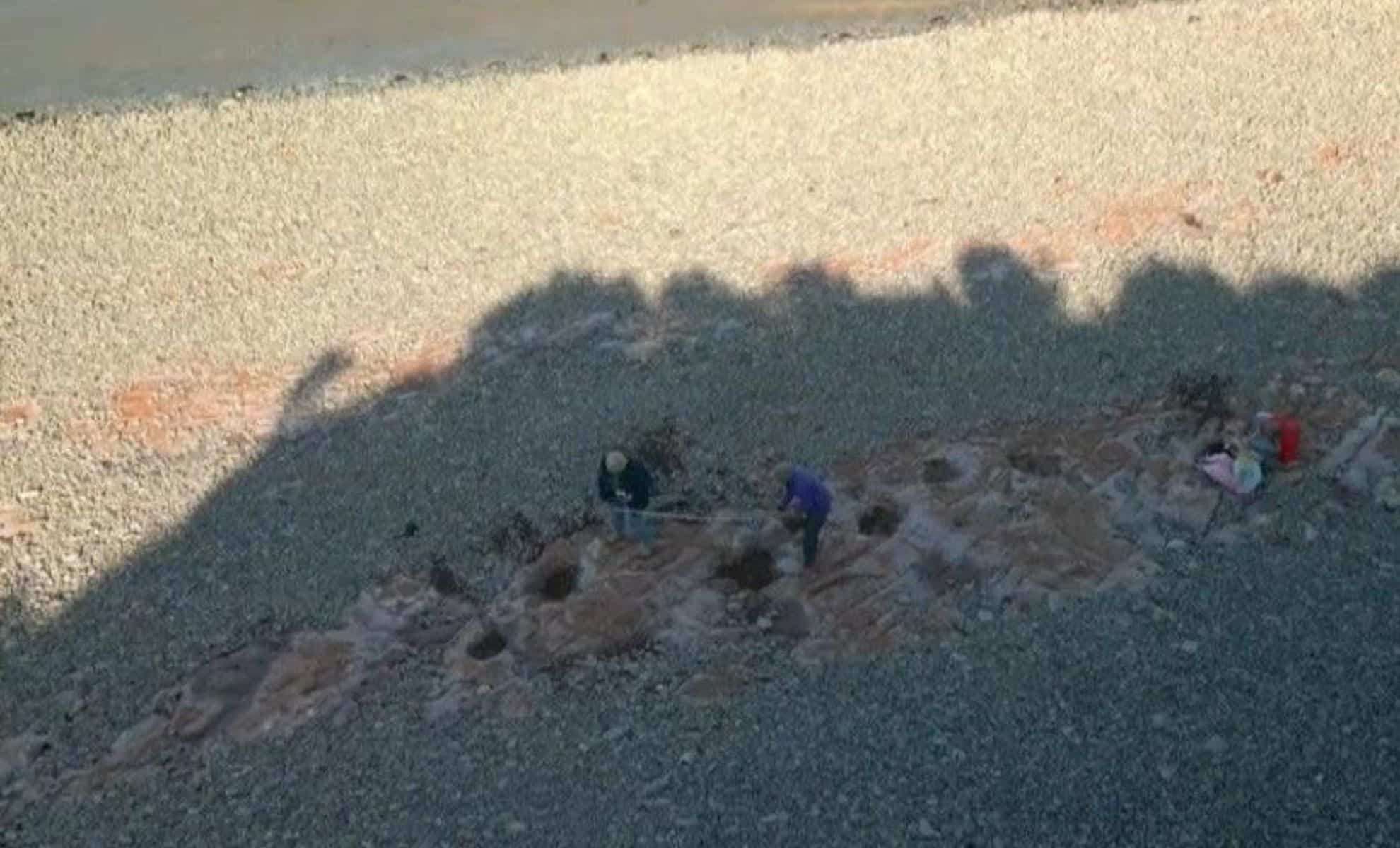
“It’s a major discovery—the excitement when someone brings us clear dinosaur evidence is unbelievable,” remarked Cindy Howells, a paleontologist at the National Museum Wales, during a conversation with the BBC. Historically, Wales had yielded few dinosaur fossils, so finds like this are reshaping that narrative. “Previously, our dinosaur evidence was scarce,” Howells explained, “but that is rapidly changing with recent discoveries.”
The footprints are attributed to an early sauropod species named Camelotia. These large herbivorous dinosaurs, characterized by elongated necks, tails, and small heads, likely stood close to 3 meters (10 feet) tall and measured about 4-5 meters (13-16 feet) in length.
Like many sauropodomorphs, Camelotia fed on plants, leaving behind these giant tracks while navigating the ancient landscape. While skeletal remains of related species have been uncovered across the Bristol Channel, such well-preserved footprints are rare and precious.

Wales’ Expanding Heritage of Dinosaur Fossils
This footprint find bolsters Wales’ reputation as a rich source of dinosaur fossils. In 2014, paleontologists discovered a near-complete skeleton of a 201-million-year-old dracoraptor at the same beach where Tegan found the footprints. These and other fossil finds have encouraged scientists to revisit their understanding of dinosaur populations in the region. “We’re now uncovering bones or tracks every five to six years, painting a continuous picture of dinosaur life in Wales over roughly 15 million years—it’s extraordinary,” Howells noted.

These tracks also highlight South Wales’ geological prominence. Known as a “prehistoric hotspot,” the area is abundant in fossils from both the Triassic and Jurassic periods. Favorable geological conditions have preserved a wealth of ancient relics that help scientists reconstruct the Mesozoic era. Howells remarked that the footprints might correspond with Wales’ first recorded dinosaur prints from 1879, emphasizing this location’s long-standing paleontological significance.
Reflecting on the discovery, Howells expressed awe at the temporal connection: “It’s incredible to think we’re walking the same shores where these massive creatures once roamed hundreds of millions of years ago.” The find offers both inspiration and a humbling glimpse into a world long vanished.
Decoding the Dinosaur Behind the Tracks
While the footprint discovery has captivated researchers, further study is necessary to fully decipher its significance. Preliminary evidence suggests the tracks belong to a sauropodomorpha dinosaur, but exact classification awaits confirmation. The footprint sequence—left, right, left, right—with consistent spacing indicates not random depressions but deliberate steps made by a sizable herbivorous dinosaur moving bipedally. “The pattern and spacing rule out accidental holes,” Howells explained.
The dimensions and stride offer insights into the dinosaur’s locomotion. Based on footprint size and gap between steps, scientists infer that Camelotia was a large dinosaur primarily walking on two legs, shifting to all fours when foraging. “Standing about 3 meters tall and 4-5 meters long, it had a long neck and tail and moved bipedally but could also walk quadrupedally when feeding,” Howells said.
If scientifically verified, these footprints will become a crucial piece in understanding dinosaur diversity in Wales, supplementing an increasing number of vital fossil finds.
Enhancing Knowledge of Wales’ Ancient Past
Tegan’s unexpected discovery has reignited enthusiasm for Wales’ prehistoric heritage and advanced scientists’ grasp of the dinosaurs that once thrived here. Each newly uncovered fossil contributes to a clearer picture of the Mesozoic era, when dinosaurs dominated the planet. The footprints Tegan spotted are among several finds reshaping views of life in prehistoric Wales.
As study continues, the status of Wales as a key paleontological region grows stronger. The South Wales group of the Geologists’ Association suggests this location could be “the premier British site for dinosaur tracks beyond the Triassic.” This latest discovery firmly reinforces that reputation.
For now, Tegan’s footprints remain a captivating reminder for both scientists and the public. Her story illustrates how the distant past persists in the present, connecting us meaningfully to a world long before humans.









0 comments
Sign in to Comment