
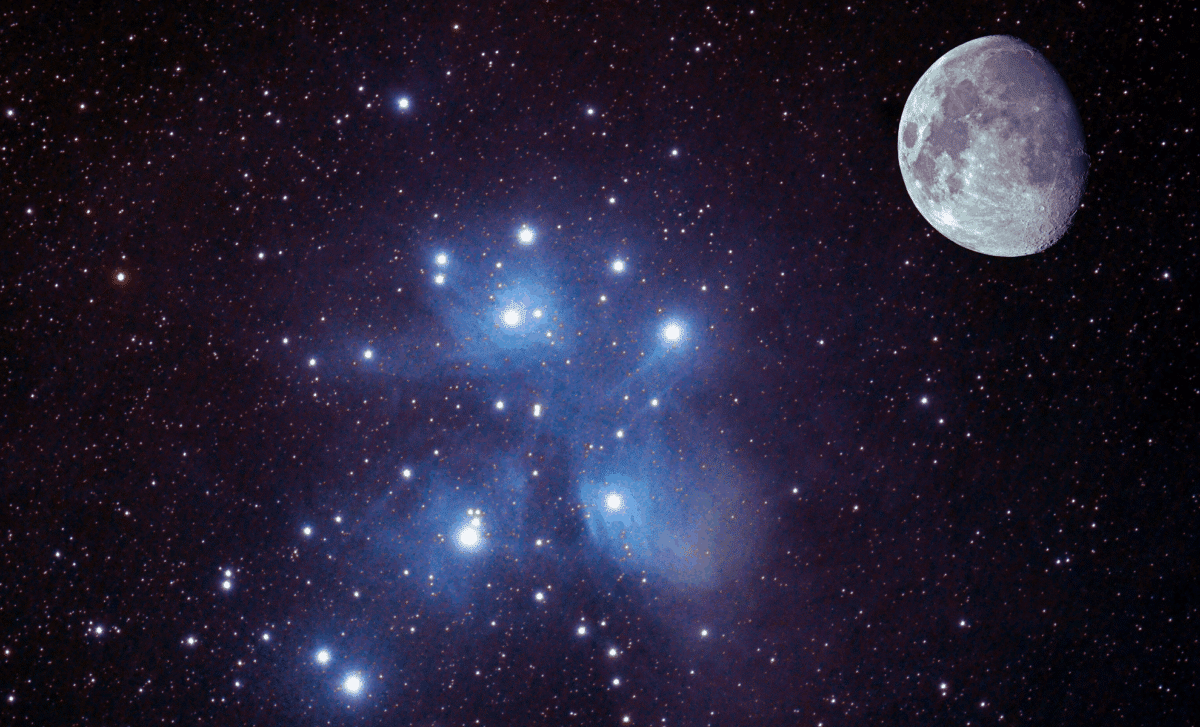
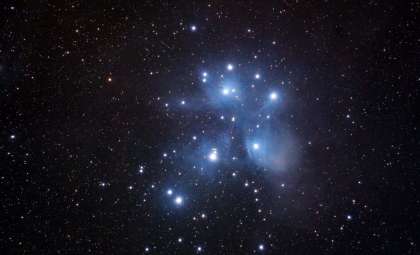
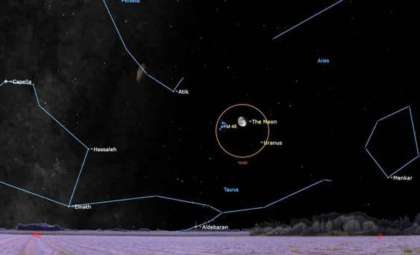
Tonight, skywatchers across North America have a fantastic chance to observe the waning gibbous moon as it glides close to the dazzling Pleiades star cluster, often referred to as the Seven Sisters. This less common celestial event allows viewers to witness several stars briefly disappear behind the moon’s glowing edge and then reappear from its shadow—a spectacle best seen through a telescope rather than binoculars, as Space.com explains.
Timing and Viewing Locations for the Moon-Pleiades Encounter
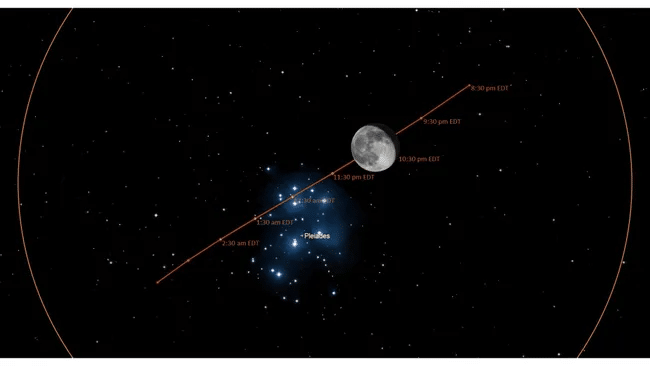
The event’s visibility depends on your geographical location. In the western US and Canadian regions, the moon will start its close approach to the Pleiades cluster during early to mid-evening hours, appearing low in the east-northeast sky at roughly 10 degrees elevation. Observers in the eastern United States and Atlantic Canada will find the event occurring nearer to local midnight, with the moon positioned higher over the horizon. This stellar conjunction typically lasts around two hours, offering plenty of opportunity to watch the moon obscure and then reveal some of the brightest stars within the cluster.
Stars like Electra, Taygeta, and Maia will momentarily hide behind the moon’s illuminated edge before surfacing again from the shaded side. These disappearances and reappearances can be pinpointed accurately for particular locations, with timing charts provided by the International Occultation Timers Association (IOTA). For example, skywatchers in Chicago can expect Electra to vanish at 10:27 p.m. CDT and reemerge at 11:20 p.m., highlighting the precision needed for observing this event.

Best Tools and Methods for Observing the Occultation
To fully appreciate this lunar and stellar interaction, appropriate equipment is essential. Although binoculars can provide a general view, a telescope with a minimum of 50x magnification is preferable to follow the stars as they near the moon’s brilliant perimeter. Using a stable tripod will also enhance tracking and clarity, especially when watching stars reappear from the moon’s darker limb.
The Pleiades stretch about one degree in the sky—slightly wider than the moon’s apparent size. Since the moon moves roughly half a degree per hour, observing this event requires patience and accuracy. Time-lapse photography offers a striking way to capture the moon’s passage across the cluster, revealing the stars as they continually vanish behind and emerge from the lunar surface.
North American Visibility and Star Timelines
The timing of star occultations shifts based on region. For instance, stars such as Alcyone and Atlas can primarily be seen disappearing in the northwestern US, western Canada, and Alaska. The star Electra is covered over a broad expanse of North America, including Greenland, while Maia is observable from much of the US, central and eastern Canada, as well as Greenland. IOTA offers detailed schedules in Universal Time (UT), which observers can convert to their local time zones.
For example, in Denver, Colorado, Alcyone will be obscured at 10:32 p.m. MDT and will reappear at 10:51 p.m. MDT, providing a focused viewing window. Such precise tables enable enthusiasts to plan carefully and not miss these fleeting moments when stars disappear behind the moon.
The Continuing Series of Pleiades Occultations
This event is part of an ongoing series of Pleiades occultations that began in September 2023 and extends through July 2029. Each month, the moon crosses in front of various stars within the cluster, visible from different places on Earth. After 2029, the moon’s path will shift south of the cluster, with the next set of occultations anticipated around 2042.
North America’s next prominent Pleiades occultation will happen on the evening of Wednesday, December 3, 2025, shortly before a full moon. This predictable pattern lets astronomy enthusiasts prepare well ahead to witness these rare cosmic interactions on multiple occasions in the coming years.
- Categories:
- News




0 comments
Sign in to Comment