
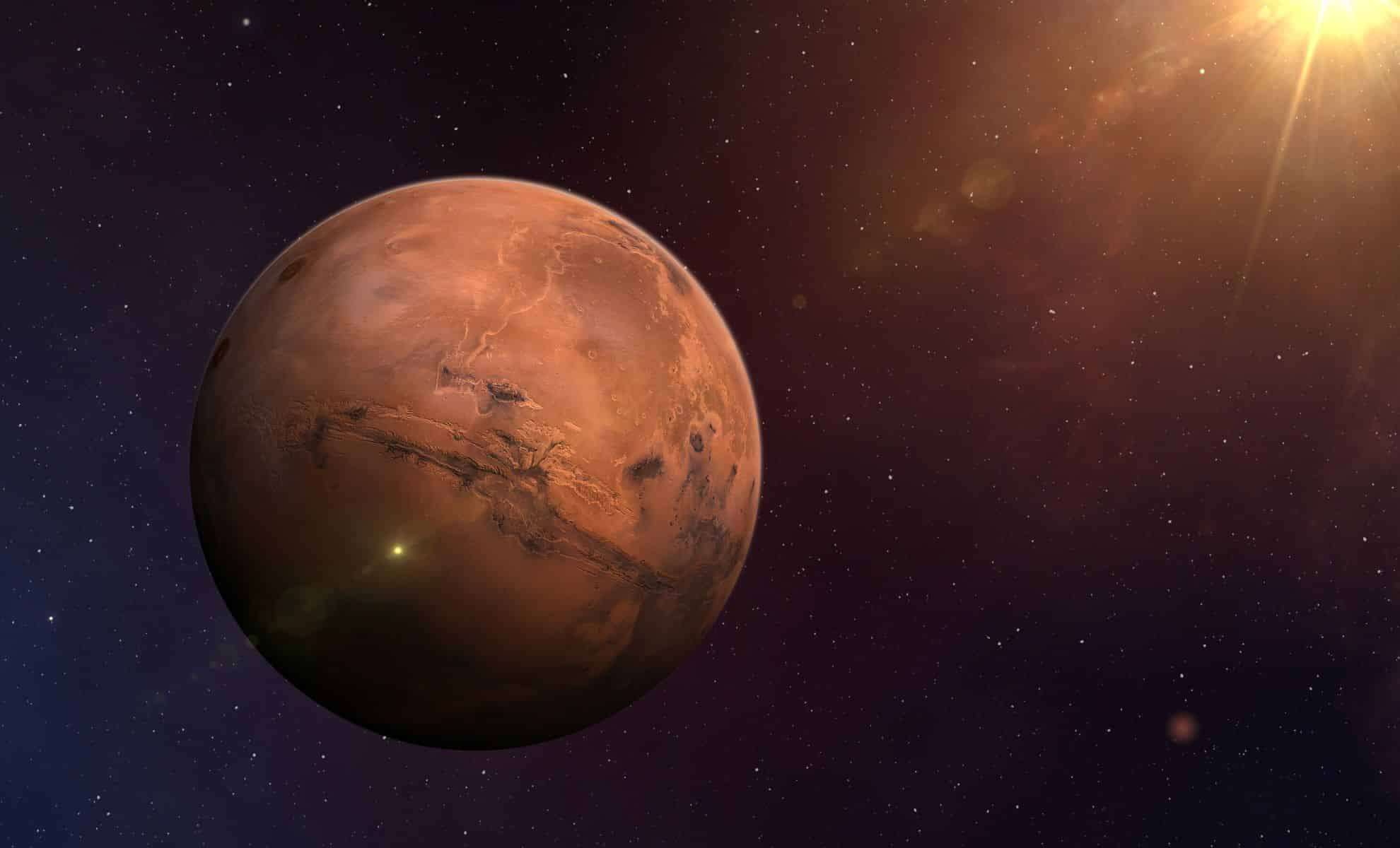
Mars is now a frigid and barren planet, yet its ancient past featured a much more hospitable climate, with flowing water, lakes, and even a northern ocean. Contemporary studies suggest that microbial life might still endure beneath the ice at mid-latitude regions of Mars.
New Insights Point to Ice as a Key Habitat on Mars
A recent investigation spearheaded by Dr. Aditya Khuller, a postdoctoral fellow at NASA’s Jet Propulsion Laboratory, sheds light on the possible refuges for life on Mars. The team suggests that photosynthetic bacteria might survive within the icy mid-latitude zones of the planet.
This concept draws from Earth's radiatively habitable zones, environments where life persists under icy surfaces in extreme cold. By examining how sunlight interacts with Martian ice and dust, researchers chart new directions for missions hunting for signs of life. These findings were unveiled at the 56th Lunar and Planetary Science Conference in 2025.

Understanding Solar Radiation’s Penetration into Martian Ice
The team constructed a detailed model to explore how sunlight and ultraviolet rays pass through layers of ice and dust on Mars. Utilizing sophisticated numerical simulations, they assessed radiation penetration under different ice purity levels and dust contamination.
They found that in pure ice, sunlight can shine through up to 6.5 meters. However, the damaging ultraviolet rays only extend roughly 3 meters within compact granular ice. The presence of dust in the ice significantly limited how deeply sunlight could reach.
Revealing Potentially Life-Friendly Conditions on Mars
The study highlights the possibility that Martian ice fields could serve as “radiatively habitable zones.” Solar radiation may foster conditions conducive to photosynthesis beneath the ice in the planet’s mid-latitudes. These icy areas might occasionally thaw, resulting in pockets of liquid water.
“Under similar ephemeral near-freezing conditions, widespread microbial habitats containing cyanobacteria, chlorophytes, fungi, diatoms, and heterotrophic bacteria are found in the shallow subsurface (top few centimeters to meters) of ice sheets, glaciers, and lake ice containing dust and sediment on Earth.”
Photosynthesis Under Martian Ice: A Possibility?
Seasonal melting cycles are integral to microbial life in Earth's icy habitats, enabling photosynthesis beneath transparent ice layers during summer months. When cold returns, this activity halts as water refreezes.
The Martian mid-latitude ice experiences similar temperature shifts, which could allow microbial ecosystems to thrive in sync with the seasons.
“In the summer, ice in the shallow subsurface melts due to solar heating at these locations. Photosynthesis then occurs in the subsurface, below a translucent ice lid, with nutrients scavenged from the dust and sediment present in the subsurface liquid water. During winter, the subsurface liquid refreezes, and photosynthesis ceases until the next summer.”
- Categories:
- Science










0 comments
Sign in to Comment