
In June 2024, researchers conducting marine studies off Baja California achieved the inaugural live observation of the ginkgo-toothed beaked whale, a deep-ocean species previously identified only through beached specimens. The team collected a minute skin sample during this sighting, culminating a five-year quest and challenging previous ideas about the whale's habitat.
Beaked whales represent some of the ocean’s most mysterious mammals. Of the 94 officially recognized cetacean species, nearly a quarter belong to this elusive family, many of which remain unseen alive in their natural environment. The ginkgo-toothed beaked whale (Mesoplodon ginkgodens) was notably one of these missing observations.
Following an Enigmatic Call Across the Pacific Ocean
The pursuit started in 2020 when Elizabeth Henderson and her research collaborators from Mexico and the United States began studying a unique whale vocalization known as BW43. Initially, the call was thought to belong to Perrin’s beaked whale, another species yet to be documented alive.

Over a period of three years, the team revisited the same oceanic region multiple times, switching from a sailing vessel to a hired Mexican fishing boat, but never succeeded in spotting the whale visually. The breakthrough occurred in 2024 after partnering with Oregon State University and deploying the Pacific Storm, a ship towing hydrophone arrays designed to capture underwater sounds and featuring an elevated observation platform equipped with powerful binoculars.
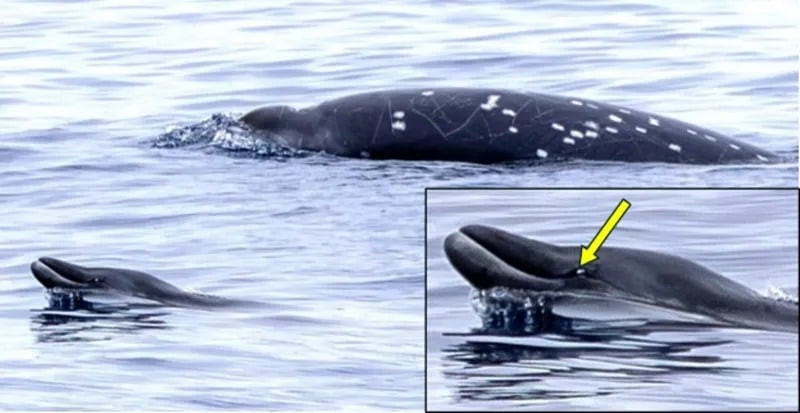
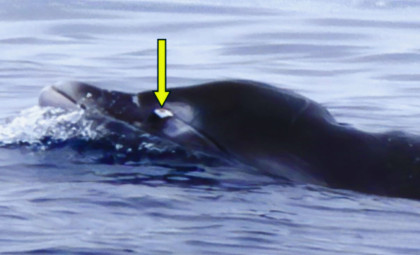
That same morning, two whales surfaced multiple times before retired Oregon State University scientist Robert Pitman successfully obtained a biopsy using a modified crossbow. The dart retrieved a small piece of skin roughly the size of a pencil eraser. Subsequent genetic tests confirmed the identity as ginkgo-toothed beaked whales. According to Henderson, lead author of a paper published in Marine Mammal Science, the team celebrated this milestone after years of dedication.
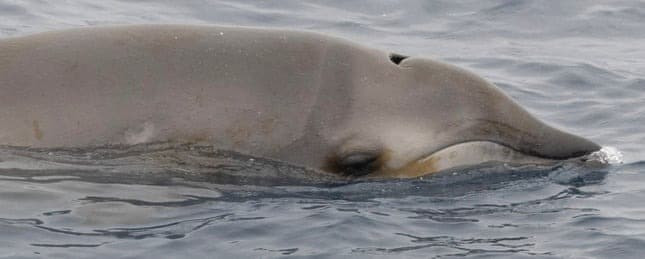
“All had a slightly paler head and melon compared to the back, dark eye patches, and a pale eye spot in front of and slightly above the eye patch,” described the authors in the study.
A Dramatic Event With an Unexpected Interloper
The crucial confirmation nearly slipped away due to an unforeseen incident. As the biopsy dart floated, a local albatross swooped down and began pecking at the end holding the vital tissue.
As reported in The Guardian, Henderson recounted the crew’s response, which included yelling and throwing leftover bread to distract the bird.
“In hindsight, it is very funny, but in the moment it was very stressful,” she said.
The tiny skin fragment turned out to be pivotal. Numerous beaked whale species have been identified only from decomposed animals found on shores. Prior to this sighting, the ginkgo-toothed beaked whale had never been recorded alive in the wild.
Expanding Knowledge of Its Habitat
This observation has also prompted experts to revise their perspective on the species’ location. Most earlier data came from stranded specimens found in Japan, with only two reported strandings along North America’s west coast, which were previously treated as rare exceptions.
Based on the team’s analysis of sound recordings, the whale vocalization now linked to the ginkgo-toothed beaked whale suggests the species likely resides year-round off California and northern Baja California. Henderson highlighted that prior assumptions that North American strandings were sick or wandering individuals may need reevaluation.
Beaked whales are highly vulnerable to naval sonar, which can disrupt their feeding behaviors and sometimes result in dangerous rapid ascents causing injury akin to decompression sickness. As Pitman shared with The Guardian :
“A quarter of those are beaked whales, but most people have never even heard of them. These are the largest, least-known animals left on the planet.”
- Categories:
- Science





0 comments
Sign in to Comment