
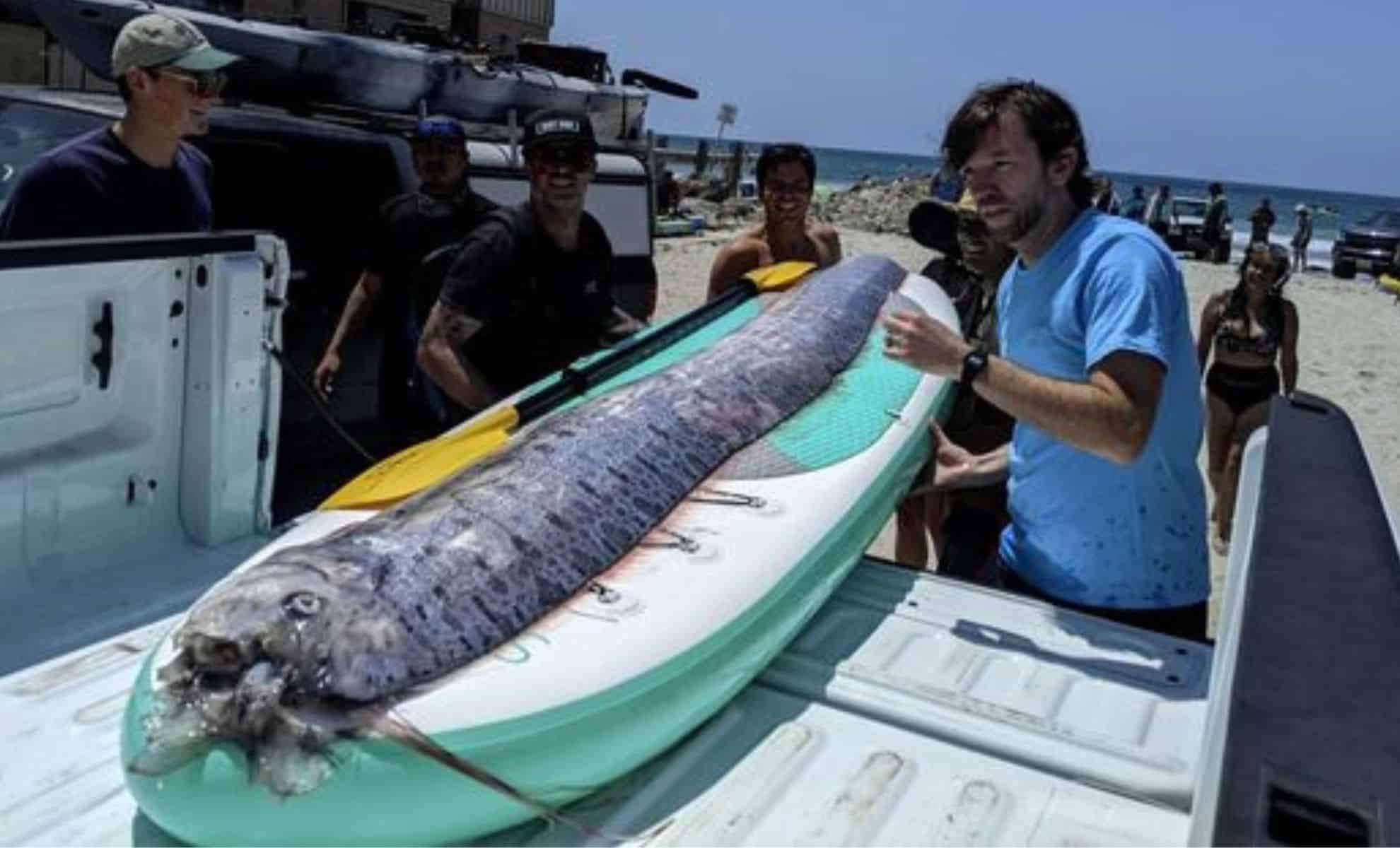
A rarely seen oarfish, nicknamed the “doomsday fish” due to its legendary ties to natural catastrophe predictions in Japanese mythology, recently appeared near La Jolla Cove off the coast of San Diego.
This remarkable find has drawn considerable attention from both the scientific community and local residents, marking only the 20th recorded emergence of an oarfish in California since the early 20th century.
Encountering a Rare Giant of the Deep
Distinctive for its elongated, ribbon-like form and vivid coloring, the oarfish inhabits deep ocean zones, typically between 700 and 3,280 feet beneath the surface. Due to its deep-sea habitat, encounters with this species are extraordinarily uncommon. This specimen was spotted by kayakers and snorkelers exploring near La Jolla Cove. As explained by Lauren Fimbres Wood, representative of the Scripps Institution of Oceanography at UC San Diego, local experts and lifeguards collaborated to carefully bring the large fish ashore.

The appearance of this oarfish excites marine scientists, offering a unique chance to study a creature seldom seen by humans. In 125 years, only 20 such sightings have been documented along the California coast, underscoring the rarity of each event. Ben Frable, Scripps’ resident fish specialist, emphasized the fish’s exceptional rarity and noted ongoing necropsy procedures designed to uncover the cause behind its death.
Myth Meets Marine Biology: The Cultural Significance of the ‘Doomsday Fish’
While researchers welcome the appearance of the oarfish as a valuable biological event, its presence carries a more ominous meaning in Japanese folklore. Referred to as the “Ryugu no tsukai” or “messenger from the sea god's realm,” these fish have been historically linked with warnings of impending earthquakes and tsunamis. Legend holds that the sea deity Ryujin sends these deep-sea creatures to signal seismic disturbances—a belief that has endured since the 1600s.
Such associations gained global attention following multiple oarfish sightings preceding the 2011 Tohoku earthquake and the Fukushima nuclear crisis in Japan. Nevertheless, scientific investigations have found no evidence that links these creatures’ surface occurrences to earthquakes. Hiroyuki Motomura, an ichthyologist at Kagoshima University, explains that oarfish typically ascend due to illness or deterioration, drifting upward with ocean currents rather than responding to seismic events.
Probing the Enigmas of the Oarfish
The recent capture of the oarfish near La Jolla Cove has ignited fresh interest among scientists seeking to unravel the mysteries surrounding this elusive species. The specimen will be preserved within the Scripps Marine Vertebrate Collection, which hosts one of the largest assemblages of deep-sea fishes worldwide. This resource supports detailed analysis aimed at understanding oarfish biology, physiology, and their adaptation to the deep-sea environment.
Despite uncertainties about why this individual surfaced, every discovery enhances the scientific community’s knowledge of these marine giants. The ongoing necropsy at the National Oceanic and Atmospheric Administration (NOAA) lab will evaluate potential mortality factors including disease or environmental pressures, providing clues into the oarfish’s uncommon behavior.
Guidelines for Witnessing Rare Marine Species
For visitors to California’s coastline, encountering a rare creature like the oarfish can be profoundly exciting but requires careful handling. Experts advise reporting sightings to local lifeguards or connecting with organizations such as Scripps to ensure proper care and facilitate scientific examination. Removing marine animals from their natural setting is prohibited, and adherence to official procedures helps support conservation and research goals.
As researchers continue to examine the oarfish specimen and explore its nature, this episode highlights the many wonders still concealed beneath ocean waves. Whether appreciated through cultural lore or scientific inquiry, the oarfish remains a fascinating subject that continues to deepen our understanding of marine life.













0 comments
Sign in to Comment