
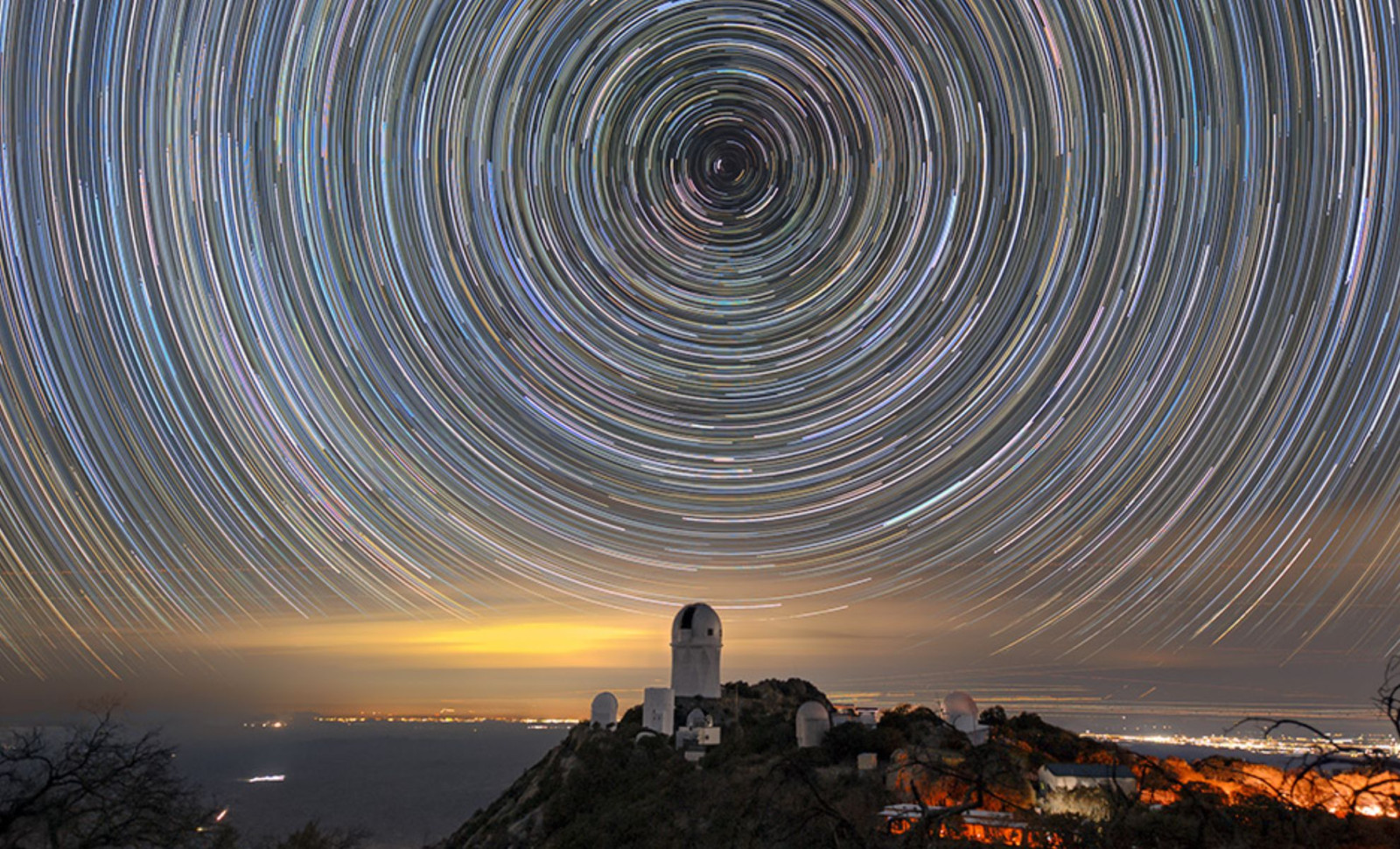
The Dark Energy Spectroscopic Instrument (DESI) has wrapped up the most comprehensive cosmic survey to date, cataloging over 47 million galaxies and quasars throughout the sky. This extensive dataset is expected to provide new insights into one of cosmology's greatest mysteries: how dark energy evolves over time.
Operating from the Kitt Peak National Observatory in Arizona since 2021, DESI exceeded expectations outlined by the Lawrence Berkeley National Laboratory (Berkeley Lab). Instead of the anticipated 34 million galaxies and quasars, the instrument captured data well beyond that figure, showcasing its outstanding observational performance.
Designed to construct a 3D map of the universe, DESI measured precise positions and distances of galaxies spanning billions of light-years. Scientists intend to contrast the distribution of matter in the early universe with cosmic structures observed today.

The finalized survey encompasses close to 14,000 square degrees of the celestial sphere, with plans to extend coverage to 17,000 square degrees. However, certain regions remain challenging to observe due to bright foreground features such as the Milky Way.
DESI Yields the Largest Spectroscopic Cosmic Map Ever
David Schlegel from the Lawrence Berkeley National Laboratory explained that previous cosmic maps contained data on roughly 5 million galaxies. The Dark Energy Spectroscopic Instrument (DESI) has expanded this sample to nearly ten times that amount, establishing it as the most extensive spectroscopic survey to date. He shared with New Scientist that astronomical mapping has grown exponentially each decade, noting:
“We’ve actually been on this curve now for my whole career where, every 10 years, we’re making 10-times-larger maps,” he said. “You can ask the question, at what point have you mapped every observable galaxy within 10 billion light years… and if we stayed on the curve, we would do that by 2061.”
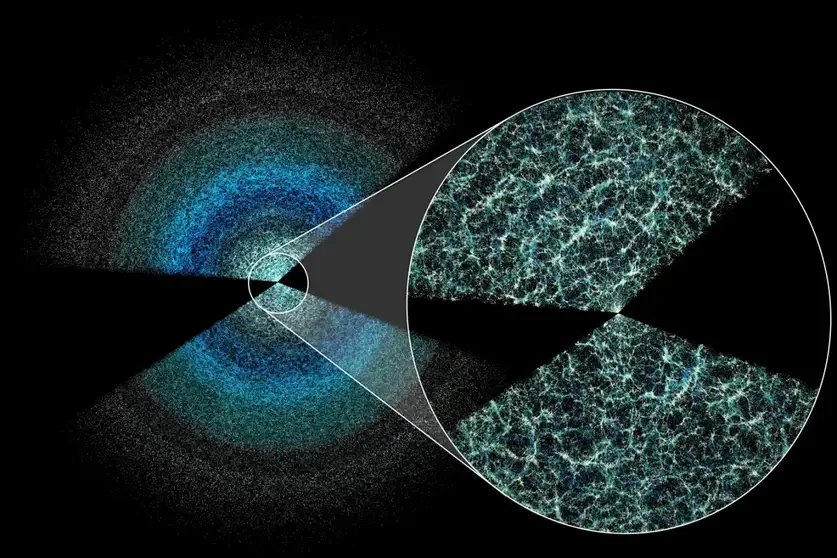
Some of the galaxies examined in the DESI survey were incredibly faint, with researchers reconstructing remote objects based on just 100 to 200 photons gathered by the instrument. Achieving such measurements required exceptional precision due to the vast distances involved.
While the core five-year survey phase has concluded, the data is undergoing detailed analysis. The wider scientific community is expected to access the comprehensive results following about a year of further processing.
New Dark Energy Data Challenges Cosmological Models
A key goal of DESI is to enhance understanding of dark energy, the mysterious force thought to constitute close to 70 percent of the universe. A preliminary dataset released in 2024 from DESI hinted that dark energy might be diminishing, contradicting the prevailing cosmological framework, Lambda-CDM.
Scientists aim to use the complete 3D cosmic map to study galaxy distributions across different epochs with greater statistical confidence. Although a definitive understanding of dark energy’s nature remains unsettled, this extensive dataset is expected to provide more robust insights in upcoming analyses.

Adjusting to Vast Volumes of Astronomical Data
The project illustrates how astronomical research has transformed over recent decades. Ofer Lahav from University College London reflected on the contrast between earlier galaxy surveys and the large modern datasets. Speaking with New Scientist, Lahav recalled that about 40 years ago, during his PhD at Cambridge, galaxy samples numbered only in the thousands, limiting the scope of cosmological studies.
Today, colossal surveys like DESI produce data at a scale that demands sophisticated analysis and data management methods. He pointed out that younger researchers now grapple with the challenge of extracting meaningful results from datasets that far exceed manageable sizes.
“We’ve built a remarkable piece of equipment that met all our expectations and then some,” stated Michael Levi, DESI director and a scientist at Berkeley Lab. “Now we’re pushing beyond our original plan. We don’t know what we’ll find, but we think it’ll be pretty exciting.”
DESI’s research will continue for at least two and a half more years. Scientists are also exploring potential updates to extend the instrument’s operation into the 2030s, furthering one of astronomy’s most ambitious mapping endeavors.
- Categories:
- Space





0 comments
Sign in to Comment