
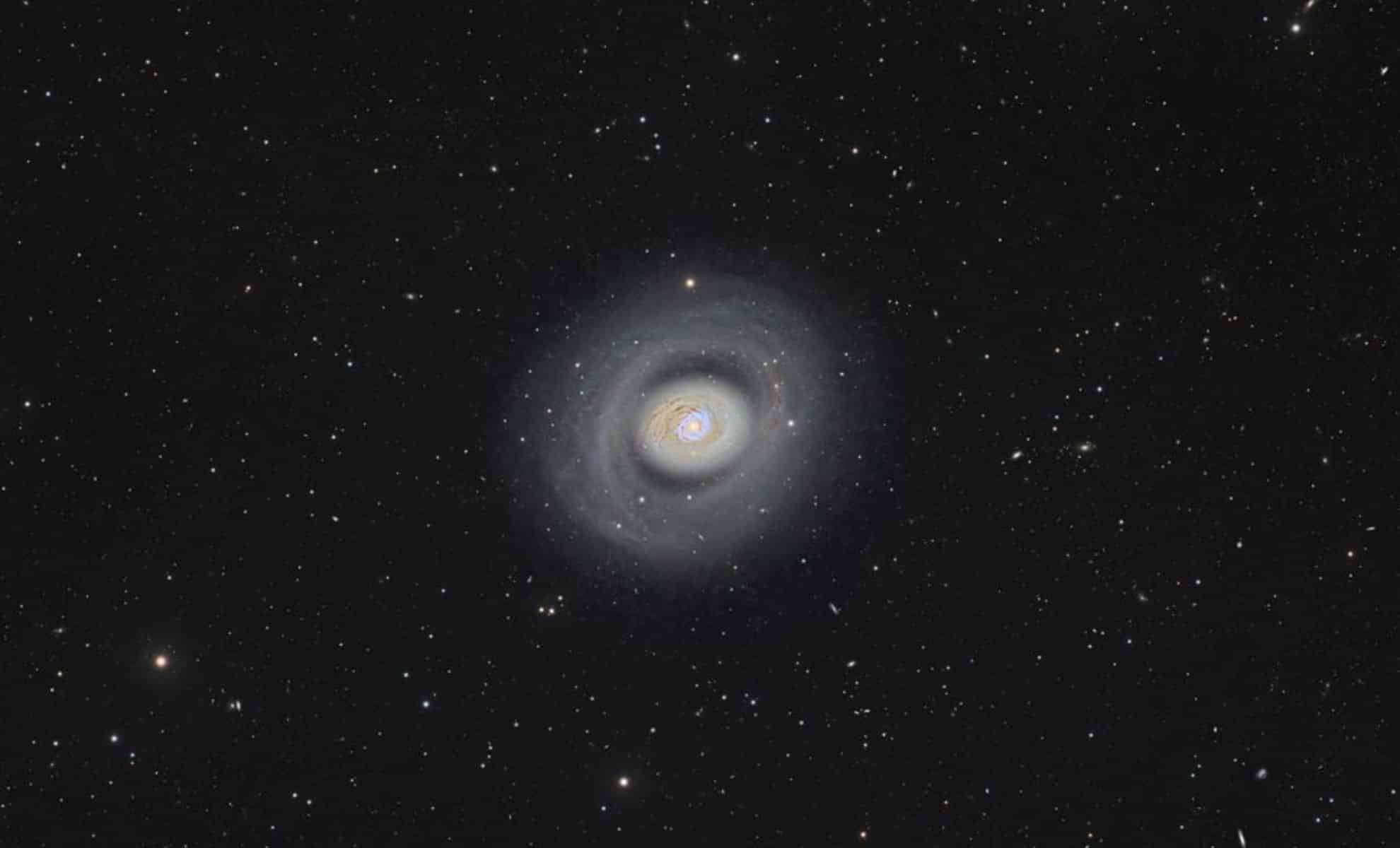
Vermont-based enthusiast Michele Hernandez Bayliss has achieved an impressive breakthrough in amateur astrophotography by photographing two renowned galaxies: the Croc’s Eye galaxy (Messier 94) and the famous Whirlpool galaxy (Messier 51).
Stargazing From a Personal Observatory
Although Hernandez Bayliss has been observing the skies visually for years, she only recently ventured into astrophotography.
Over the last two years, she dedicated herself to constructing a home observatory in Weybridge, Vermont.

Despite Vermont’s erratic weather patterns, characterized by overcast skies and brief clear windows, she captured a remarkable view of the Croc’s Eye galaxy in late April.
Equipped with a Takahashi TOA-130NFB Refractor, a Stellarvue SVX140T-R telescope, and a collection of essential accessories, Hernandez Bayliss gathered over 20 hours of data across two nights.
The result is an exquisitely detailed image of Messier 94, a spiral galaxy located approximately 34 million light-years away.
“Processing galaxies can be tricky,” Hernandez Bayliss shared with Space.com, “The Croc’s Eye galaxy was much smaller than expected through my 990 mm telescope, so I had to use HDR compression carefully and manage the Synthetic Luminance generated from the LRGB data.”
Exploring the Whirlpool Galaxy’s Structure
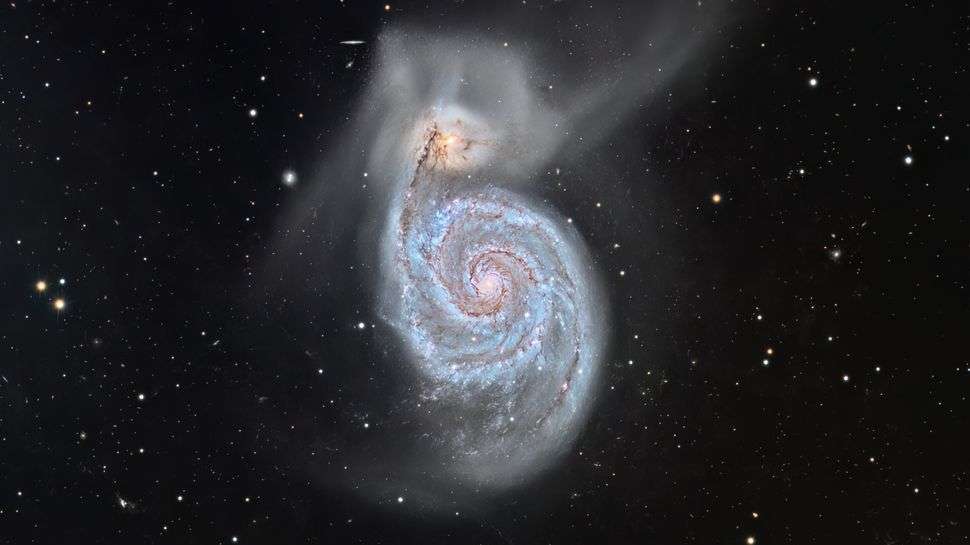
Earlier this year, Hernandez Bayliss focused her instruments on the iconic Whirlpool galaxy (Messier 51), known for its bright core and sweeping spiral arms.
She combined RGB and hydrogen-alpha (Ha) filters to expose intricate details within the galaxy.
Over 16 hours of observation in February, she revealed the delicate fine structures of the Whirlpool, including the prominent dark dust lanes entwined in its spirals.
The resulting image beautifully showcases a “grand-design” spiral galaxy, highlighting its captivating features.
This galaxy’s spiral arms are thought to be shaped by gravitational interactions with the neighboring smaller galaxy NGC 5195, which lies close by and enhances M51’s structure — a subtlety that Hernandez Bayliss’s photograph captures with vivid clarity.
Overcoming Astrophotography Challenges
Capturing deep-sky objects is complex, and Hernandez Bayliss faced several obstacles during her sessions.
The most significant challenge was securing clear, dark skies, often a rarity in Vermont due to frequent clouds and bright moonlight.
“Getting two consecutive cloud-free, moonless nights with crystal-clear conditions was truly a stroke of luck!” she remarked.
Photographing galaxies like Messier 94, which appears relatively compact in the night sky, demands meticulous attention.
Hernandez Bayliss’s workflow involved delicately balancing the details — dimming the core to emphasize spiral arms while preserving subtle textures.
Thanks to her combination of advanced telescopic equipment, specialized filters, and expert image processing, she produced images that rival those of seasoned professionals.
- Categories:
- Space








0 comments
Sign in to Comment