
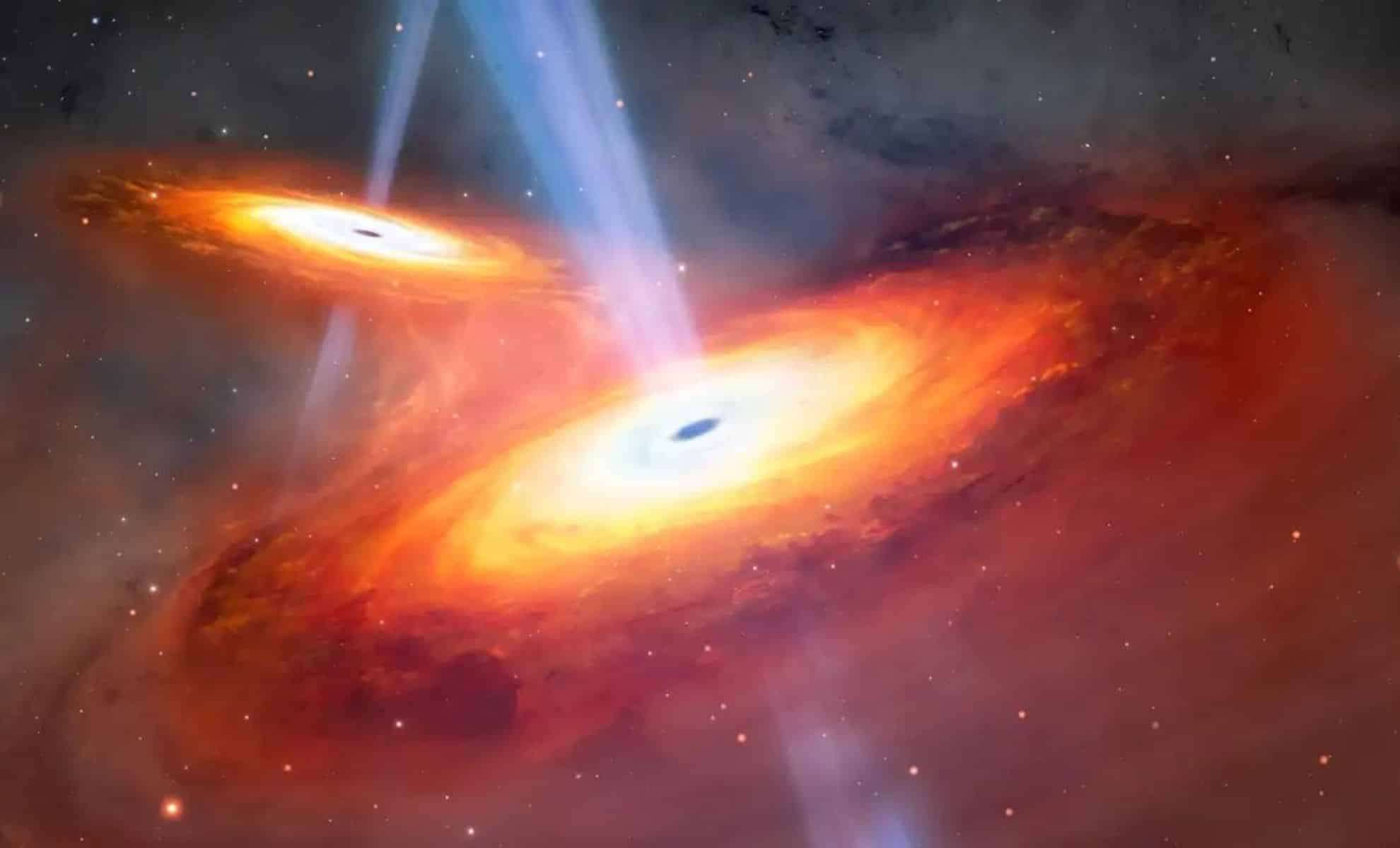
Astronomers have uncovered the most remote pair of merging quasars ever detected, shedding light on the universe’s formative times.
These quasars, observed as they existed roughly 900 million years after the Big Bang, represent the earliest confirmed pair from the Cosmic Dawn period. The findings, detailed in The Astrophysical Journal Letters, emphasize the pivotal influence of galactic collisions in the evolution of the cosmos.
Understanding the Era of Cosmic Dawn
The Cosmic Dawn refers to a vital stage in cosmic history, spanning from approximately 50 million to one billion years post-Big Bang. This epoch marks the birth of the first luminous objects—stars and galaxies—that brightened the universe and triggered the reionization of neutral hydrogen.

Detecting merging quasars from this time is especially crucial, as it offers concrete proof of early cosmic interactions that helped build large-scale cosmic frameworks. Astronomer Yoshiki Matsuoka from Ehime University in Japan remarked, “The existence of merging quasars during the Epoch of Reionization has long been theorized, and this is the first confirmation.”
Techniques Behind the Discovery
Scientists employed the Subaru telescope’s Hyper Suprime-Cam to detect these quasars, with follow-up observations involving spectroscopic imaging to validate their findings.
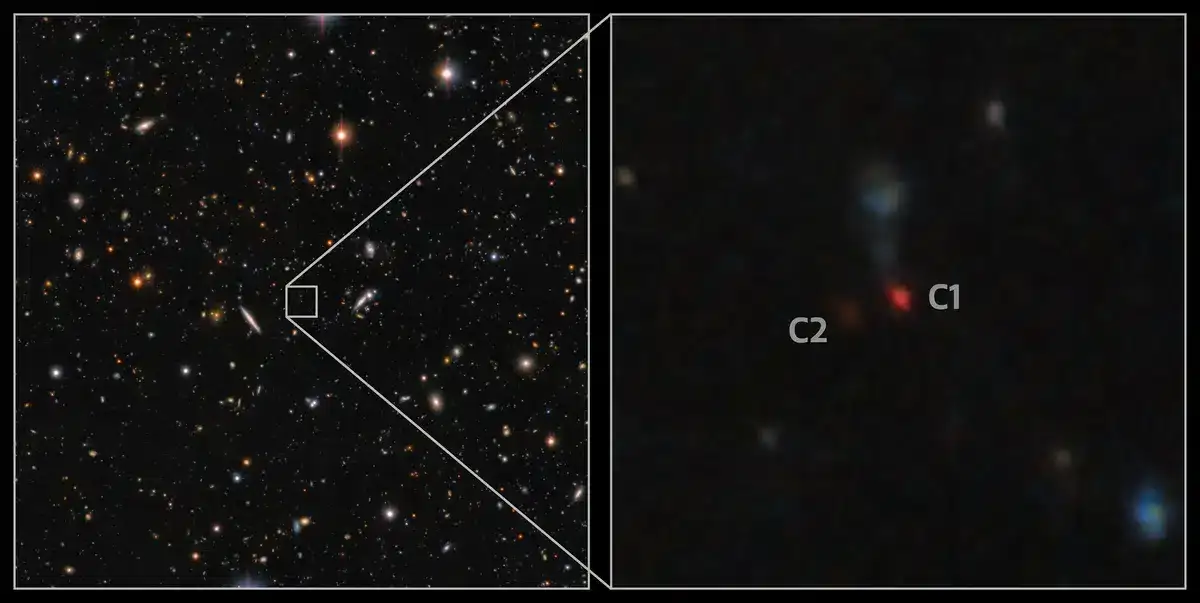
These quasars, seen at a redshift of z = 6.05, reveal conditions over 12 billion years ago. Initial imagery showed faint reddish spots amidst many nearer galaxies and stars.
Further detailed study using the spectroscopic instruments aboard the Subaru and Gemini North telescopes confirmed these spots as true quasars. “While a few hundred early-universe quasars have been cataloged, none were previously observed as pairs,” Matsuoka noted. “This contrasts with straightforward expectations from cosmological models, which predict widespread galactic mergers, typically resulting in numerous merging quasar pairs throughout the cosmos.”
Key Features of the Quasar Pair
Each quasar harbors a supermassive black hole around 100 million times the Sun’s mass. Notably, the comparable masses have led researchers to label them as “twins.”
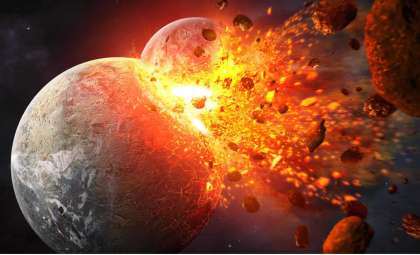
The pair’s interaction is further highlighted by a gaseous bridge connecting their host galaxies, signaling an ongoing major galactic merger. This process is influential at a cosmic scale, impacting the dynamics and structure of nearby galaxies. Matsuoka added, “Although this is a singular discovery, it indicates that supermassive black holes and galaxies evolve through mutual mergers.”
Cosmological Impact of the Findings
Locating merging quasars from the Cosmic Dawn supports theoretical models of cosmic evolution. It implies the early universe experienced frequent galactic mergers that paved the way for the large-scale structures we observe now, thereby reinforcing the hierarchical structure formation model.
The merger event offers insights into how supermassive black holes grew and how galaxies formed during the universe’s infancy. Matsuoka emphasized, “It bolsters the traditional understanding of cosmic evolution driven by gravity’s effect on all matter.” This discovery provides a crucial perspective on early universe dynamics and how gravity sculpted the cosmic landscape.
Future Studies with Next-Generation Telescopes
The research team aims to utilize the James Webb Space Telescope for deeper exploration of gas motion and star formation in these galaxies. Upcoming observatories, such as the Vera Rubin Observatory, will improve detection and classification of distant celestial sources, expanding our knowledge of the early cosmos.
These forthcoming studies are expected to reveal complex interactions between supermassive black holes and their host galaxies, clarifying the mechanics behind gas flows and stellar birth during mergers. This will advance our comprehension of galaxy evolution processes.
Identifying this quasar pair marks a milestone in probing the universe’s earliest stages, underlining the importance of sophisticated instruments and ongoing observations in unveiling the mysteries of cosmic origins.
- Categories:
- Astronomy ,
- News ,
- Space




0 comments
Sign in to Comment