
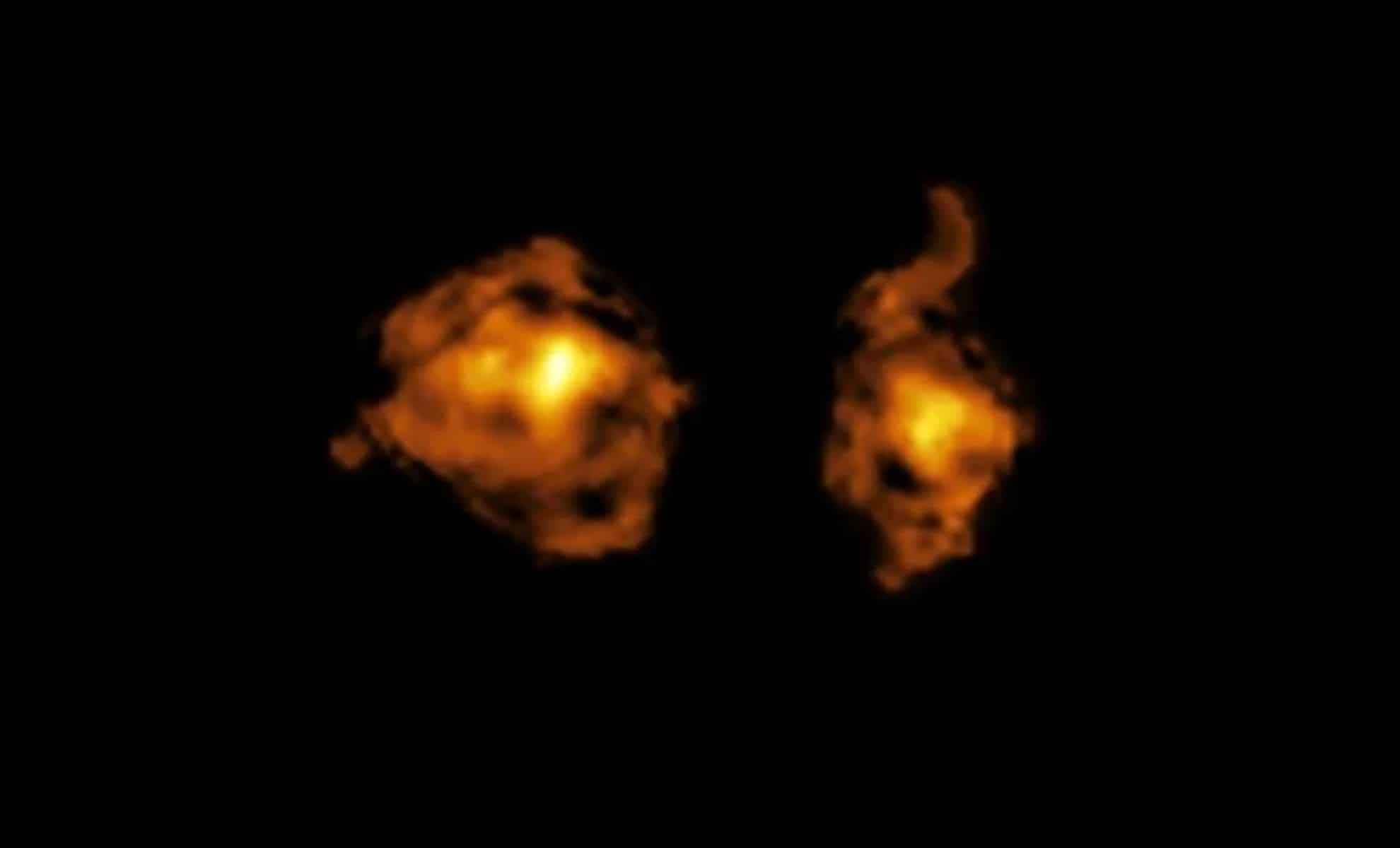
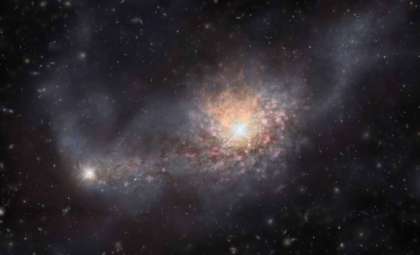
Deep within the vast universe, astronomers have observed a striking encounter between two distant galaxies, resembling a fierce cosmic clash. Utilizing data from Chile’s Atacama Large Millimeter/submillimeter Array (ALMA) and the Very Large Telescope operated by the European Southern Observatory (ESO), scientists detected one galaxy emitting a potent stream of radiation towards its adjacent galactic companion.
An Epic Cosmic Encounter Billions of Years Ago
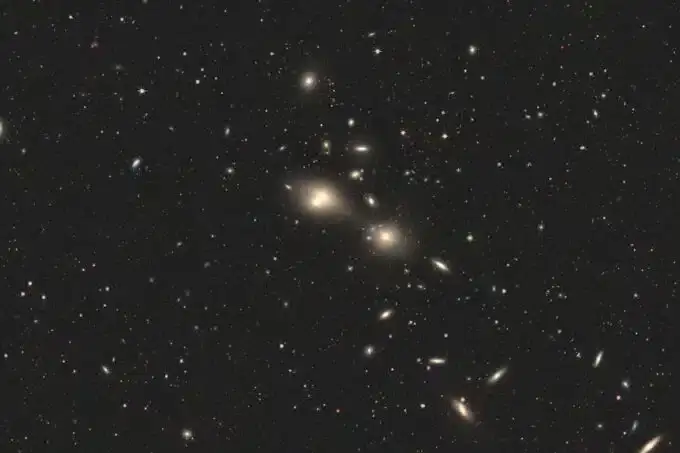
The galaxies involved are separated by such a great expanse that their light took 11 billion years to arrive on Earth, implying this turbulent event took place when the universe was just a fraction of its current age—about 18%. Traveling at an incredible pace exceeding 311 miles per second (500 kilometers per second), these galaxies are engaged in a gravitational embrace driving this spectacular interaction.
Pasquier Noterdaeme, a CNRS scientist at Paris’ Institut d’Astrophysique and a co-leading author, shared, “We identified a quasar, probably ignited by the merger of two galaxies, which is actively altering the gas configuration within its neighboring galaxy.” This phenomenon, sometimes dubbed a “cosmic joust,” marks the inaugural direct observation of a quasar’s radiation influencing the internal gas layout of a nearby galaxy.

The Quasar’s Impact on Star Formation
Quasars are extraordinarily luminous and energetic centers of galaxies, fed by supermassive black holes devouring matter at immense rates. In this case, the quasar sends a focused radiation beam into the companion galaxy, cutting through dense clouds of gas and dust. This high-energy stream disrupts the gas clouds, halting their collapse and the subsequent birth of new stars.
Sergei Balashev, co-author of the research and a scientist at the Ioffe Institute in Russia, stated in an ESO announcement, “This is the first direct evidence showing how a quasar’s radiation reshapes the gas structure inside an otherwise typical galaxy.” The radiation undermines the companion’s potential star formation by fragmenting the cold gas reservoirs necessary for stellar creation, as detailed in related findings.
Quasar Feedback Spurs Turbulent Activity in Its Host Galaxy
The effect is mutual between these involved galaxies. As they interact, gas channels toward the quasar’s central black hole, fueling the quasar and boosting its emission of powerful radiation. This creates a cyclical feedback mechanism, escalating the quasar’s energy output and amplifying its influence on the cosmic environment.
This exceptional observation was achieved thanks to ALMA’s exquisite imaging capabilities, which resolved the two galaxies that previously appeared as a single entity. Additionally, the ESO’s X-shooter instrument provided spectral data to examine how quasar radiation disturbs the neighboring galaxy’s gas.
This breakthrough paves the way for a deeper comprehension of how quasars govern the evolution of their galaxies and impact nearby cosmic structures. Future observatories such as the Extremely Large Telescope (ELT) are expected to further illuminate these dramatic galactic events.
- Categories:
- Space






0 comments
Sign in to Comment