
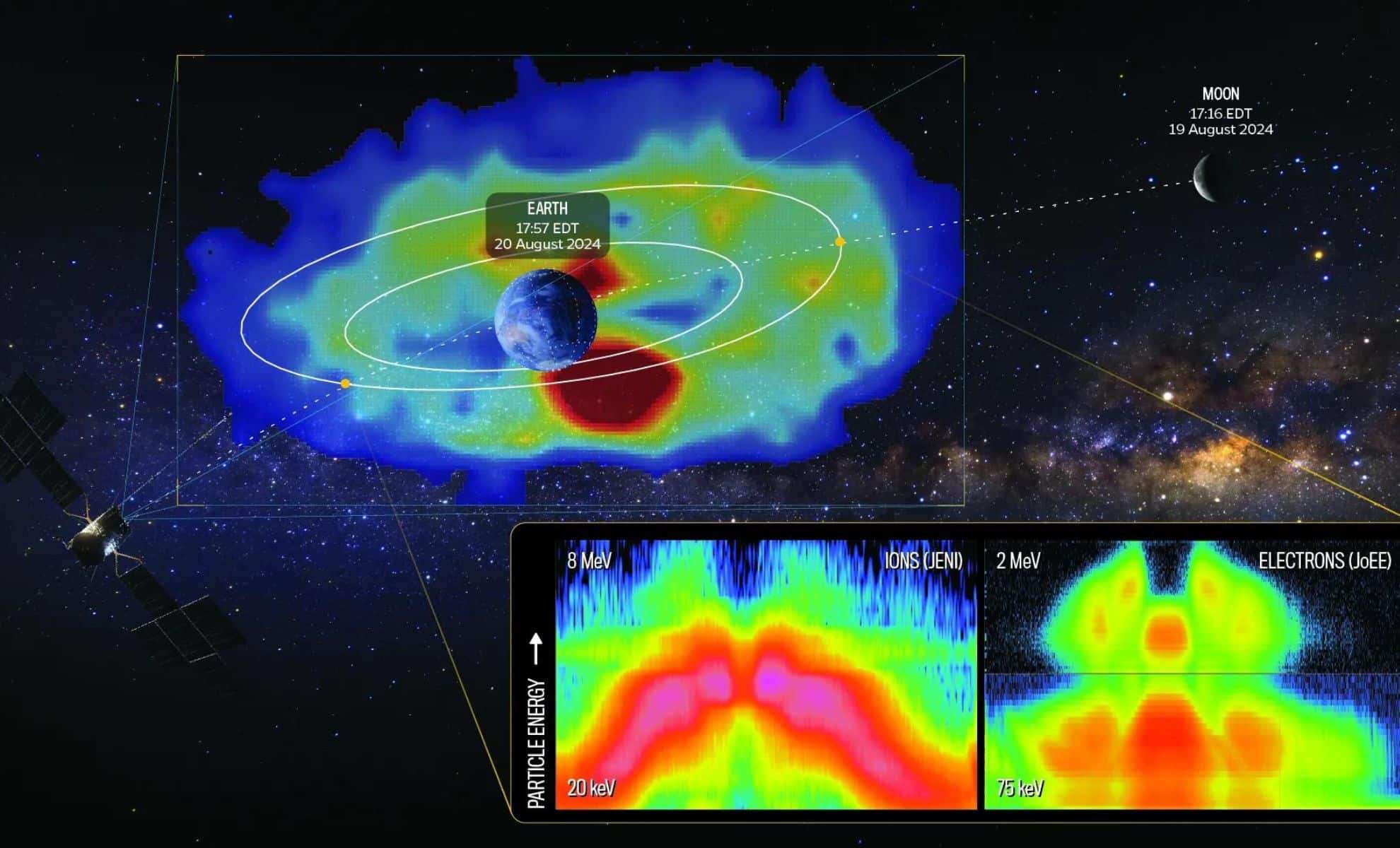
An instrument aboard NASA’s spacecraft has achieved the sharpest image ever recorded of Earth's radiation belts during its recent trajectory past the Moon and Earth. This significant accomplishment marks a key moment in the mission’s journey toward Jupiter to further probe the planet’s magnetosphere and its satellites.
Revealing the Hidden Structure of Earth’s Radiation Belts
Throughout the August 2024 flyby of the Moon and Earth, NASA’s JENI (Jovian Energetic Neutrals and Ions) instrument, engineered by the Johns Hopkins Applied Physics Laboratory (APL), successfully captured unprecedented visuals of the radiation belts. Unlike conventional cameras, JENI’s cutting-edge sensors detect energetic neutral atoms generated when charged particles interact with hydrogen atoms in Earth’s atmosphere.
This breakthrough imaging showcased a remarkably intricate view of the million-degree plasma halo surrounding Earth, unveiling the complex formations within the Van Allen radiation belts. As Matina Gkioulidou, deputy lead of JENI at APL, stated, “Once we saw the crystal-clear images, celebrations followed immediately. We captured the expansive ring of scorching plasma enveloping Earth in an extraordinary level of detail, igniting enthusiasm for the upcoming Jupiter mission.”

This advancement significantly aids scientists in comprehending the interactions between magnetic fields and charged particles in space, a critical component in forecasting space weather. The highly refined images support developing improved models to predict radiation risks within space environments around Earth, as well as for missions beyond.
A Milestone Flyby and Extensive Data Gathering
This flyby was a vital maneuver in JUICE’s mission preparation for its arrival at Jupiter. Between August 19–20, 2024, the spacecraft executed a dual gravity assist, a pioneering approach allowing it to gain velocity and refine its path. This technique will be integral to navigating the Solar System throughout the mission.
During a 30-minute pass at just 465 miles above the Moon, JUICE’s JoEE (Jovian Energetic Electrons) detector was engaged, collecting valuable data on the interaction between charged particles, plasma, and Earth’s sole natural satellite. These findings set the stage for the more intense radiation measurements expected at Jupiter’s moons.
On August 20, JUICE traversed Earth’s magnetosphere around 37,000 miles over the Pacific Ocean, offering JENI and JoEE an exceptional chance to map the complex energetic ion and electron conditions defining the radiation belts. Pontus Brandt, lead investigator of both instruments, highlighted, “The wealth of data from our deep magnetosphere pass is phenomenal. JENI’s imaging of the whole system we navigated was the perfect complement.”
Significance for Future Space Exploration
The presence of the Van Allen radiation belts poses serious obstacles for spacecraft and crewed missions. High-energy particles can impair sensitive electronics and endanger astronaut health. The data from JUICE’s instruments will enable more effective strategies to safeguard spacecraft and crews during extended missions to destinations like the Moon and Mars.
Insights gained about Earth's radiation environment, combined with forthcoming data from Jupiter, will be instrumental in preparing for sustained human activities in deep space. JUICE will continue gathering critical data during upcoming flybys of Venus and Earth in 2025 and 2026 before its anticipated arrival at Jupiter in 2031.
This milestone image and the comprehensive data from JUICE’s flyby underscore the vital cooperative efforts between NASA and the European Space Agency (ESA) to deepen our knowledge of radiation conditions in Earth’s vicinity and across the Solar System.
- Categories:
- Astronomy ,
- News ,
- Space ,
- Nasa








0 comments
Sign in to Comment