
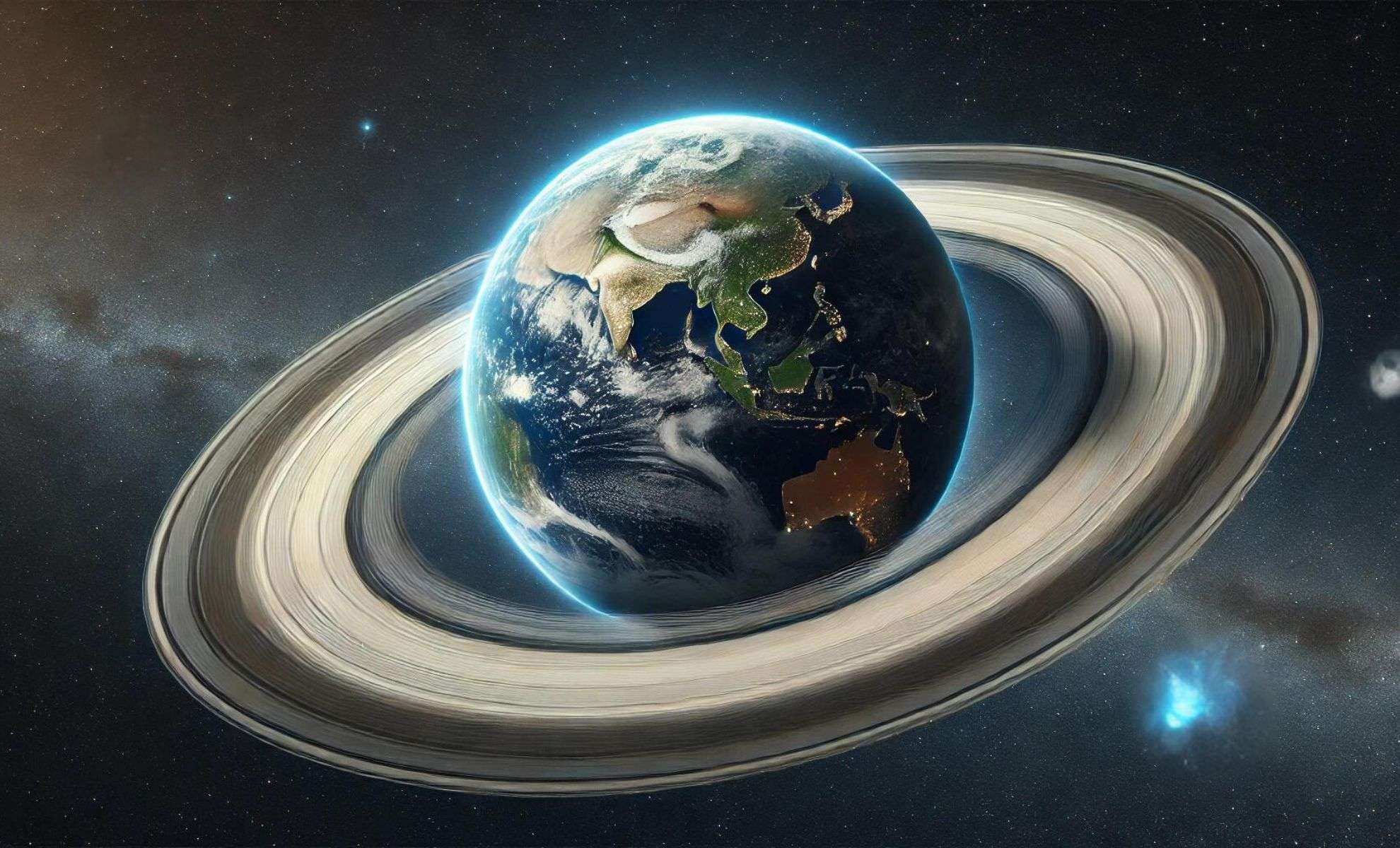
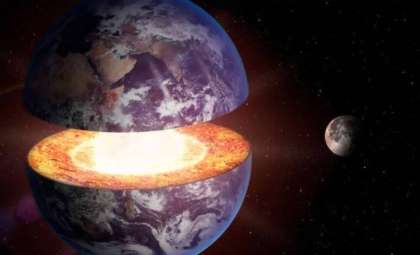
Recent geological findings indicate that Earth may have been surrounded by a debris ring similar to those seen around Saturn.
A team from Monash University in Australia introduced this idea in a paper published in Earth & Planetary Science Letters. Their research suggests that roughly 466 million years ago, a colossal asteroid breakup gave rise to a ring encircling Earth that endured for millions of years. This ring could have played a significant role in triggering climatic shifts and sculpting Earth’s geological features.
Under the leadership of Professor Andy Tomkins, the scientists focused on a striking cluster of impact craters from that era, mostly found near the equator. They propose that fragments from the disintegrated asteroid continually bombarded equatorial regions over an extended period.

Tracing the Ring’s Existence Through Crater Patterns
The concept that our planet once had a ring system stems from the distinctive concentration of impact craters dated to 466 million years ago. Examining 21 known craters from this timeframe, the group led by Professor Andy Tomkins discovered these impacts all lie close to Earth’s equatorial band — a departure from the typically random distribution of meteor strikes. By reconstructing original crater locations using tectonic plate movement models, they found the impacts occurred within 30 degrees latitude of the equator.
Professor Tomkins remarked, “Considering a ring system’s potential influence on global temperature adds complexity to the ways extraterrestrial events shape Earth’s climate.” Their hypothesis envisions an asteroid captured by Earth’s gravity that broke apart to form a ring. Over tens of millions of years, this material gradually fell back toward Earth, primarily impacting equatorial regions.
How a Ring Could Have Affected Earth’s Climate
Such a ring might have significantly altered Earth’s climate. Approximately 20 million years after the ring’s formation, Earth experienced the Hirnantian Ice Age, one of its coldest climatic phases. The research suggests the ring might have contributed by creating shading that blocked sunlight near the equator.
The team believes this debris ring cast an equatorial shadow zone reducing solar energy reaching the surface, thus cooling global temperatures. This could explain the timing and intensity of the Hirnantian Ice Age. While volcanic eruptions and atmospheric changes likely played roles, the temporary ring could have intensified the cooling event.
Context Within the Solar System’s Ringed Worlds
The idea of Earth once sporting a ring is novel but aligns with the phenomenon observed on other planets. Saturn’s magnificent rings are iconic, yet rings also envelop Jupiter, Uranus, and Neptune, composed largely of ice and rock particles orbiting their host planets. Earth’s hypothesized ring, however, would have consisted mainly of rocky fragments from the shattered asteroid.
Notably, planetary rings tend to be short-lived. Even Saturn’s rings are relatively young—estimated at around 10 million years—and slowly deteriorate. Meanwhile, Mars is actively breaking apart its moon Phobos, which could create a ring in the coming 20 to 40 million years. If Earth did have a ring, it likely existed for only tens of millions of years before dispersing.
Exploring the Climatic and Geological Impacts of an Ancient Earth Ring
This new ring hypothesis invites many questions about its influence on Earth’s climate and geological development. The team plans to simulate how asteroids fragment and establish rings, then model how such a ring would evolve and interact with Earth’s environment over millions of years. Unraveling these dynamics may reveal how the ring contributed to planetary cooling and the Hirnantian Ice Age.
A ring system could have cast shadows over wide equatorial zones, cutting solar radiation and modifying weather, ocean currents, and temperature gradients. Future research will probe these thermal and climatic effects.
Researchers will also investigate whether prolonged debris fallout impacted tectonic activity, shaped landforms, or even triggered mass extinction events. Examining crater distributions and meteorite deposits in geological records can offer insights into the ring’s long-term influences.
By comparing with other planets, especially Mars’ emerging ring from Phobos’ breakup, scientists hope to understand how rings affect planetary environments. These cosmic insights could illuminate Earth’s ancient history and aid future planetary exploration.
- Categories:
- News







0 comments
Sign in to Comment