
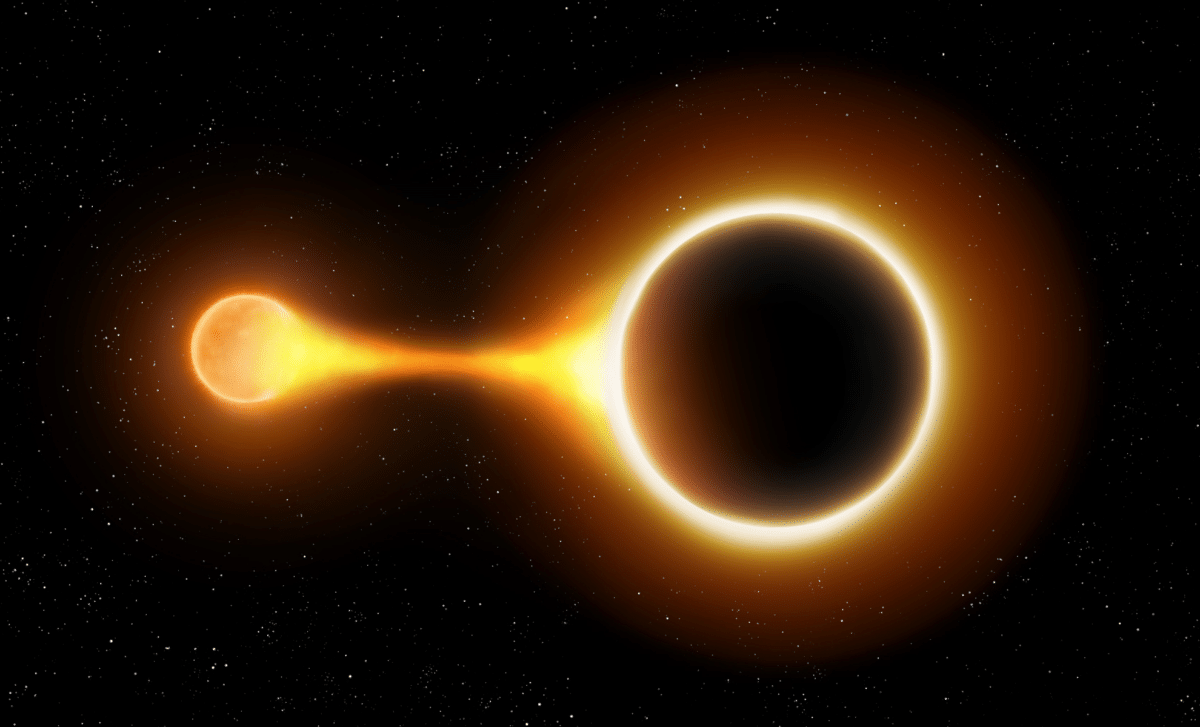
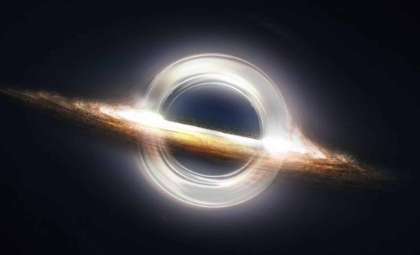
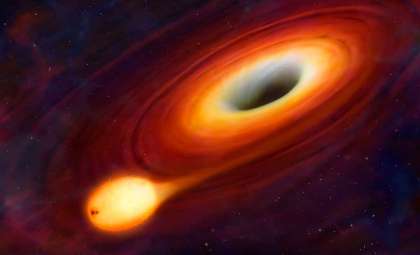
Astronomers have successfully witnessed, for the first time, a rotating black hole dragging spacetime around it, an effect termed Lense-Thirring precession. Revealed in a recent Science Advances publication, this discovery validates a key prediction of Einstein’s general relativity. The event was observed during a dramatic tidal disruption event (TDE) named AT2020afhd, where a star approached a supermassive black hole, was ripped apart, producing a luminous, wobbling accretion disk and highly relativistic jets.
Star’s Destruction Reveals a Subtle Cosmic Phenomenon
The remarkable cosmic occurrence behind this discovery went beyond spectacle—it uncovered a crucial piece of physics. After AT2020afhd’s star was torn apart by gravity, its remnants formed a compact disk swirling around the black hole, shooting jets at near light speed. The standout feature was the consistent oscillation of the disk and jets, repeating roughly every 20 days, providing direct evidence of the black hole’s spin distorting spacetime around it.
This precession stems from a theoretical insight first posited by Einstein in 1913 and later rigorously described by Josef Lense and Hans Thirring in 1918. This phenomenon, known as frame-dragging, proposes that spinning massive bodies twist the fabric of spacetime, much like a stirring spoon influences honey. Direct observation of this subtle effect has long eluded researchers—until now.

Dr. Cosimo Inserra, a co-author of the report published in Science Advances and an astrophysicist at Cardiff University, highlighted the significance of the finding:
“Our study shows the most compelling evidence yet of Lense-Thirring precession – a black hole dragging space time along with it in much the same way that a spinning top might drag the water around it in a whirlpool.”
He further noted the value of this phenomenon for studying black hole behavior and tidal disruption events:
“This is a real gift for physicists as we confirm predictions made more than a century ago. Not only that, but these observations also tell us more about the nature of TDEs – when a star is shredded by the immense gravitational forces exerted by a black hole.”
Validation Through Multiwavelength Observations
The research team integrated observations from NASA's Neil Gehrels Swift Observatory and the Karl G. Jansky Very Large Array to detect the signature of precession. Unlike the steady emissions typically seen in TDEs, the X-ray and radio signals from AT2020afhd fluctuated noticeably, hinting at complex dynamics beyond standard energetic outputs.
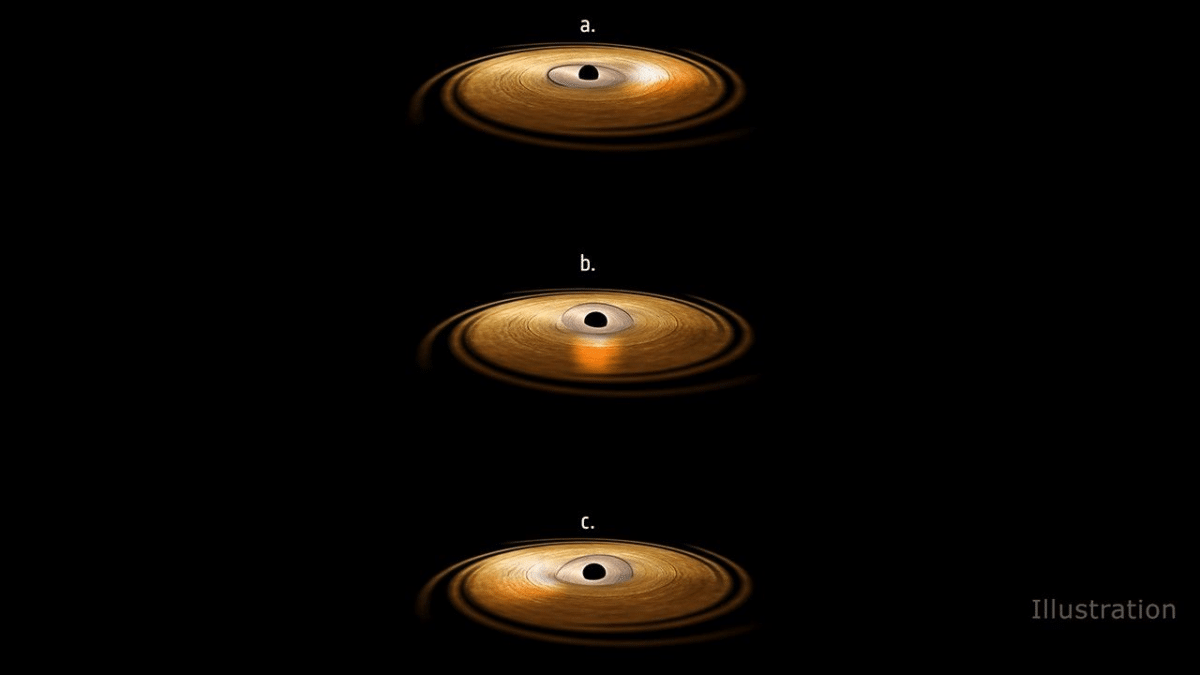
Using electromagnetic spectroscopy, scientists confirmed that both the accretion disk and the jets were co-precessing, oscillating in unison. These results go past simple observations of energetic changes and directly illustrate the dynamics of frame-dragging in play.
Dr. Inserra elaborated:
“Unlike previous TDEs studied, which have steady radio signals, the signal for AT2020afhd showed short-term changes, which we were unable to attribute to the energy release from the black hole and its surrounding components. This further confirmed the dragging effect in our minds and offers scientists a new method for probing black holes.”
This real-time measurement of the black hole’s gravitomagnetic effect—the curved trajectories of matter within warped spacetime—enhances our understanding of black hole rotation, jet formation, and the destiny of matter under extreme gravitational influence.
Understanding the Nature of Cosmic Spin and Gravitomagnetism
At the core of this frame-dragging phenomenon is the principle that rotational motion generates influential fields. Similar to how a spinning electric charge produces a magnetic field, a rotating mass as dense as a black hole creates a gravitomagnetic field that alters spacetime geometry around it.
This idea, theorized for over a century, has now transitioned from theory into observable fact, thanks to instruments sensitive enough to detect subtle variations in emissions across various wavelengths.
Dr. Inserra provided an evocative comparison:
“By showing that a black hole can drag space time and create this frame-dragging effect, we are also beginning to understand the mechanics of the process.
So, in the same way a charged object creates a magnetic field when it rotates, we’re seeing how a massive spinning object – in this case a black hole – generates a gravitomagnetic field that influences the motion of stars and other cosmic objects nearby.”
This insight strengthens astrophysical links among mass, motion, and spacetime structure, with potential impacts on models of galaxy formation, jet behavior, and the evolving dynamics of accretion disks.
A Cosmic Milestone During Reflective Times
Though deeply technical, the discovery resonates on a human level, sparking awe about our universe’s mysteries. Beyond confirming Einstein's theory, it opens up new avenues for exploring the universe’s most extreme environments.
Reflecting the spirit of wonder, Dr. Inserra stated:
“It’s a reminder to us, especially during the festive season as we gaze up at the night sky in wonder, that we have within our grasp the opportunity to identify ever more extraordinary objects in all the variations and flavors that nature has produced.”
By pushing observational frontiers, this work now enables scientists to probe the invisible fabric of spacetime, shaped and contorted by forces predicted over a century ago.
- Categories:
- Physics






0 comments
Sign in to Comment