
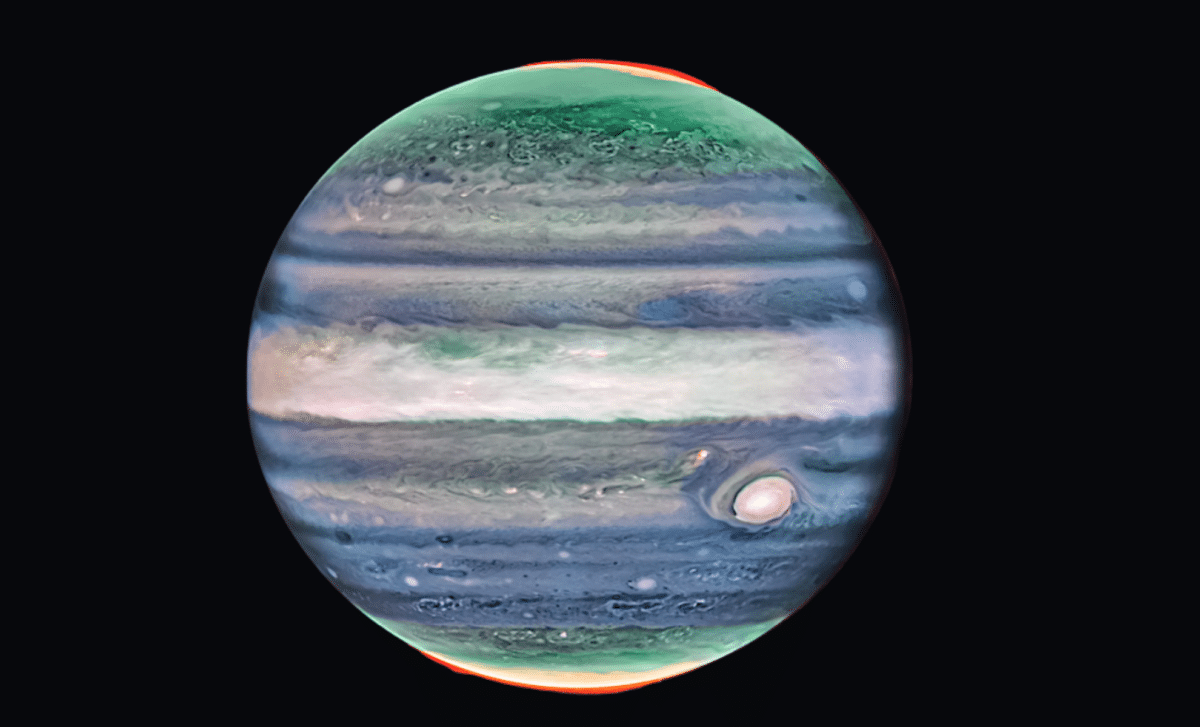
Scientists have produced the most detailed global map to date of Jupiter’s upper atmosphere, uncovering a remarkably stable and persistent atmospheric framework that has endured for years. Published in The Astrophysical Journal Letters, this groundbreaking work is set to transform how we comprehend atmospheric dynamics not only on Jupiter but throughout the solar system. For years, atmospheric behavior on Jupiter was thought to be chaotic, but recent data reveals a much steadier, planet-wide atmospheric pattern.
A New Understanding of Jupiter’s Atmospheric Stability
Contrary to previous beliefs portraying Jupiter’s atmosphere as turbulent, the comprehensive study led by Kate Roberts at Boston University has revealed a more organized and consistent structure. By mapping the upper atmosphere globally, researchers discovered that temperature differences between Jupiter’s hemispheres are surprisingly stable, overturning longstanding ideas about fluctuating and unpredictable heat distributions. Their findings illustrate that the poles are consistently warmer than the equatorial region, exhibiting no erratic temperature spikes.
Roberts' team identified a gradual temperature decline from the poles to the equator, with values shifting from 833 Kelvin (1,040°F) near the poles to 754 Kelvin (900°F) around the equator. This persistent trend over multiple years contradicts earlier models suggesting erratic heat variations, offering a valuable framework for examining thermal energy transport on giant planets.

“This stability establishes a fixed baseline for interpreting how heat and charged particles move across the planet, setting up the mechanisms that drive those patterns,” Roberts said.
Implications for Broader Planetary Atmosphere Research
The identification of a stable atmospheric pattern on Jupiter holds far-reaching importance beyond this gas giant, impacting our grasp of atmospheric behavior on other large planets, as well as Earth. Jupiter’s powerful magnetic field and vivid auroras reflect a dynamic balance of heat flow and charged particle activity that is now better understood, helping decode similar processes in atmospheres across the cosmos.
“Understanding upper atmospheres as a whole will help us understand Earth,” said Roberts.
These findings contribute to fundamental questions about atmospheric responses under extreme conditions, vital for advancing the study of exoplanets and other bodies in our solar neighborhood. If Jupiter’s atmospheric patterns are reflected elsewhere, scientists might finally clarify puzzling atmospheric phenomena on distant gas giants and exoplanetary worlds.
Influence of Winds and Ionized Gases on Jupiter’s Upper Atmosphere
One of the study’s most intriguing revelations, detailed in The Astrophysical Journal Letters, concerns the role of high-altitude winds. Unlike Earth, where atmospheric circulation primarily shapes weather, Jupiter’s upper atmosphere is driven by expansive winds guiding charged gases along magnetic field lines, creating vertical movements crucial to atmospheric stability. These winds manage the distribution of ions like H3+, a hydrogen ion that emits infrared light, which serves as a window into Jupiter’s atmospheric conditions.
This vertical transport of ionized gas is key to clarifying Jupiter’s ionosphere's behavior. It influences where charged gases accumulate and explains infrared brightness patterns previously misattributed solely to temperature changes, highlighting charged particle density as the underlying factor.
A Comprehensive View of Jupiter’s Energy Emissions
The investigation also uncovers new insights about how Jupiter balances its energy. Rather than perfectly retaining incoming energy, Jupiter releases vast amounts back into space. Researchers estimate that roughly 25.8 trillion watts of energy escape from the upper atmosphere around midday, with the majority originating from mid-latitude regions rather than the auroral zones.
This finding challenges earlier assumptions regarding the sources of Jupiter’s heat and invites a revised understanding of thermal dynamics on gas giants. With this updated atmospheric map, Roberts’ team is poised to refine models of planetary energy loss, providing fresh perspectives on Jupiter’s overall energy cycle and the physics governing planetary atmospheres.
“The goal of my research is to try and narrow down where all this extra energy is coming from,” Roberts explained, emphasizing the ongoing importance of unraveling Jupiter’s complex thermal mechanisms.
- Categories:
- Astronomy









0 comments
Sign in to Comment