

In 1997, observers across the globe were treated to an extraordinary cosmic spectacle: Comet Hale-Bopp, a colossal comet visible without any aid for an astonishing 569 days. Its discovery and prolonged presence captivated both astronomers and the general public alike, marking a milestone in space observation. Recently, NASA’s Hubble Space Telescope unveiled remarkable imagery showcasing this gigantic comet’s impressive tail and gigantic nucleus, which dwarfs by about five times the size of the celestial body linked to the dinosaurs’ extinction event.
The Fortuitous Unveiling of Hale-Bopp
On July 23, 1995, two independent astronomers, Alan Hale and Thomas Bopp, made the accidental discovery of what would become known as the “Great Comet of 1997.” Their discovery happened quite by chance as both were exploring the night sky for unrelated astronomical objects. Hale, based in New Mexico, was observing a previously identified comet and was aiming his telescope at a star cluster within Sagittarius.
“As soon as I looked,” Hale told Time, “I saw a fuzzy object nearby. It was strange, because I’d looked at M70 a couple of weeks earlier and the object hadn’t been there.”
Add Cosmo Herald as a Preferred Source

Meanwhile, Bopp, located in Arizona, observed the same unexpected object. Recognizing it as an unknown entity, both astronomers promptly reported their findings to the Central Bureau for Astronomical Telegrams to officially announce the discovery of a new comet. While Hale’s notification arrived quickly via digital transmission, Bopp’s telegram took longer to reach the Bureau, prompting humorous remarks from Brian Marsden, the Bureau’s director:
“Nobody sends telegrams anymore… by the time that telegram got here, Alan Hale had already e-mailed us three times with updated coordinates.”
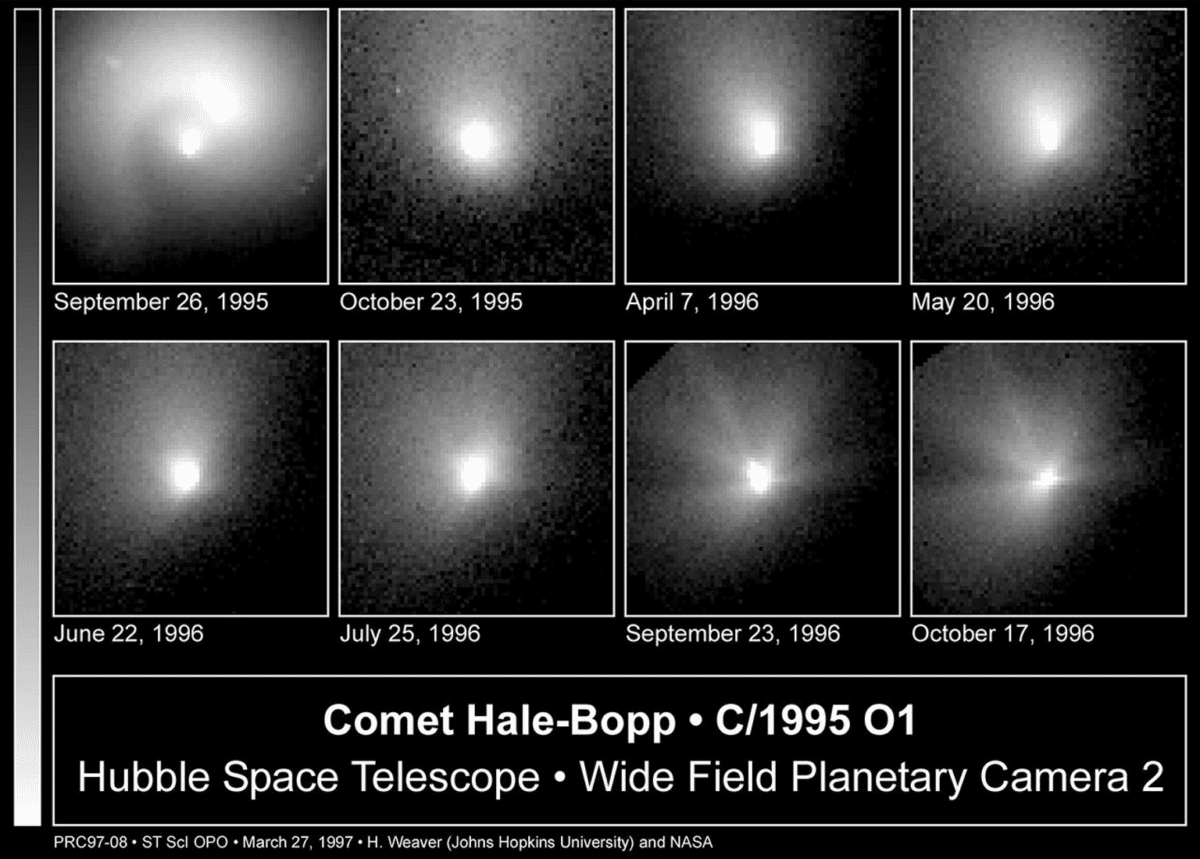
Astonishing Longevity: Hale-Bopp’s 569-Day Display
What truly set Hale-Bopp apart was the extraordinary length of time it remained visible. Most comets grace the night sky for mere weeks or a few months before fading away, but Hale-Bopp defied this expectation by remaining visible to the naked eye for a record-breaking 569 days. From the end of 1996 through mid-1997, viewers worldwide enjoyed the brilliant spectacle of this comet as it journeyed across the night sky.
This impressive visibility was largely due to the comet’s immense size. NASA estimates that the nucleus of Hale-Bopp is about 37 miles (60 kilometers) wide, roughly five times larger than the asteroid believed to have caused the dinosaur extinction. This tremendous scale enabled the comet to shine brightly over an extended period, providing a breathtaking celestial show. At its closest point to the Sun, the comet’s luminous tail stretched dramatically, creating a breathtaking vista for observers.
The Epic Voyage of Hale-Bopp: A 2,534-Year Orbit
Hale-Bopp’s elliptical path around our Sun spans an impressive 2,534 years, making this rare sighting a once-in-a-lifetime event for modern observers. Its nearest approach to the Sun, or perihelion, occurred on April 1, 1997. The comet’s brightness was so intense at times that it was visible during daylight hours, attracting attention from astronomers at all levels. Arriving during a time of increased interest in space exploration and comet research, its impact was particularly profound.
Though its appearance was temporary, Hale-Bopp left a lasting legacy within astronomy and popular culture. Renowned as the “Great Comet” of its era, it set new standards for comet visibility and size. The tail, extending millions of kilometers into space, painted the night in brilliant blue and white tones, captivating countless viewers. While the comet has long since moved away from Earth, the memory of its magnificent display endures, inspiring awe decades later.
- Categories:
- News













0 comments
Sign in to Comment