
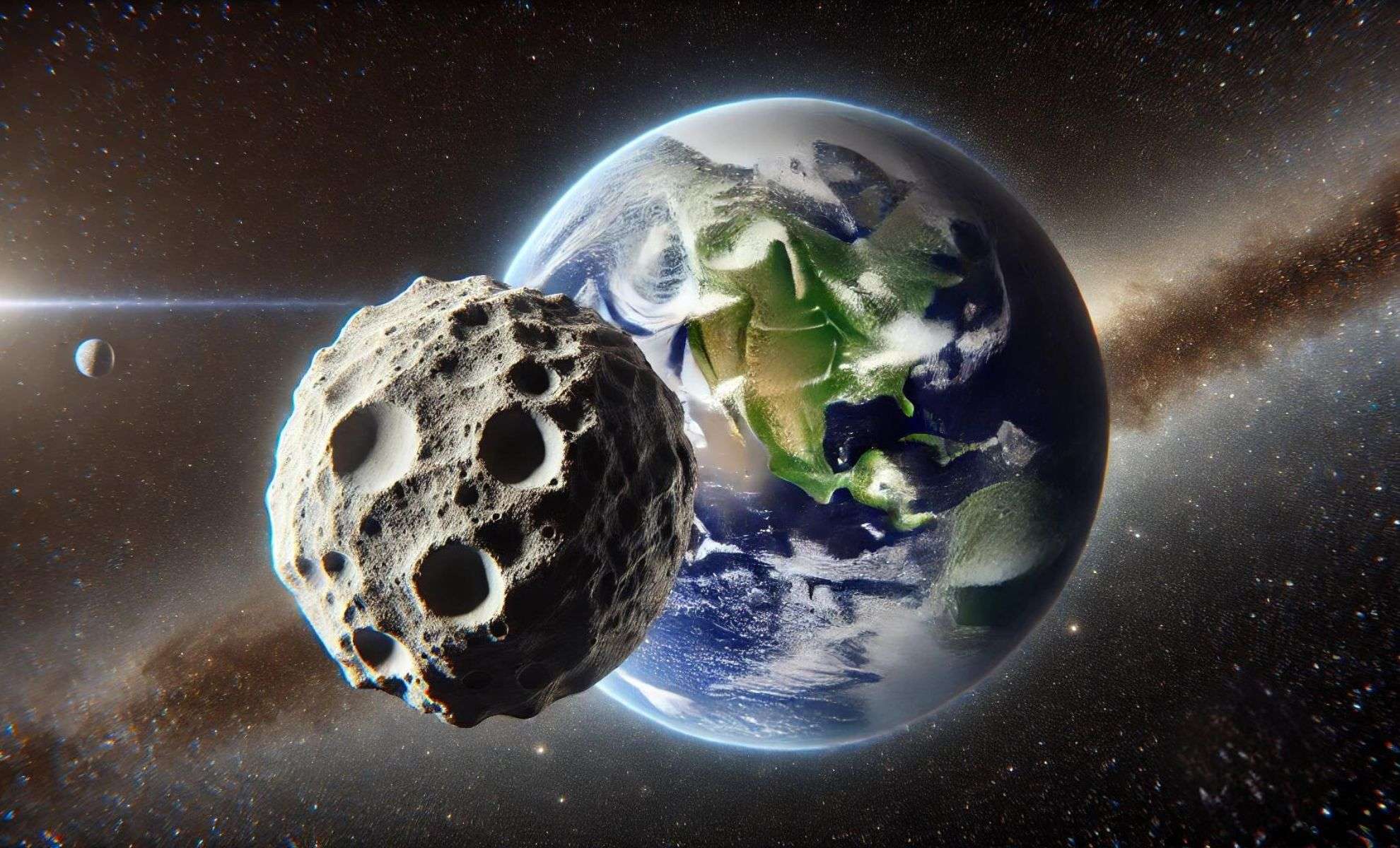
Beginning on September 29, 2024, Earth will gain a temporary second ‘moon’ as asteroid 2024 PT5 is captured by our planet’s gravity, remaining nearby for almost two months before resuming its solar orbit.
Understanding Mini-moons: Formation and Characteristics
A mini-moon happens when a small space object, like an asteroid, is momentarily trapped by Earth’s gravitational field. Unlike the stable orbit of our natural Moon, these objects have unstable trajectories and soon escape. Although uncommon, previously observed mini-moons have provided researchers with valuable data on the gravitational interactions between Earth and these small bodies.
These mini-moons form when an asteroid approaches Earth with the precise velocity and angle needed to be gravitationally captured temporarily. If these conditions change even slightly, the asteroid either continues past Earth or enters orbit. Studying these events helps scientists better understand how gravity governs the movement of small solar system objects.

Asteroid 2024 PT5: A Brief Earthbound Satellite
Asteroid 2024 PT5 was discovered on August 7, 2024, by the Asteroid Terrestrial-Impact Last Alert System (ATLAS). Measuring roughly 33 feet (10 meters) across, this small asteroid will enter a temporary Earth orbit starting September 29 and remain until November 25, 2024. According to researchers Carlos and Raúl de la Fuente Marcos, 2024 PT5 will perform a temporarily captured flyby, failing to complete a full orbit before leaving Earth’s gravitational sphere and continuing its path around the Sun.
Although ephemeral, this mini-moon event represents an excellent chance for astronomers to observe how Earth’s gravity affects small asteroids. Belonging to the Arjuna group — near-Earth objects with Earth-like orbits — 2024 PT5’s low relative speed and proximity enabled Earth to snag it briefly.
Amateur astronomer Tony Dunn shared a visual simulation on X (formerly Twitter) showing 2024 PT5's short-lived orbital dance as Earth’s mini-moon:
Newly-discovered #asteroid 2024 PT5 is about to undergo a “mini-moon event” when its geocentric energy becomes negative from September 29 – November 25.https://t.co/sAo1qSRu3J pic.twitter.com/pVYAmSbkCF
— Tony Dunn (@tony873004) September 10, 2024
Is the Mini-moon Visible to Star Gazers?
Despite the exciting arrival of 2024 PT5 as a mini-moon, its small size and faintness make it impossible to see without specialized instruments. With a magnitude of 22, it remains far beyond the visibility of the naked eye and most amateur telescopes. Generally, objects need to be brighter than magnitude 6 to be detected without high-end equipment, meaning only professional observatories can track it.
While invisible to most observers, astronomers will closely observe 2024 PT5 using radar and sensitive instruments. Monitoring how Earth’s gravity interacts with this asteroid provides crucial insights into asteroid behavior during close Earth encounters and supports preparations for future asteroid missions.
Significance of Mini-moons in Research
Though small and transient, mini-moons like 2024 PT5 offer valuable perspectives on the gravitational mechanics of near-Earth objects. Understanding Earth’s temporary captures enhances predictive models for asteroid trajectories, which is vital for planetary defense strategies against potential threats.
Furthermore, mini-moons attract interest from asteroid mining and space exploration efforts. Due to their proximity and accessibility, these objects could serve as viable targets for scientific study or resource extraction. As technologies advance, mini-moons may become platforms for testing innovative space mission concepts, paving the way for future exploration milestones.
Though brief, the appearance of 2024 PT5 as Earth’s temporary mini-moon highlights the dynamic nature of our planet’s interactions with small bodies in the solar system.
- Categories:
- Astronomy ,
- News ,
- Space







0 comments
Sign in to Comment