
For many years, the search for extraterrestrial intelligence has captivated scientists worldwide. Efforts have ranged from monitoring radio transmissions and detecting laser signals to analyzing infrared emissions that could indicate advanced alien technologies. Despite this extensive pursuit, confirmed extraterrestrial signals remain elusive. A recent paper published in The Astronomical Journal raises a compelling question: if alien communications have already reached Earth, why haven’t we identified them? Claudio Grimaldi, a theoretical physicist at the École Polytechnique Fédérale de Lausanne (EPFL), suggests the chance that we’ve overlooked such signals is greater than earlier estimates indicated.
The Difficulty of Capturing Alien Technosignatures
Technosignatures refer to detectable traces of alien technology, encompassing everything from artificial radio broadcasts and laser flashes to heat anomalies from mega-structures. For us to observe these technosignatures, two key factors must be met: signals must reach Earth, and our detection systems must be sensitive enough to recognize them. While the first seems simple, the latter is highly intricate. Even if extraterrestrial signals have passed through our solar system, they might have been too faint, transient, or mingled with cosmic background noise, escaping notice. How likely we are to detect these signals depends greatly on our instruments’ tuning to various frequencies, plus the signal’s strength and duration.
The suggestion that some alien transmissions may have been missed due to technological constraints remains a debated topic among astronomers. While some theorize past surveys might have captured signals undetected, the possibility of overlooking them remains high because of such limitations. Grimaldi’s research introduces a different angle: the actual volume of alien signals intersecting Earth might be smaller than commonly assumed.

EPFL Study: A Statistical Model for Alien Signal Detection
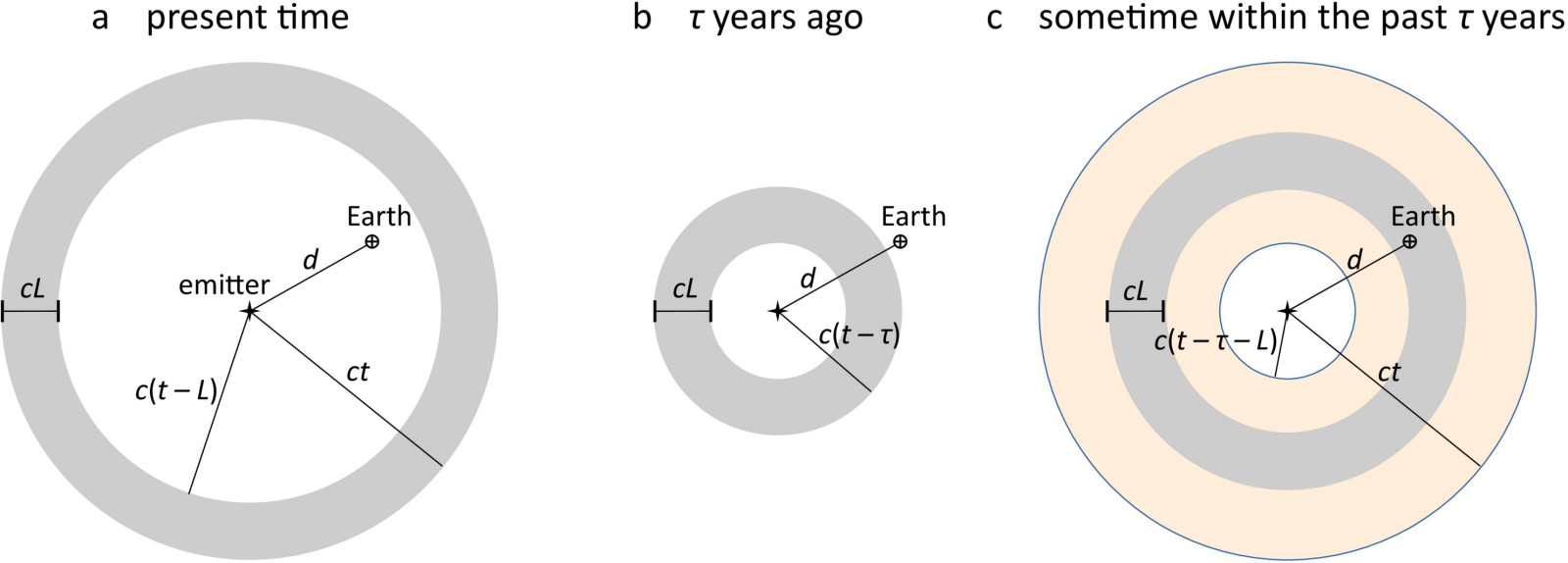
In his study featured in The Astronomical Journal, Grimaldi employs statistical modeling to rethink the search for alien technosignatures. His approach assesses the likelihood of registering signals from far-off advanced civilizations, factoring in signal lifetimes and realistic source distances. The findings imply that a high chance of detecting signals today necessitates a considerable number already having swept past Earth without detection. According to his calculations, this scenario becomes increasingly improbable, especially considering that potential signal sources might outnumber the habitable worlds in specific galactic regions.
The research distinguishes two technosignature types: omnidirectional emissions like thermal waste from gigantic engineering efforts, and highly focused signals such as targeted beacons or laser bursts. While omnidirectional signals disperse widely and can be diffuse, focused signals are concentrated but require cutting-edge sensor sensitivity to capture. Grimaldi’s framework sheds light on why previous attempts may have failed to find definitive signs of alien civilizations.
Reasons Behind the Continued Absence of Alien Signal Detection
Given the possibility that alien signals have passed near Earth without our awareness, why have we yet to register any despite long-standing efforts? Grimaldi’s analysis points to the universe’s enormous scale and the limited scope of our searching techniques. The Milky Way’s diameter spans about 100,000 light-years, and even state-of-the-art telescopes survey only minuscule portions of the sky. The hypothesized signals are expected to be exceedingly rare, so only a handful might be detectable at any one time. Success in finding these transmissions depends not just on advanced tools, but also on strategic targeting and timing.
Additionally, signal characteristics complicate detection further. For instance, a narrow laser beam could arrive too weak to register or completely miss our detectors’ coverage. Conversely, broad omnidirectional emissions might be stronger but get lost within the vast cosmic noise. These challenges collectively mean that even if extraterrestrial transmissions exist, their chances of being intercepted at the right moment remain extraordinarily slim.
- Categories:
- News













0 comments
Sign in to Comment