

A team from the SETI Institute and Penn State University has conducted the most extensive search yet for extraterrestrial radio transmissions from the TRAPPIST-1 star system. Utilizing the enhanced Allen Telescope Array (ATA), they observed the system for a total of 28 hours, aiming to identify indications of intelligent alien technology.
TRAPPIST-1: A Key Location in the Quest for Extraterrestrial Life
Sitting approximately 41 light-years away in the constellation Aquarius, TRAPPIST-1 has attracted significant attention as a potential host for life beyond our solar neighborhood. This system contains seven rocky planets, several positioned within the habitable zone—the circumstellar region where liquid water could potentially exist on planetary surfaces. This critical factor boosts its appeal for life detection studies.
This investigation represents the longest continuous radio survey ever devoted to the TRAPPIST-1 system. Researchers employed the upgraded Allen Telescope Array to search for technosignatures—specialized radio signals that could reveal the presence of technological civilizations. Such signals may originate from deliberate broadcasts or incidental emissions from alien technology.

“TRAPPIST-1 remains among the most promising systems in our search for extraterrestrial intelligence,” stated Nick Tusay, a graduate research fellow at Penn State University. “With multiple planets situated in the habitable zone, it’s an excellent location for this kind of investigation.”
The advanced capabilities of the ATA enabled analysis of millions of signal candidates, ultimately filtering down to around 11,000. Of these, 2,264 were associated with planet-planet occultations (PPOs), events where one planet passes in front of another from our viewpoint. Such configurations could theoretically allow detection of interplanetary communications from a hypothetical civilization. Despite this, no signals were confirmed to originate outside Earth.
Cutting-Edge Techniques and Future Prospects in the Search for Alien Technology
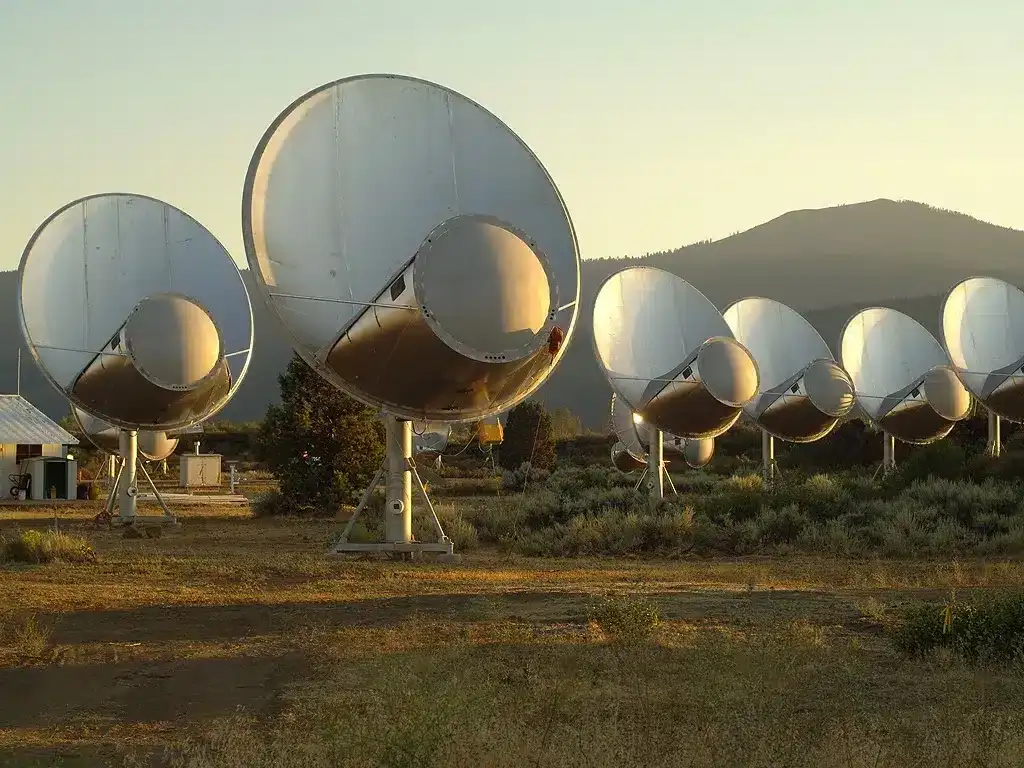
Although no alien transmissions were found, this work marks significant progress in extraterrestrial intelligence detection methods. The Allen Telescope Array in California’s Lassen National Forest is crucial to this effort, and recent enhancements have enabled more sensitive scans of remote star systems. The research particularly targeted narrowband signals, which are prime candidates for signs of artificial technological sources outside the solar system.
A notable approach involved examining planet-planet occultations, a newer tactic designed to improve detection chances during mutual planetary alignments. “Most searches look for intentional beacons,” explained Tusay. “Our receivers can detect signals above a certain power threshold, so limitations exist. However, with next-generation instruments like the Square Kilometer Array (SKA), observing extraterrestrial spacecraft transmissions may become feasible.”
The SKA is poised to transform radio astronomy upon its future completion. This $2.2 billion project will deploy over 130,000 antennas in Western Australia and nearly 200 radio dishes in South Africa, covering one square kilometer. Such scale will enable detection of extremely weak signals, including both intentional transmissions and inadvertent broadcasts from distant civilizations.
Researchers are enthusiastic about these advances. “Our study demonstrates progress toward identifying signals comparable to human radio emissions,” said Tusay. “When the SKA comes online, we’ll extend our reach deeper into space and increase our chances of finding intelligent life.”
Ongoing Efforts in the Pursuit of Extraterrestrial Communications
Though this campaign did not yield extraterrestrial technosignatures, it sets a solid precedent for subsequent studies. The SETI Institute and collaborators continue refining their search protocols and expanding observational targets beyond TRAPPIST-1. The system’s Earth-sized worlds and potential habitability keep it central to future investigations.
Published recently as a preprint and undergoing peer review for the Astronomical Journal, the results emphasize the need to advance methodologies and instrumentation. With more powerful observatories like the SKA on the horizon, researchers remain hopeful that forthcoming searches will produce more definitive discoveries.
Tusay underscored the gradual but steady nature of this quest: “While this attempt didn’t yield detections, each step leads us closer to grasping the cosmos’ mysteries. Enhanced technology and novel strategies make me confident we will eventually detect extraterrestrial signals. Patience and persistence are key.”
- Categories:
- News ,
- Extraterrestrial life












0 comments
Sign in to Comment