
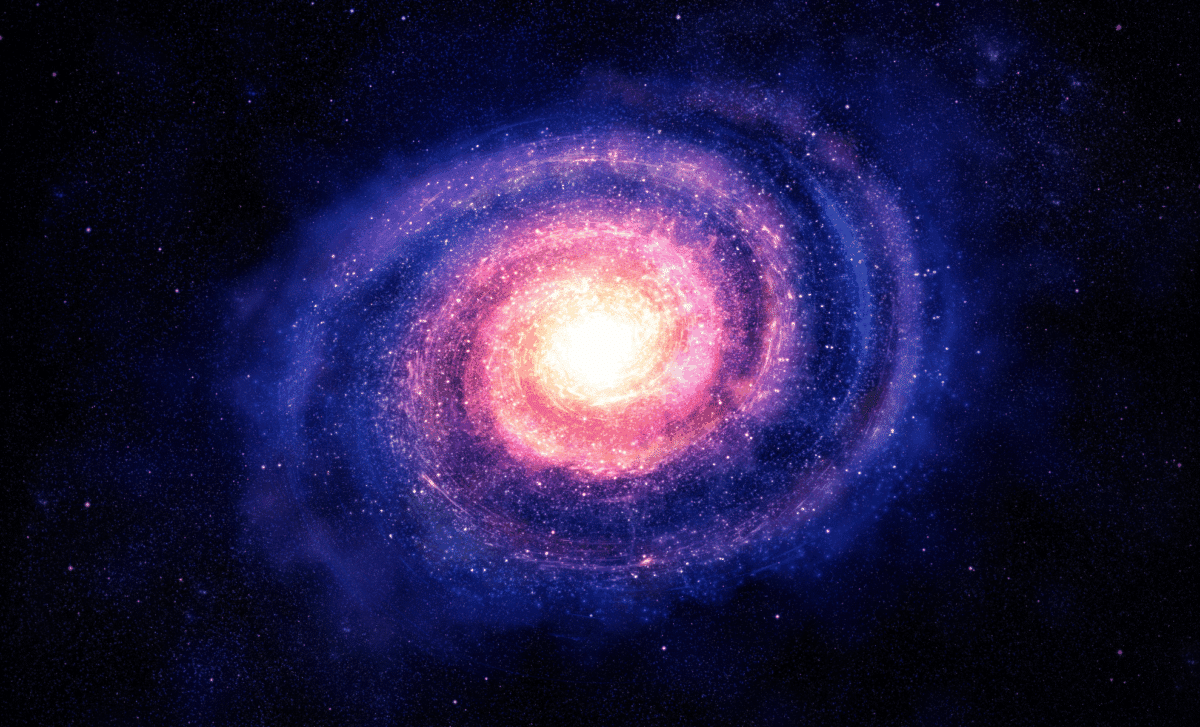
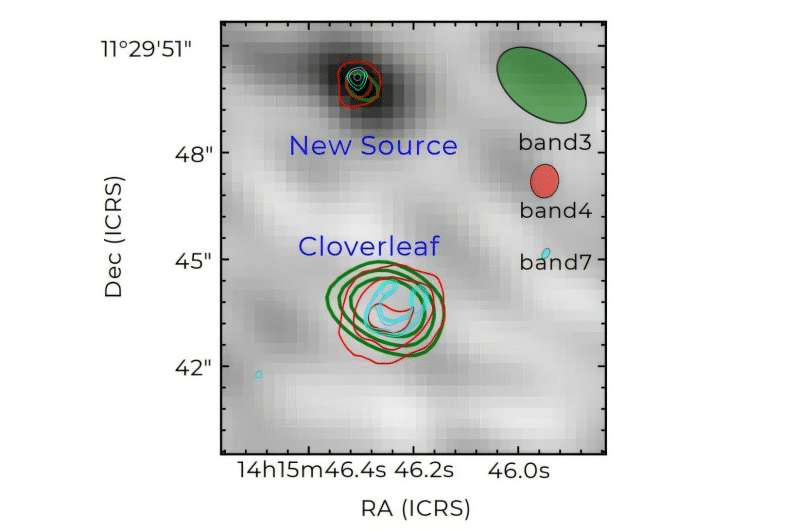
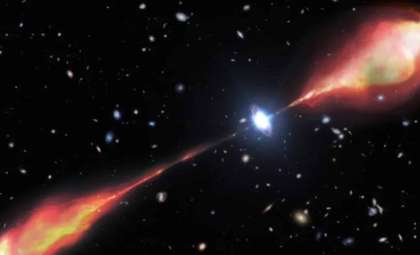
A team of astronomers led by Natsuki H. Hayatsu has unexpectedly detected an ultra-luminous infrared galaxy (ULIRG) concealed behind the Cloverfield quasar, H1413+117, located at a redshift of 3.39. This finding, detailed in Monthly Notices of the Royal Astronomical Society, emphasizes the critical role these luminous galaxies play in tracing star formation during the universe’s formative eras. This latest insight adds to the growing knowledge surrounding the nature of ULIRGs.
Unexpected Find Behind the Cloverfield Quasar
Using the highly sensitive Atacama Large Millimeter/submillimeter Array (ALMA), researchers pointed their instruments toward the well-studied Cloverfield quasar (H1413+117), unaware that a spectacular discovery awaited them. The quasar, famous for its quadruple gravitational lensing, served as the backdrop for revealing a ULIRG previously hidden from view. At redshift 3.39, this galaxy exists in an evolutionary phase that traditional optical methods fail to observe clearly, posing challenges to astronomers studying early cosmic star formation.
Analysis of the gathered data revealed the galaxy’s infrared output to be immense—around 2.8 trillion times that of our Sun. Its molecular gas content spans an estimated 40 to 230 billion solar masses, pointing to an exceptionally active and dense star-forming environment. The central black hole’s mass is approximately 100 million solar masses. Such traits strongly indicate extremely vigorous starburst activity typical of ULIRGs, highlighting its importance in unraveling cosmic history.

The Enigma of Optically Invisible Galaxies
The identification of this ULIRG hidden behind the Cloverfield quasar sheds light on the complexities faced when probing the early universe. These galaxies are often thickened by copious dust and primarily detected via their strong infrared emissions, which signal rampant star formation. Their optical and ultraviolet signatures are faint or absent because dust obscures visible light, making them largely undetectable with conventional optical telescopes.
The researchers explain,
“Dusty, submillimeter-selected galaxies without optical counterparts contribute a non-negligible fraction of the star formation in the early universe. However, such a population is difficult to detect through classical optical/ultraviolet-based surveys. We report the serendipitous discovery of such an optically dark galaxy, behind the quadruply-lensed z = 2.56 quasar, H1413+117.”
This optical invisibility points to a highly complex environment where massive clouds of dust absorb and scatter starlight, thwarting traditional imaging techniques. Technologies such as ALMA, operating in the submillimeter range, can pierce through this dust, unveiling these obscured galaxies and allowing astronomers to examine their star formation activity more effectively.
Starburst Triggered by Galactic Collision
The detected ULIRG is currently experiencing an early-stage major galactic merger, which likely drives its rapid star formation. Observations reveal that the molecular gas has not yet stabilized dynamically, indicating active disruption consistent with ongoing collision. Such mergers are key catalysts for the intense star-forming activity characteristic of ULIRGs. The galaxy’s abundant molecular gas reserves suggest that this starburst phase will continue as the merger progresses.
As the authors state,
“To infer the evolutionary stage of such an optically dark galaxy, be it a massive starburst, QSO [quasi-stellar object], or hot DOG, it is essential to clarify the physical state of the gas, especially the dense molecular gas that provides the fuel for star formation, and this will be the subject of future follow-up studies.”
This dynamic interaction, though chaotic, supplies the raw materials fueling new stars. By dissecting these merging processes, scientists can gain vital insights into how early galaxies formed and evolved. ULIRGs’ explosive star formation significantly impacts the growth and maturation of galaxies in the early cosmos.
Insights into the Early Universe’s Galactic Evolution
Studying this newly found ULIRG bears major implications for comprehending galaxy development over cosmic time. Continued research on similar objects will help astronomers piece together the intricate steps leading to galaxies like the Milky Way. Observing galaxies across different evolution stages allows tracing the transformation from dense molecular clouds to fully developed star systems.
Moreover, this breakthrough implies a substantial number of optically dark galaxies may remain concealed behind well-known astrophysical entities such as quasars. These hidden galaxies might be caught in nascent phases of starburst or merging activity. With advancements in detection methods and expanding survey efforts, the cosmic census of such obscured galaxies is likely to grow, enriching our understanding of the universe's formative architecture.
- Categories:
- News


0 comments
Sign in to Comment