
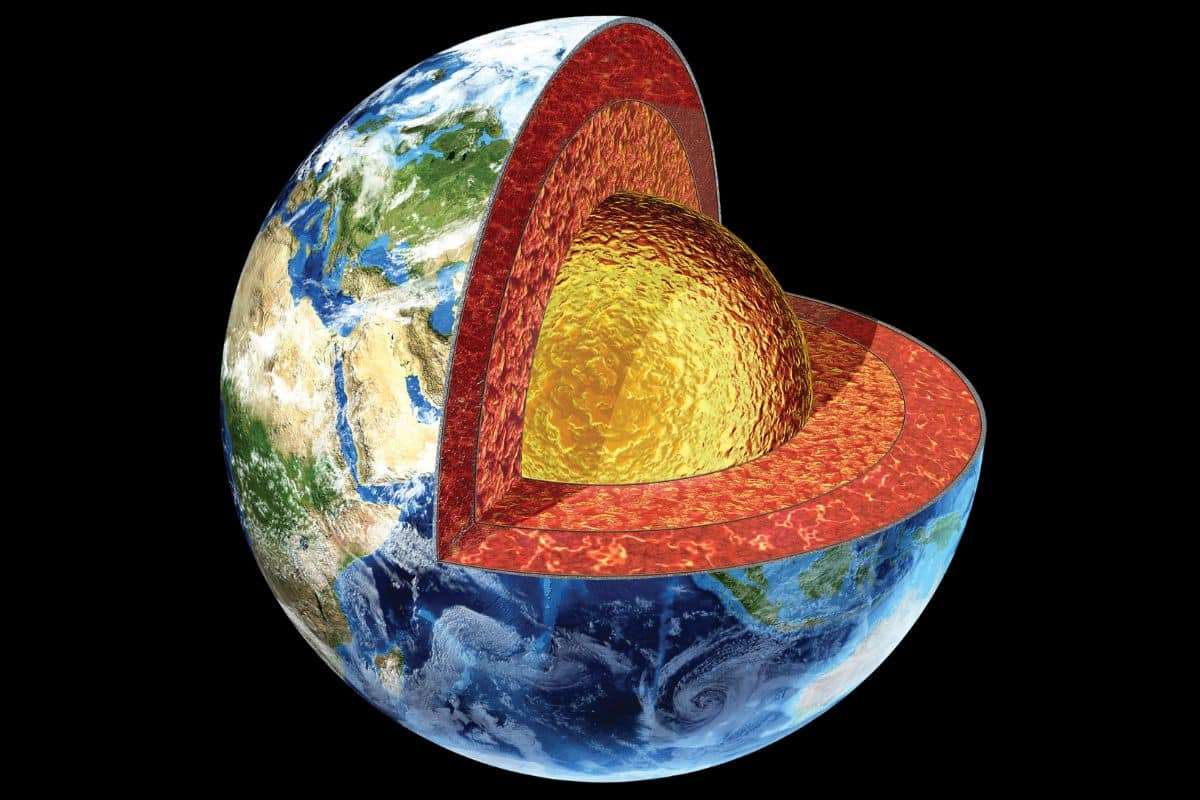
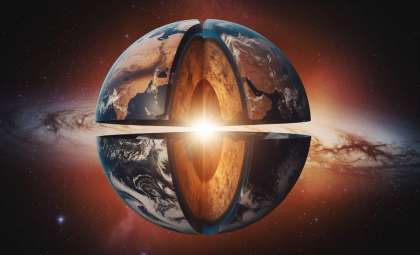
New research reveals that helium, traditionally seen as a nonreactive gas, can form stable bonds with iron when subjected to extreme environments. This insight points to the possibility that Earth’s core contains previously undetected helium deposits, challenging long-held ideas about how our planet formed and evolved.
Unexpected Bonding Under Intense Conditions
A paper in Physical Review Letters from researchers based in Japan and Taiwan explored elemental behavior at pressures and temperatures similar to those deep within Earth.
The team found that helium atoms can enter the iron crystal lattice, creating robust compounds that persist even after pressure decreases. Surprisingly, about 3.3% of iron samples incorporated helium—a concentration far exceeding prior estimates by thousands of times.

“Because studying such intense conditions is challenging, we use a laser-heated diamond anvil cell to replicate the necessary pressures and temperatures,”
explained Professor Kei Hirose, a lead scientist on the project.
“In these experiments, we compressed iron and helium together under pressures of 5 to 55 gigapascals and temperatures ranging from 1,000 kelvins up to nearly 3,000 kelvins. To put that in perspective, these pressures are about 50,000 to 550,000 times earth’s atmospheric pressure, and the highest temperatures could melt iridium, a metal noted for its heat resistance in car spark plugs.”
Connections to Earth’s Ancient Inner Layers
Scientists have identified elevated ³He/⁴He ratios in volcanic samples from regions including Hawaii and Iceland. These findings suggest the presence of primordial helium deep inside Earth, yet the mechanism allowing this helium to remain trapped has been unclear until now. The discovery that helium chemically binds with iron in the core provides a compelling explanation.
“Helium normally diffuses out easily under normal conditions; anyone who has seen a deflating helium balloon knows this,”
Hirose noted.
Revisiting Our Planet’s Formation Story
If helium reservoirs exist in the core, this reshapes how scientists view Earth's early history. It is believed that when Earth formed about 4.5 billion years ago, it captured large amounts of helium and hydrogen from the solar nebula, with some hydrogen later playing a role in ocean formation.
This breakthrough also invites a reassessment of element interactions at extreme pressures, an area crucial for understanding not only Earth's core but also the interiors of other planets such as the gas giants Jupiter and Saturn, where high-pressure chemical behavior is key to their characteristics.
Next Steps: Broadening the Search Beyond Earth
Going forward, researchers aim to explore how helium might bond with other core constituents like nickel and silicon. They are also keen to determine if similar hidden helium reservoirs might be present within the Moon or Mars, which could shed light on the evolutionary tales of these nearby bodies.







0 comments
Sign in to Comment