

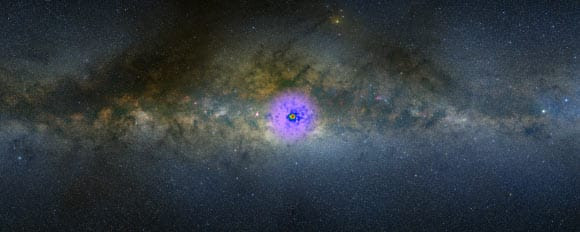
An enigmatic gamma-ray glow emanating from the Milky Way’s core continues to challenge astronomers. Recent investigations have yet to exclude self-annihilating dark matter as the origin of the energy known as the Galactic Center Excess. This emission forms a spherical halo of intense radiation spanning thousands of light-years around the galaxy’s nucleus.
For over ten years, scientists have been divided over whether this radiation arises from conventional sources like pulsars or from more exotic phenomena. This question is crucial since dark matter is thought to comprise 85% of all matter in the universe but remains fundamentally undetectable.
Complex Galactic Center Hinders Clear Interpretation
The brightness and density of the Galactic Center Excess signal are difficult to analyze because the Galactic core is one of the most intense and cluttered zones of high-energy emission in the gamma-ray spectrum.

Its crowded environment complicates distinguishing which sources contribute to the signal. Florian List from the University of Vienna explains the difficulty:
“Interpreting the signal is particularly difficult because the Galactic Center is an exceptionally bright and crowded region of the gamma-ray sky.”
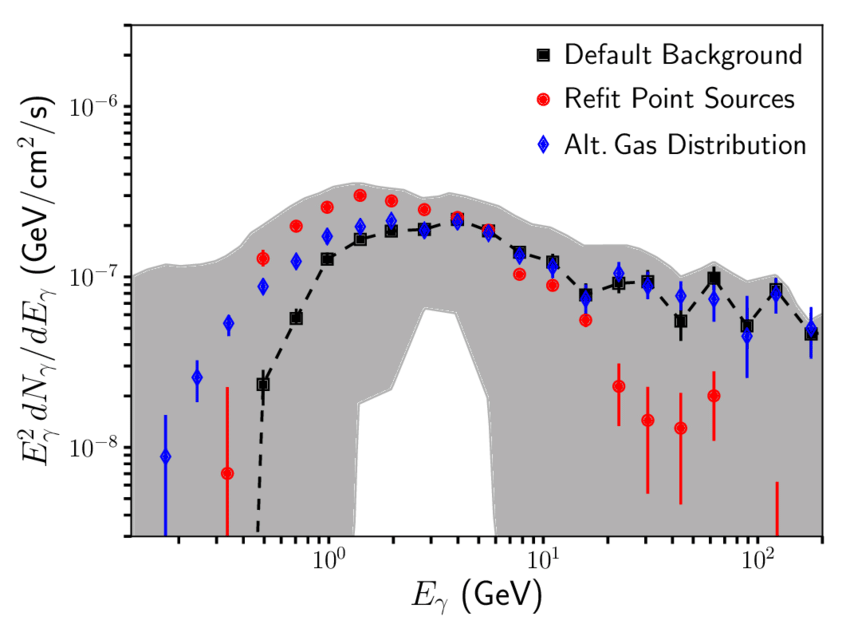
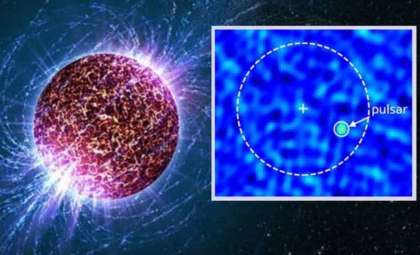
Several hypotheses exist. One suggests that numerous pulsars — highly magnetized rotating neutron stars — emit these gamma rays. Another proposes that a special kind of dark matter particle could annihilate itself, releasing gamma radiation.
This latter hypothesis relies on the idea that some dark matter particles might be their own antiparticles, annihilating on contact and emitting energy in the form of gamma rays.
Dark Matter Remains a Viable Source
Published in Physical Review Letters, the study describes dark matter as undetectable by electromagnetic radiation and outnumbering conventional matter by about five to one.
While dark matter annihilation could theoretically produce widespread gamma rays, the phenomenon would predominantly occur in regions of high dark matter concentration due to rare self-interactions.
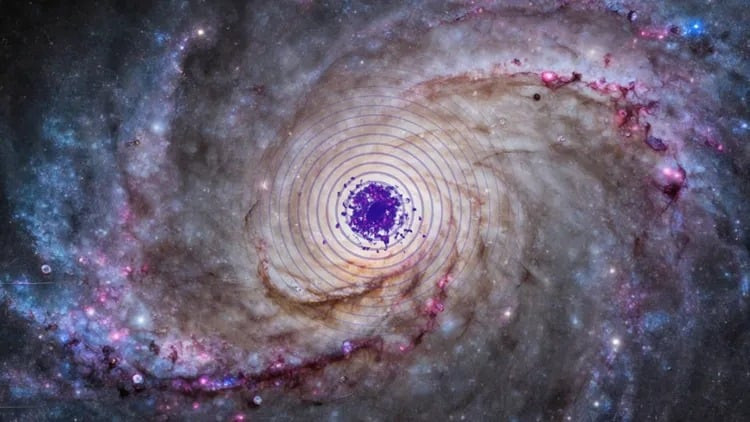
The galaxy’s central region is particularly important because it potentially hosts sufficiently dense dark matter to make self-annihilation significant.
The research likens the process to how electrons and positrons annihilate, releasing energy, while self-annihilating dark matter particles act as their own antimatter equivalents.
Advanced Machine Learning Alters Pulsar Interpretations
To discern between explanations, List and his team utilized machine learning trained on over a million simulated gamma-ray datasets. Earlier studies proposed that bright but unresolved sources could explain the Galactic Center Excess.
The latest results indicate that these sources, including pulsars, must be exceptionally dim, making them nearly indistinguishable from emission patterns expected from self-annihilating dark matter.
The numbers are astonishing: initially, scientists thought a few hundred pulsars might suffice, but current analysis suggests the need for over 35,000 pulsars near the Milky Way’s center.
Nick Rodd from Lawrence Berkeley National Laboratory remarked:
“Our new analysis shows that the sources would have to be so faint that they would be almost indistinguishable from the emission expected from annihilating dark matter.”
While the mystery persists, this study limits possible explanations and demonstrates that dismissing dark matter as a cause remains premature. List emphasizes that this does not prove dark matter causes the signal but highlights the need for more investigation.
- Categories:
- News






0 comments
Sign in to Comment