
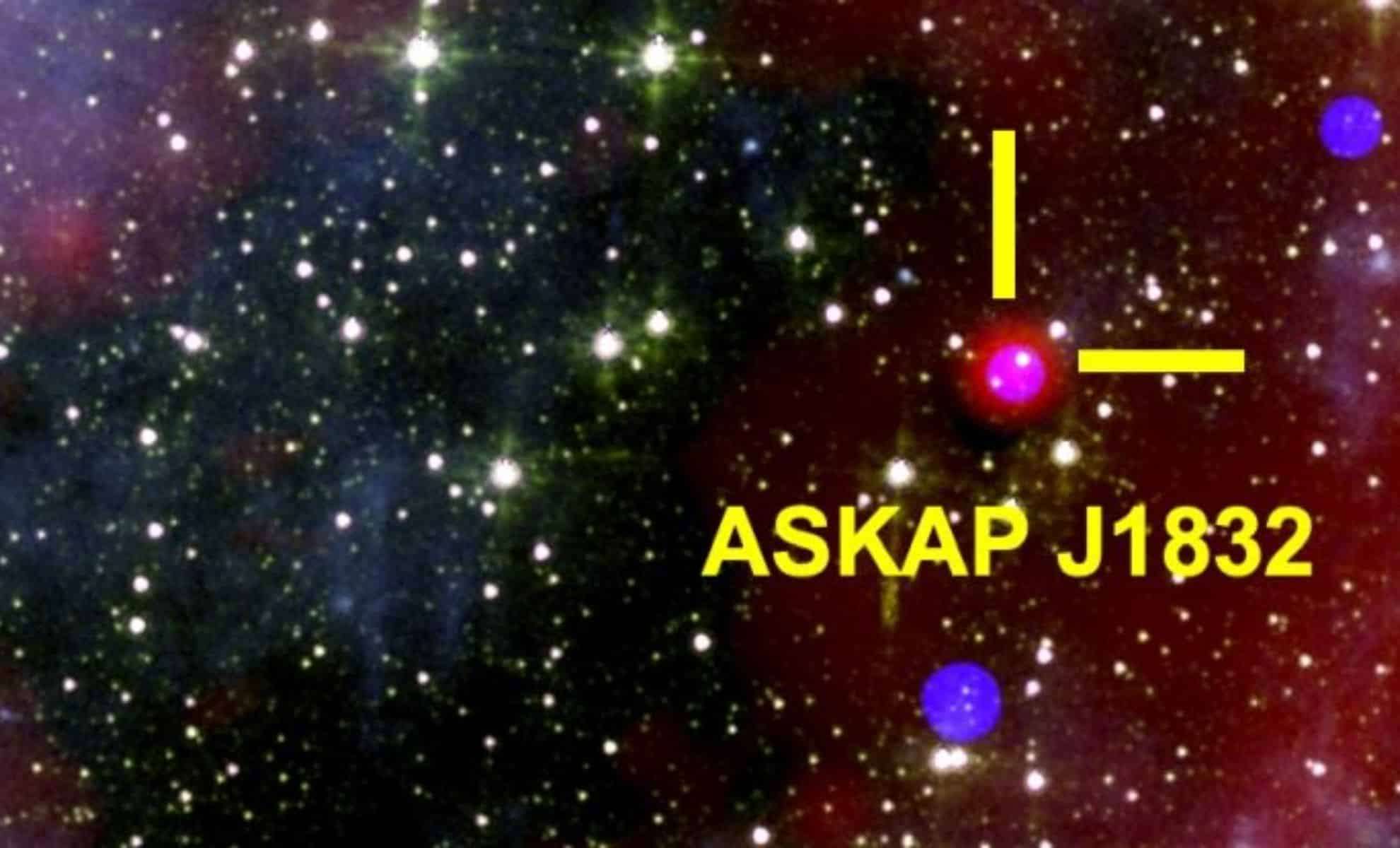
Astronomers have uncovered an extraordinary cosmic source emitting repeating radio signals alongside X-ray radiation, marking a pioneering discovery that could redefine categories of astronomical phenomena. Designated ASKAP J1832-0911, this object was observed through the Australian Square Kilometer Array Pathfinder (ASKAP) telescope and the Chandra X-ray Observatory. The findings, detailed in Nature, reveal a long-period radio transient (LPRT) that emits radio pulses every 44 minutes, each lasting approximately two minutes. This newly found signal pattern challenges previous understandings of neutron stars, white dwarfs, and suggests the potential existence of previously unknown astrophysical phenomena.
Unprecedented Multiwavelength Observation
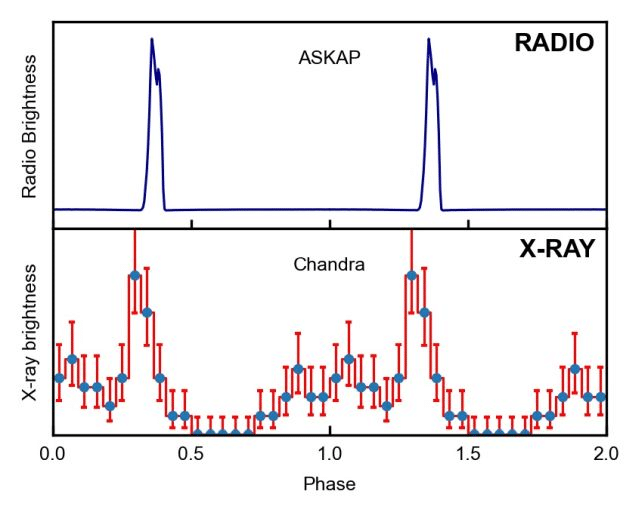
ASKAP J1832-0911 distinguishes itself not only by its regular emission cycle but also as the only LPRT known to produce simultaneous radio frequency and X-ray radiation. Unlike typical sources that appear briefly before fading, this object has been continuously monitored for over ten months, exhibiting variations in brightness but maintaining a consistent rhythm. The perfect alignment of the radio and X-ray peaks confirms their origin as a single source. “Detecting X-rays from ASKAP J1832-0911 was like stumbling upon a rare gem,” explained Wang. “Since ASKAP scans vast portions of the sky and Chandra focuses on much smaller areas, it was a fortunate overlap that allowed us to capture both emissions simultaneously.” This coincidence has granted researchers a rare comprehensive look into this enigmatic object's behavior across the electromagnetic spectrum.
Exploring the Nature of ASKAP J1832-0911
Speculation about the source of these signals ranges from highly magnetic stellar remnants to complex binary systems. Some scientists believe it might be a magnetar, a neutron star with extremely strong magnetic fields. Others theorize it could be a binary star system involving a strongly magnetized white dwarf, a low-mass star that has nearly exhausted its fuel. “ASKAP J1831-0911 may represent either a magnetar or a binary system featuring a magnetic white dwarf nearing the end of its life,” Wang noted. While both hypotheses remain viable, neither perfectly fits the data. For instance, a white dwarf in this scenario would require a magnetic field exceeding 5 billion Gauss—beyond current detection limits though not impossible theoretically. Conversely, a magnetar could explain the field strength more straightforwardly but its observed properties don't entirely match expectations for such objects.

Hidden Within a Dense Galactic Neighborhood
The object's challenging detection stems from its position roughly 15,000 light-years away within a particularly dense sector of the Milky Way. This region is cluttered with stars, gas clouds, and dust that obscure observations at visible and infrared wavelengths. Despite deploying sensitive instruments like the Spitzer Space Telescope for infrared surveying, no complementary signals have been detected. This is unsurprising given the heavy dust obscuration typical at these distances. “The identification of transient X-ray emission opens novel avenues for probing these mysterious sources.” Pending observations from the James Webb Space Telescope (JWST) could further illuminate this puzzling object. For now, the source remains elusive across most wavelengths, solidifying its standing as one of the galaxy’s most baffling phenomena.
Implications and Future Prospects
ASKAP J1832-0911 marks the tenth known LPRT but is the first to reveal X-ray activity alongside radio bursts. This suggests a possibly larger, unexplored population of similar cosmic sources. “Detecting one hints at many more hidden in the galaxy,” stated astronomer Nanda Rea from the Institute of Space Science and the Catalan Institute for Space Studies in Spain. This breakthrough expands the understanding of how stellar remnants behave under extreme magnetic and physical environments and sparks renewed debates about alternative stellar evolutionary paths and emission mechanisms involving long-period cycles. “Yet, existing models fail to fully explain the observations, which may point to novel physics or require new theories of stellar evolution.” Should further studies confirm its nature, ASKAP J1832-0911 could inaugurate a new frontier in astrophysical research, revealing a more intricate and dynamic galactic environment than previously imagined.
- Categories:
- News




0 comments
Sign in to Comment