

A team of astronomers has identified ten previously unknown pulsars within the crowded globular cluster Terzan 5, positioned in the Sagittarius constellation, using sophisticated radio astronomy techniques.
This breakthrough, achieved through a partnership between the National Radio Astronomy Observatory (NSF NRAO) in the U.S. and South Africa’s MeerKAT radio telescope, has been detailed in the journal Astronomy & Astrophysics.
These new pulsars significantly increase the known number of such objects in this cluster and offer valuable clues about their unusual properties and evolution.

Unveiling Neutron Stars Amidst a Dense Star Cluster
Terzan 5, located near the Milky Way's core, is a densely packed globular cluster hosting hundreds of thousands of stars. Pulsars are incredibly dense, rapidly spinning neutron stars emitting beams of radiation from their magnetic poles, with densities millions to billions of times greater than ordinary stars.
Before this discovery, astronomers had cataloged 39 pulsars within Terzan 5. Adding ten new pulsars highlights the cluster’s remarkable diversity and the exceptional conditions facilitating the formation and survival of these exotic remnants.
Scott Ransom of the NSF NRAO shared his enthusiasm: “Discovering new, exotic pulsars is rare. What’s truly fascinating is the variety of these odd pulsars found within a single cluster.” This diversity reflects the distinctive evolutionary histories sculpted by the cluster’s dense and dynamic environment. The closely packed stars in Terzan 5 create a perfect setting for gravitational interactions that shape pulsars in unique ways.
Precision Tracking and Data Synthesis
MeerKAT’s advanced capabilities were instrumental in accurately locating and measuring the pulsars’ spin rates, complementing over twenty years of archival data from the NSF Green Bank Telescope (GBT). This combined observational effort enabled astronomers to chart the pulsars’ trajectories and monitor their periodic changes, uncovering fine details about their inner workings and orbital behavior. The team relied on pulsar timing techniques to study how these stars rotate and evolve within the cluster.
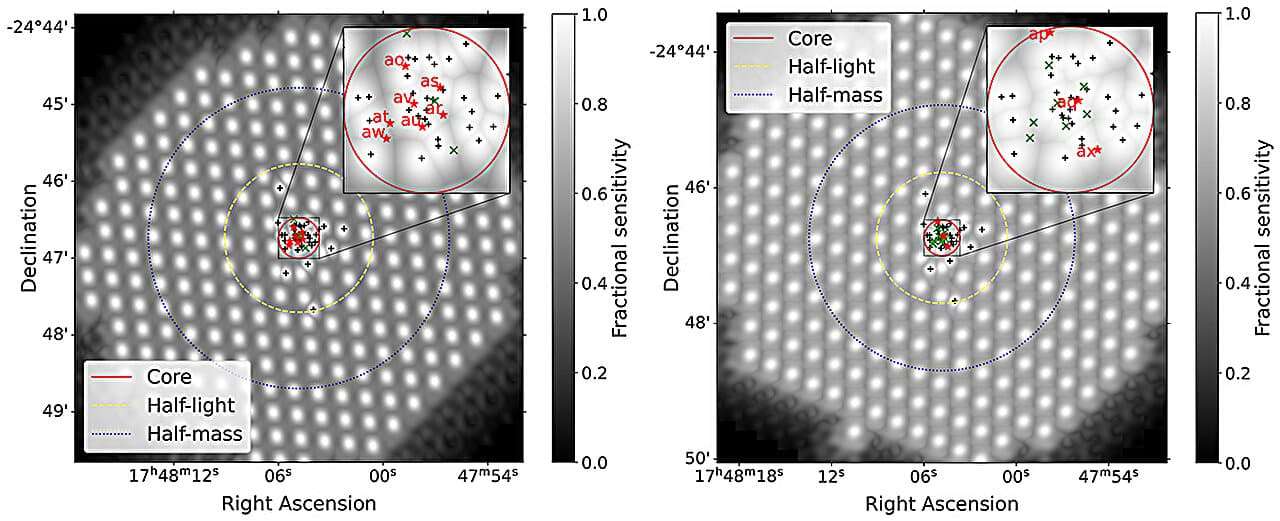
“Without the extensive archive from the NSF Green Bank Telescope, we wouldn’t have been able to thoroughly characterize these pulsars or interpret their astrophysical significance,” added Ransom. The archival observations were crucial for confirming the identity of the pulsars and revealing their physical traits. These findings enrich our understanding of their spatial distribution and orbital dynamics within the cluster, shedding light on their formation and progression.
Identification of Neutron Star Pairs
Among the recently found pulsars, researchers uncovered two candidates likely forming a binary neutron star system. Out of the approximately 3,600 pulsars identified in the Milky Way, only around 20 are known double neutron star binaries. These systems are particularly intriguing because intense gravitational forces can accelerate one of the stars to very high spin rates, sometimes creating a millisecond pulsar. This new binary could challenge existing records for the fastest-spinning pulsar in such a system, as well as feature the longest known orbital period of its type.
Pulsars in binary systems provide exceptional laboratories for testing gravitational physics and relativity. Their mutual gravitational attraction can transfer mass and angular momentum between stars, producing rapid rotations and complex orbital interactions.
The current fastest-spinning pulsar is already located within Terzan 5, and this discovery further enriches the cluster’s pulsar diversity. “Continued observations will be essential to fully understand these pulsars,” Ransom emphasized.
Detection of Rare Spider Pulsar Systems
In addition to the neutron star binaries, three newly discovered systems belong to the rare category of spider pulsars, including “Redbacks” and “Black Widows.” These systems feature a pulsar that gradually strips material from its companion star through a plasma winds, creating a unique interactive environment.
Spider pulsars are notable for their complex relationships with their companions, where the pulsar’s energy drives off surface material from the companion star, forming an enveloping plasma cloud. These processes can induce significant changes in the pulsar’s spin rate and magnetic properties. The discovery of these spider pulsars, along with the other newly found pulsars, enhances insights into pulsar classifications and the extreme conditions they endure. Such findings are vital for refining models of stellar evolution and neutron star physics.
- Categories:
- Astronomy ,
- News ,
- Science ,
- Space ,
- Physics







0 comments
Sign in to Comment