
What began as a standard home improvement project in Tielt, Belgium, unexpectedly led to the unearthing of a concealed underground passage dating back to the First World War. According to a report by HeritageDaily, this ordinary residence at Nieuwstraat No. 7 once served a clandestine function during one of history's most devastating conflicts.
A Secret Military Hub Amidst Urban Homes
During the course of World War I, Tielt was transformed into the strategic headquarters of the German Fourth Army (AOK IV). Under German occupation, multiple buildings on Nieuwstraat were appropriated and repurposed for military use. Among them, No. 7 Nieuwstraat emerged as a notable site with covert importance.
Archives reveal that this townhouse was far more than a temporary bunker; it operated as a command center equipped with a specialized map room and an extensive scale model depicting the front line. From here, the German High Command orchestrated pivotal wartime actions, including the initial chlorine gas attack at Steenstraete in April 1915, along with subsequent flamethrower deployments.

By 1917, the address was central to formulating the Flandern-Stellung, a complex defensive system responsible for significant setbacks to Allied forces.
Homeowner discovers hidden tunnel beneath townhousehttps://t.co/M6RniKY0cF pic.twitter.com/uRPt1XTK1T
— HeritageDaily (@HeritageDaily) April 15, 2025
Discovery of a Century-Old Subterranean Passage
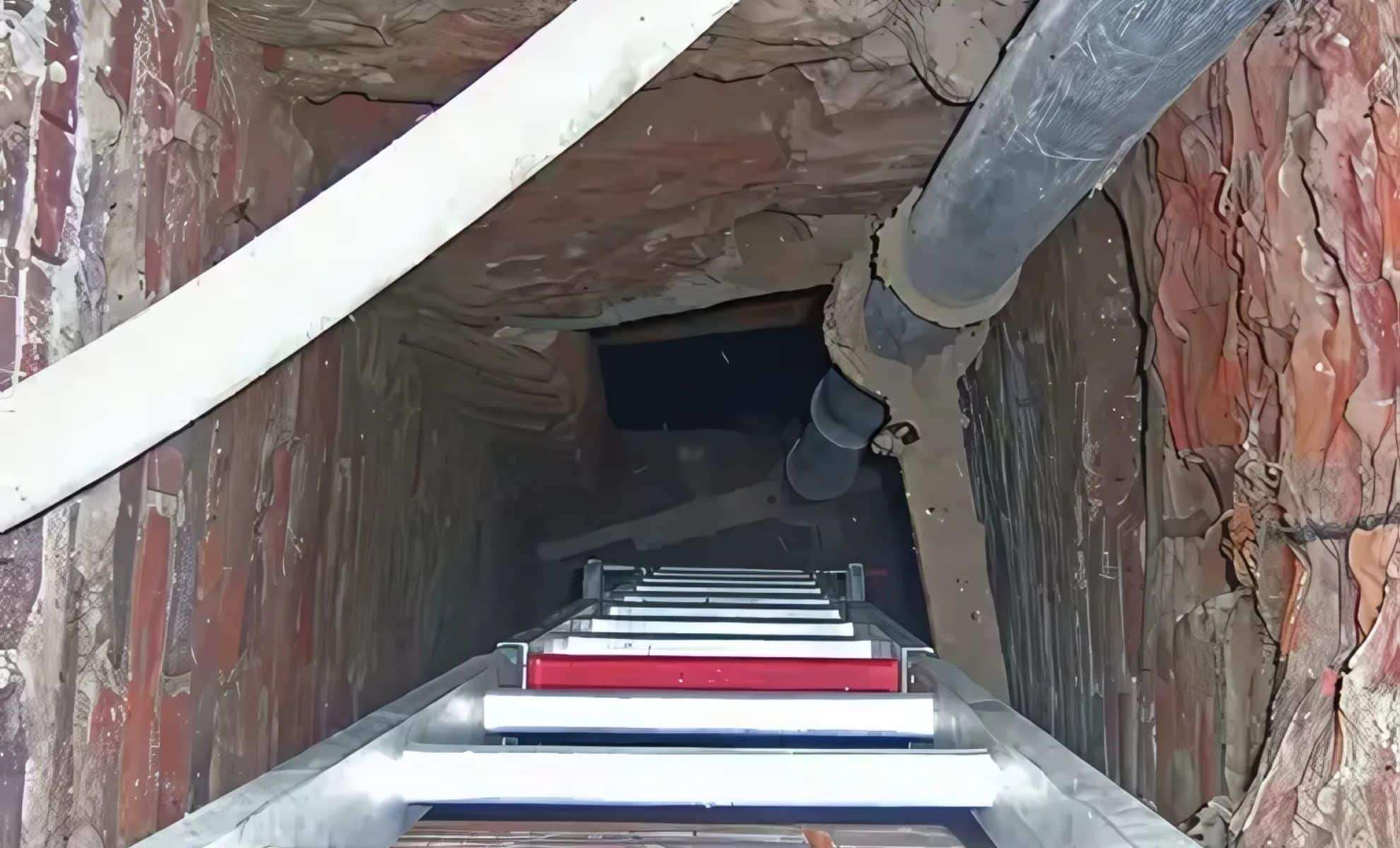
The tunnel was uncovered when the homeowner spotted a hidden manhole cover while carrying out renovations. What seemed like an unusual structural feature turned out to be an entrance to a slender vertical shaft, roughly 0.77 by 0.65 meters in size, descending nearly 4 meters underground.
At the shaft's base, experts found an 18th-century well, but even more intriguing was a 9.7-meter-long barrel-vaulted tunnel extending northwest parallel to the neighboring homes. The tunnel terminates in a sealed passageway believed to have once linked to Nieuwstraat No. 5.
Beyond Waterworks: A Potential Secret Escape Path
Although the passage could be linked to an ancient overflow drainage system, specialists from the Agency for Immovable Heritage propose it served a more strategic function. Considering its location and the site’s military history, the tunnel might have operated as a concealed corridor allowing discreet movement between residences or acting as an emergency exit for German officers.
This discovery provides a clear illustration of how wartime operations and secrecy were embedded directly within civilian architecture during occupation.
Renewed Focus on Tielt’s Wartime Legacy
The find has sparked fresh investigation into Tielt’s involvement in WWI and the adaptation of urban spaces for military tactics. Structures now serving civilian purposes had once been integral to strategic efforts, hinting at further possible buried secrets.
The tunnel offers valuable insights into the logistical framework underpinning the German forces in occupied Belgium, a narrative often eclipsed by frontline battles.
The Past Lurking Beneath Our Feet
This discovery underscores how historical remnants can remain hidden below today's urban environments. As renovations continue across Europe, additional wartime artifacts may well come to light.
For now, the tunnel beneath Nieuwstraat No. 7 stands as a silent testimony to a period when cities were transformed by conflict—and hidden histories lie just beneath the surface, forgotten until uncovered.
- Categories:
- News











0 comments
Sign in to Comment